What happened
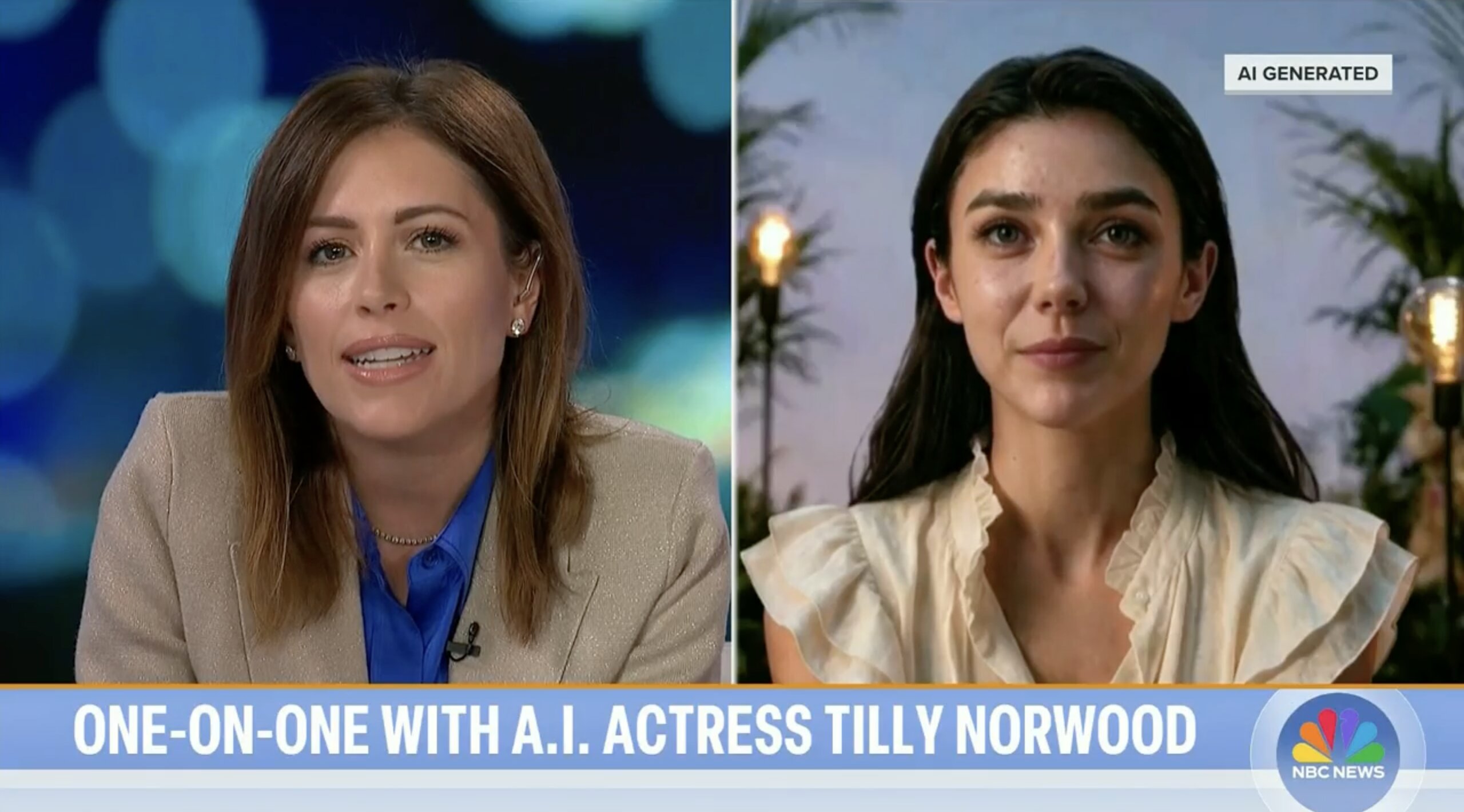
NBC News aired an interview Monday on 3rd Hour of Today in which correspondent Chloe Melas spoke by video call with Tilly Norwood, an AI-generated actress who debuted in September 2025.
Why it matters
Melas said the avatar felt glitchy, forgot prior calls, and repeated herself, concluding she was not speaking to a human and that Norwood is not coming for jobs quite yet.
What to watch
Norwood framed herself as a creative tool rather than a threat, so the test is whether such avatars improve enough to be trusted on air. Norwood's debut was September 2025.
WHO IT HITSThis lands on broadcast and entertainment newsrooms weighing whether to book AI-generated guests, and on actors whose likeness and voice work could be substituted by such avatars.
Ask the AI about this article →
Summaries like this, in your inbox every morning.
The segment placed an AI-generated performer inside a familiar television format: a correspondent interviewing a subject by video call. NBC's own framing leaned into the oddity, with co-host Al Roker asking "How bizarre is this?" and Melas calling it "quite an assignment." Norwood's answers were crafted to sound disarming, describing herself as "a new kind of paintbrush" and saying her purpose is to be a creative tool, not a threat. That framing sat alongside a question about warnings from AI experts, which Melas raised during the conversation.
Melas's own post-interview assessment supplied the most concrete detail. She said it was "pretty clear" she was not speaking to a human being, citing a robotic voice, glitchiness, repeated answers, and the avatar forgetting earlier calls. At the same time, she noted that Norwood commented on her appearance, saw what she was wearing, and understood her surroundings. She concluded that Norwood is not coming for jobs quite yet, a judgment that rests on the gap between the avatar's conversational polish and its lapses in continuity.
The stakes appear to hinge on whether such avatars can close that gap, since a broadcast interview is an unforgiving test of memory and natural speech. For newsrooms, the question is whether an AI guest can be presented credibly to an audience; for actors, it is whether a synthetic performer can be trusted with the kind of appearance Melas described. Both outcomes remain open based on the segment alone.
For example, today's edition would include:
AI-summarized, only the topics you pick — one digest a day via Email, Slack, or Discord.
Free · 30 seconds with Google · unsubscribe anytimeWhat is AIToday? →
Ask AI anything about this article. Q&As are published on this page for other readers too.
AppLovin CEO Adam Foroughi said e-commerce advertisers 'aren't even at a ceiling of what they can spend,' but…

Huawei (ファーウェイ) developed an AI model called 博観 that specializes in local history

Apple researchers introduced CapQuiz, a benchmark that scores video captions by how well they answer human-ver…

AWS announced the general availability of TwelveLabs Marengo Embed 3.0 as an embedding model in Amazon Bedrock…

Amazon's Prime Video is launching an AI-powered feature that aligns actors' lips with dubbed audio, starting w…

Adobe introduced Generative Media in Premiere, letting editors highlight an empty gap and generate context-awa…