What happened
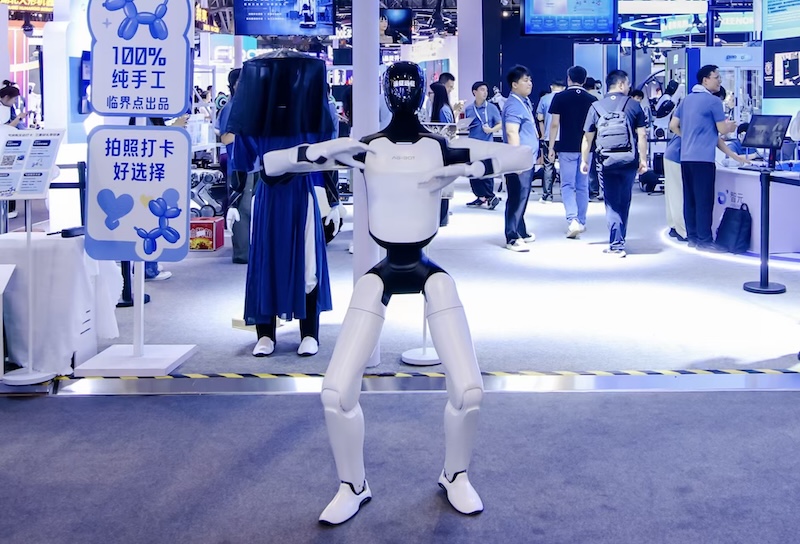
AGIBOT introduced four new robotics products at the World Artificial Intelligence Conference (WAIC) 2026 in Shanghai — the A3 Ultra humanoid robot (1.74 m tall, 60 kg, 51 degrees of freedom), X2 EDU education platform, G2 Max industrial robot, and OmniHand 3 Ultra-M dexterous hand (20 active degrees of freedom). The company deployed more than 30 robots throughout the exhibition providing visitor guidance and demonstrations.
Why it matters
Co-founder Peng Zhihui stated that the industry should judge embodied AI "by whether it can be manufactured, delivered and integrated reliably into real operating environments" — not by one-off demonstrations. AGIBOT's new products address three layers of that challenge: humanoid platforms, industrial task execution, and dexterous manipulation. The company has already integrated G2 robots into Longcheer Technology's tablet quality inspection line, processing around 3,000 units per shift after a 36-hour installation.
What to watch
AGIBOT's focus is moving embodied AI beyond laboratory demonstrations into repeatable commercial and industrial workflows, with deployments now active at manufacturing partners including Longcheer Technology and PIA Automation. The A3 Ultra supports up to eight hours of operating time with battery swapping, direct charging and autonomous charging options.
Summaries like this, in your inbox every morning.
AGIBOT's announcement at WAIC 2026 reflects a strategic pivot in how the company positions embodied AI in the market. Rather than competing primarily on technical demonstrations, co-founder Peng Zhihui explicitly reframed the competitive landscape: the test of embodied AI is whether robots can be reliably manufactured, delivered, and integrated into existing production environments. This framing responds directly to a broader industry skepticism about whether lab-proven robotics can translate into scalable commercial operations.
The company's product lineup addresses this three-part challenge systematically. The A3 Ultra provides the humanoid platform layer, supporting commercial and service applications with practical features like battery swapping and autonomous charging for extended deployment. The G2 Max targets industrial material handling with force control and omnidirectional mobility — a direct play for factory integration. The OmniHand 3 Ultra-M adds dexterous manipulation with integrated tactile sensing and force control. The X2 EDU, meanwhile, signals investment in the developer ecosystem, ensuring that universities and research teams can build on AGIBOT's architecture.
The concrete deployment at Longcheer Technology — a tablet quality inspection line processing 3,000 units per shift after a 36-hour installation — serves as proof-of-concept for that manufacturing-first narrative. This is not a promotional video; it is a working production line. AGIBOT's decision to deploy more than 30 robots throughout the WAIC exhibition as visitor guides and service robots further demonstrates the company's confidence in their reliability at scale.
Pick your industry and the AI tools you use, and get news related to your work every day.
Free · 30 seconds with Google · unsubscribe anytimeWhat is AIToday? →
Ask AI anything about this article. The AI reads this article, earlier AIToday articles, and Wikipedia, and cites its sources. Q&As are published on this page for other readers too.
In Q2, billionaires or their funds sold six 'Magnificent Seven' AI stocks

Nvidia was rising early Friday, even as the wider chip sector kept falling, Barron's reported

ElevenLabs completed a $300 million employee tender at a $22 billion valuation, and co-founder Mati Staniszews…

Skild AI used Nvidia Isaac Sim to give its S1 model one objective — score a goal — and let it compete against…
On October 15, OpenAI announced the Rosalind Academic Plan, giving approved US university labs free access to…

Neostellar Capital principal Evan Schlossman said CoreWeave's $103.7 billion in remaining performance obligati…


