What happened
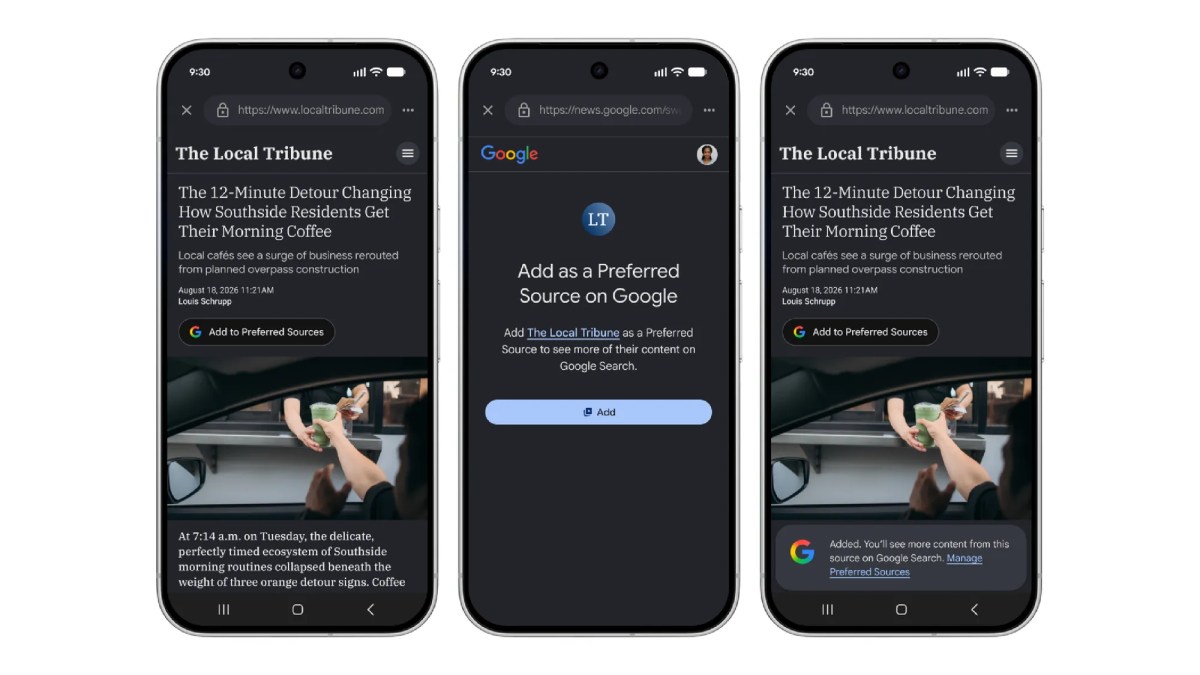
Google launched an interactive "Preferred Sources" button that publishers can embed on their websites, allowing readers to mark sites as favorites they want to see highlighted more often in Google Search, Discover, and Google News. The feature builds on a May rollout of Preferred Sources in AI Mode and AI Overviews, where over 345,000 unique sources had already been selected by that point.
Why it matters
AI-powered search and news features have reduced traffic to publisher websites. Google's studies found people are twice as likely to click through to a preferred source when available, so this tool offers publishers a way to recover lost traffic by making their sites easier for readers to find and prioritize.
What to watch
Google is also rolling out natural-language Discover feed customization, where readers can tap a three-dot menu and tell Google in plain text which topics to see more or less of. Android users will soon be able to customize audio daily briefings in the Google News app as well.
Summaries like this, in your inbox every morning.
Google's move addresses a mounting challenge: AI-powered search and overview features have diverted traffic away from traditional news and content publishers. By introducing an embeddable button and expanding the Preferred Sources system, Google is offering publishers a tool to recover lost readers while also giving its users more control over their information diet. The company's May launch of Preferred Sources across AI Mode and AI Overviews was the foundation; the new embeddable button makes adoption easier for smaller publishers who may not have had visibility into Google's preferences page. The natural-language Discover customization feature—allowing users to refine feeds in plain text rather than through preset categories—reflects a broader industry trend toward user-controlled recommendation systems, as the body notes that several social media apps have rolled out similar tools in recent months.
Pick your industry and the AI tools you use, and get news related to your work every day.
Free · 30 seconds with Google · unsubscribe anytimeWhat is AIToday? →
Ask AI anything about this article. The AI reads this article, earlier AIToday articles, and Wikipedia, and cites its sources. Q&As are published on this page for other readers too.
AMD has multi-gigawatt, multi-generation Helios rack-scale AI system commitments from large customers includin…
A columnist argues Microsoft's 4% drop from its 52-week high is a chance to buy more, pointing to Azure demand…

Lumentum says its capacity for indium phosphide (InP) lasers, which feed AI data center optics, is spoken for…
Microsoft announced Microsoft-Decision-1 on October 9, a decision-focused model built on Alibaba's Qwen3.5-9B…
Nvidia is in early talks to acquire open-weight model developer Reflection AI outright, take a bigger stake, o…

India's technology buildout is deepening across semiconductors and AI infrastructure, with chip IP, packaging…