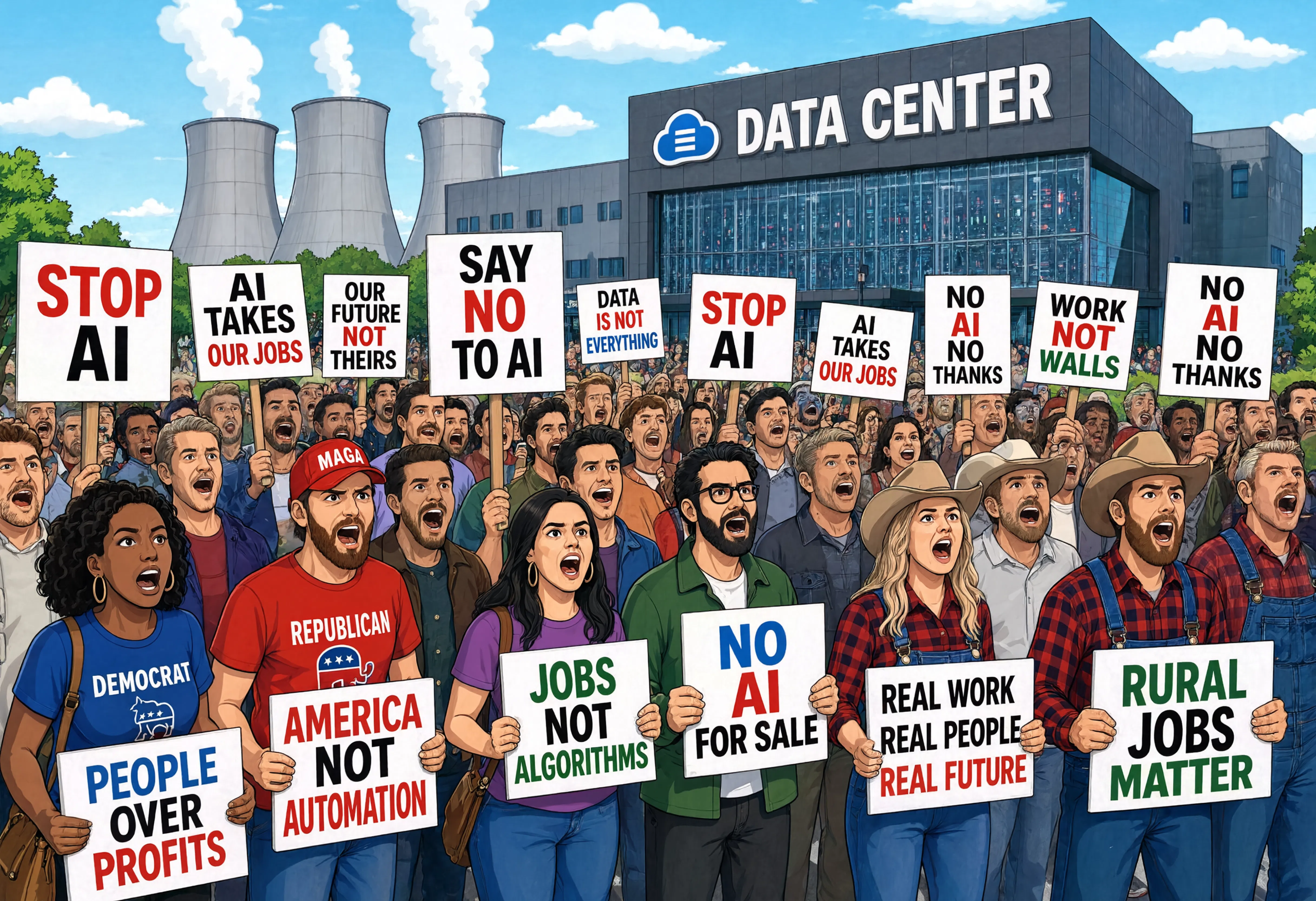
Public opposition to data centers is high and politicized.
Big tech's AI spending is $3 trillion higher than it seems.
The AI buildout is now too big to fail, quietly.
What happened
A Gallup survey from March found 71% of people oppose data centers in their areas, more than the 53% who oppose a nuclear plant. The GOP now worries this opposition could give Democrats a campaign issue, and it has led to a satirical ad for 'Data Center Coolant Collector jars' that sold out.
Why it matters
The backlash is seen as being about what data centers are for: AI. Stopping data centers won't stop AI, but it could be 'the pin to the AI bubble.' Meanwhile, big tech's real AI spending is higher than it looks—$3 trillion more due to off-balance-sheet commitments, per a Wall Street Journal analysis.
What to watch
Broadcom is reportedly aiming to raise as much as $100 billion in debt financing, and AI data center builder Nscale is eyeing a $3 billion IPO. Nvidia's earnings next week will provide an indication of the state of the AI infrastructure buildout.
Ask the AI about this article →
The article's core argument is that the backlash against data centers is not really about the buildings themselves, but about what they represent: AI. Despite the benefits, AI is being pushed by big tech companies, some of which openly discuss the jobs it will eliminate. This has created a political flashpoint, with the GOP worried that opposition could hand Democrats a potent campaign issue. The opposition is notable not just for its intensity, but for its breadth, uniting left and right in a way that seems to go beyond environmental or economic concerns.
At the same time, the financial stakes of the AI buildout are rising, along with the risk. The Wall Street Journal analysis that Big Tech's spending is $3 trillion higher than it seems, due to off-balance-sheet commitments, adds to investor wariness. The financial pressures extend down the chain, with chipmakers like Broadcom reportedly seeking massive debt financing and AI data center builders like Nscale planning IPOs. All of this, as Dave Vellante suggests, makes the AI buildout 'too big to fail… quietly.'
This context frames the other news, such as OpenAI reportedly falling behind Anthropic in revenue growth and performance. While OpenAI was once seen as unstoppable, the article suggests it is now slowing down, for now. This, combined with the political and financial pressures, paints a picture of an industry at a critical juncture where its future is being shaped as much by public sentiment and capital markets as by technological progress.
For example, today's edition would include:
AI-summarized, only the topics you pick — one digest a day via Email, Slack, or Discord.
Free · takes 30 seconds · unsubscribe anytimeWhat is AIToday? →
Ask AI anything about this article. Q&As are published on this page for other readers too.
AI system scaling has pushed interconnect requirements inside data centers from chips and boards up to racks…

Chinese large-model developer Z.ai says it can now support large-scale inference using roughly 100,000 domesti…

Analyst Ming-Chi Kuo says Nvidia has revived the Rubin CPX AI accelerator with a substantially redesigned arch…
Palantir Technologies stock has posted multi-year gains, including an 11x return over 3 years

Apple has escalated its legal battle against OpenAI, claiming in a new court filing that OpenAI is actively de…

Samsung Electronics has locked up as much as 70% of its memory production capacity under long-term supply agre…