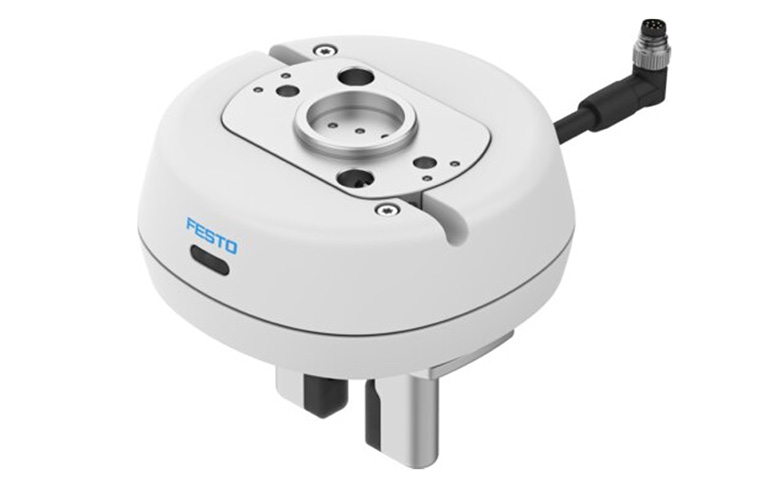
Festo Corp. launched the HPPH two-finger pneumatic parallel gripper, weighing 1.5 lb. (0.68 kg), designed to integrate controls, sensing, and safety functions directly into the gripper body to reduce wiring and weight on collaborative robots. The gripper features a force-limited gripping mode of 31.5 lbf (140 newtons) and can handle objects up to 2.2 lb. (1 kg).
GripperAI, a robot-agnostic software, uses artificial intelligence to determine optimal grasping points for previously unseen or chaotically positioned objects without requiring programming or teach-in training. The software operates on edge computing with minimal hardware (a 3D RGB-D camera and CPU with >4 GB RAM for simple tasks) and can be deployed on robot CPUs, industrial PCs, or within the camera itself.
Würth Group, which has about 1 million parts in its portfolio, tested GripperAI-equipped robots to empty crates filled with mixed, randomly oriented items. The system identified each object, selected the appropriate gripper tool, and transferred items for packaging or sorting without manual intervention or pre-programmed object data.
The HPPH is available through Festo's website and the Universal Robotics Marketplace. GripperAI can be installed on-site or operated in the cloud, supporting REST interfaces for integration.
Summaries like this, in your inbox every morning.
Pick your industry and the AI tools you use, and get news related to your work every day.
Free · 30 seconds with Google · unsubscribe anytimeWhat is AIToday? →
Ask AI anything about this article. The AI reads this article, earlier AIToday articles, and Wikipedia, and cites its sources. Q&As are published on this page for other readers too.
AIBotics completed its acquisition of NovaCore Labs' operating assets from PlayJamaica Limited, gaining 10 ser…

In an internal test, Google DeepMind robotics researchers instructed Gemini 4 Argon to watch a video of a huma…
Amulya Vishwanath, who spent seven years leading product marketing for Nvidia's robotics platforms, says robot…

Claire interviewed Rika Antonova of the University of Cambridge on the Robot Talk podcast about using AI to de…

An essay argues that after language models spread through cognitive work like writing and accounting, AI is no…

Skild AI used Nvidia Isaac Sim to give its S1 model one objective — score a goal — and let it compete against…