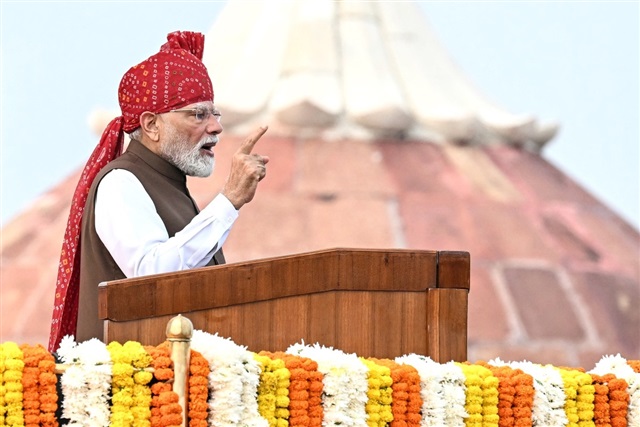
Indian Prime Minister Narendra Modi announced on August 15 that India will expand semiconductor manufacturing, scale AI training programs, and boost exports as part of a broad self-reliance push toward a developed India by 2047.
Modi tied all three sectors together in his Independence Day address from the Red Fort, positioning them as key pillars of India's economic future rather than isolated initiatives.
What happened
Prime Minister Narendra Modi used India's 80th Independence Day address on August 15 from the Red Fort to announce a push for more semiconductor manufacturing, AI training, and trade expansion as part of India's self-reliance strategy.
Why it matters
Modi explicitly framed semiconductor, AI, and trade as interconnected pillars toward building a 'Viksit Bharat' (developed India) by 2047—signaling that the government sees these sectors as critical to India's long-term economic transformation.
What to watch
The specifics of which new chip plants will be built, how the AI training initiative will be structured, and which export markets India will prioritize—these implementation details will determine whether the pledge translates into concrete investment and jobs.
Ask the AI about this article →
Modi's August 15 address marks a deliberate effort to position India's semiconductor and AI ambitions within a broader national self-reliance strategy rather than as standalone tech initiatives. By tying chip manufacturing, AI training, and trade policy together in a single speech, Modi signals that India views technological capacity and export competitiveness as interdependent—a shift from treating these sectors in isolation. The 2047 target (India's centennial of independence) gives the pledge a long-term narrative frame, though the address itself does not detail funding, timelines, or partnerships. The self-reliance framing also reflects India's geopolitical positioning amid global chip supply-chain tensions and the rise of AI competition among major powers.
For example, today's edition would include:
AI-summarized, only the topics you pick — one digest a day via Email, Slack, or Discord.
Free · takes 30 seconds · unsubscribe anytimeWhat is AIToday? →
Ask AI anything about this article. Q&As are published on this page for other readers too.
AI system scaling has pushed interconnect requirements inside data centers from chips and boards up to racks…
Chinese large-model developer Z.ai says it can now support large-scale inference using roughly 100,000 domesti…

Analyst Ming-Chi Kuo says Nvidia has revived the Rubin CPX AI accelerator with a substantially redesigned arch…
Palantir Technologies stock has posted multi-year gains, including an 11x return over 3 years

Apple has escalated its legal battle against OpenAI, claiming in a new court filing that OpenAI is actively de…
Samsung Electronics has locked up as much as 70% of its memory production capacity under long-term supply agre…