AIToday
AI Stocks & MarketsAI Business & IndustryYahoo Finance AIPublished: Aug 16, 2026, 01:00 JST5 min read

TSMC emerges as AI chip boom's biggest winner, poised to double

TSMC emerges as AI chip boom's biggest winner, poised to double

Key takeaway

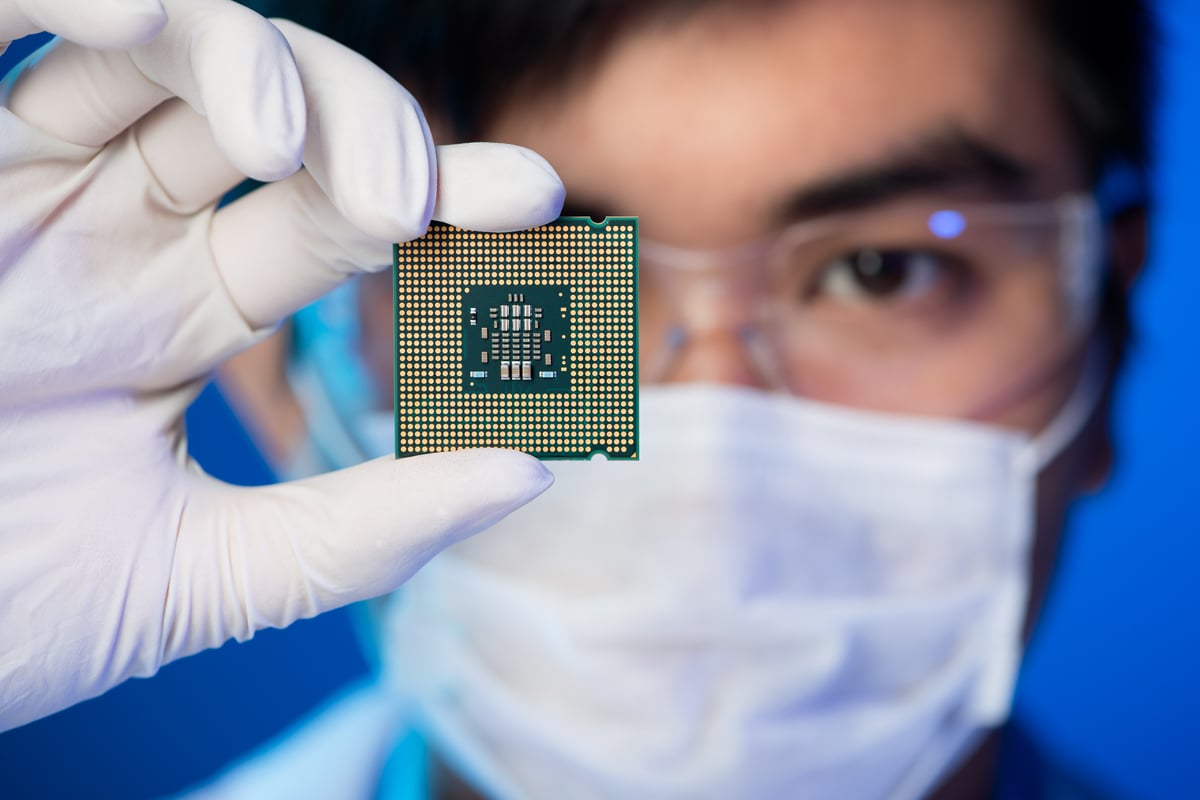
  • Taiwan Semiconductor Manufacturing (TSMC), the foundry that manufactures chips for AMD, Nvidia, and major cloud and device makers, is positioned to be the biggest winner of the AI semiconductor boom.

  • With 73% of the foundry market and revenue growing 37% year-over-year in the first half of 2026, TSMC's diversified customer base and control of advanced chipmaking processes give it pricing power—the company plans a 25% price hike for AI chip orders next year.

  • At a valuation of 25 times forward earnings, TSMC trades cheaper than the broader semiconductor sector and could double in value by 2028 if earnings growth accelerates as expected.

3 Key Points

  1. What happened

    Taiwan Semiconductor Manufacturing (TSMC) is positioned to capitalize on surging AI chip demand by manufacturing processors for AMD, Nvidia, Apple, and others through its foundry business. The company's revenue grew 37% year-over-year in the first seven months of 2026, and its 3-nanometer process output is set to increase 20% by end of 2026, while it commands 73% of the foundry market.

  2. Why it matters

    TSMC sits at the core of the AI infrastructure supply chain—both AMD and Nvidia depend on TSMC's manufacturing to deliver their own chips. Unlike AMD and Nvidia, TSMC serves a diversified client base spanning cloud giants (Amazon, Microsoft, Alphabet), smartphone makers (Apple, Qualcomm), and others, giving it broader exposure to AI adoption across data centers, PCs, and devices. The global semiconductor industry's revenue is estimated to jump 94% in 2026, and AMD predicts the high-performance AI chip market could reach $2 trillion by 2030.

  3. What to watch

    TSMC is planning a 25% price increase for customers purchasing additional AI chips next year, on top of standard 5%–10% increases, signaling pricing power. At current valuations of 25 times forward earnings, analysts project TSMC could reach $848 per share by end of 2028 if it trades at 30 times earnings with earnings per share of $28.26—nearly double its current price.

In Depth

Read the full story

The global semiconductor industry is on track for explosive growth, with market research firm Omdia estimating a 94% revenue jump in 2026 and AMD predicting that the high-performance and AI computing chip market could reach $2 trillion by 2030. At the heart of this boom sits Taiwan Semiconductor Manufacturing (TSMC), whose foundry business manufactures advanced chips for some of the world's largest technology companies.

TSMC's role is foundational but often overlooked. AMD and Nvidia, the two most visible AI chip winners, are fabless designers—they design chips but contract TSMC to manufacture them. AMD recently reported a 50% year-over-year revenue increase to $11.5 billion in Q2 2026, driven by a 107% year-over-year surge in data center revenue. Non-GAAP earnings grew even faster, jumping 246% year-over-year to $1.66 per share. AMD anticipates a 41% year-over-year revenue increase in the current quarter, with potential upside from its new Helios rack-scale server platform and faster AI compute chips. Nvidia, meanwhile, is projecting $91 billion in fiscal Q2 2027 revenue, a 95% year-over-year increase. Both companies are riding unprecedented demand for AI infrastructure.

But TSMC's advantage extends far beyond AMD and Nvidia. The Taiwan-based foundry manufactures chips for Apple, Qualcomm, Broadcom, Amazon, Microsoft, and Alphabet—a client roster spanning cloud infrastructure, smartphones, PCs, and consumer electronics. This diversified exposure insulates TSMC from dependency on any single customer and positions it to capture AI adoption across multiple markets. The numbers reflect this strength: TSMC's revenue in the first seven months of 2026 increased 37% year-over-year, outpacing its previously guided 31.6% growth for 2025. In July alone, the company reported a 45% year-over-year increase, putting it on track to beat its updated 2026 revenue growth guidance of 40%.

TSMC's manufacturing advantage is anchored in its control of advanced process nodes. The company's 3-nanometer (nm) process output is poised to increase 20% by end of 2026 compared to the first half of the year. Demand for its even more advanced 2nm process node is significantly higher than for 3nm, driven by superior performance and reduced power consumption. This technical leadership has translated into commanding market share: TSMC holds 73% of the global foundry market, compared to just 7% for second-placed Samsung. That dominance gives TSMC substantial pricing power. The company is reportedly planning a 25% price increase next year for customers ordering additional AI chips, on top of standard 5%–10% price increases for advanced chipmaking services.

On valuation, TSMC appears underappreciated. The stock trades at 25 times forward earnings, compared to 67 for the iShares Semiconductor ETF and 63 for AMD; Nvidia's multiple is roughly comparable to TSMC's. Despite TSMC's stronger earnings growth and commanding market position, analysts have become more bullish in recent months. If TSMC trades at 30 times earnings by end of 2028 with earnings per share reaching $28.26, the stock could reach $848—nearly double its current price. The analysis rests on TSMC's unique position: it is the foundry upon which both AMD and Nvidia depend, yet it services a far broader ecosystem of customers and thus captures more of the AI boom's upside.

Context & Analysis

The AI semiconductor boom has created a multi-tier supply chain in which fabless chip designers (AMD, Nvidia) depend entirely on foundries to manufacture their products. TSMC, the dominant foundry operator, sits at the choke point of this ecosystem. While AMD posted a 50% year-over-year revenue increase to $11.5 billion in Q2 2026 with a 107% surge in data center revenue, and Nvidia is projected to deliver $91 billion in revenue for fiscal Q2 2027 (a 95% year-over-year increase), both companies owe their growth to TSMC's capacity to produce advanced chips. TSMC's advantage is diversification: it does not rely solely on AMD and Nvidia but serves Apple, Qualcomm, Broadcom, and the major cloud providers (Amazon, Microsoft, Alphabet). This means TSMC captures demand from AI data centers, AI-capable smartphones, AI-capable PCs, and edge devices—a far wider aperture than the two fabless designers. The market data supports this thesis: TSMC's revenue grew 37% year-over-year in the first seven months of 2026, already exceeding its 40% full-year guidance, and July alone saw a 45% year-over-year increase. AMD's guidance for a 41% revenue increase in the current quarter and Nvidia's 95% fiscal growth pale in comparison to TSMC's trajectory, which suggests the foundry is not yet fully priced into its earnings multiple.

FAQ

Why is TSMC considered better positioned than AMD or Nvidia for the AI boom?
TSMC manufactures chips for AMD, Nvidia, Apple, Qualcomm, Broadcom, Amazon, Microsoft, and Alphabet—giving it exposure to AI demand across data centers, PCs, smartphones, and edge devices. AMD and Nvidia are fabless designers that rely on TSMC to manufacture their chips, making TSMC essential to their growth but also exposing it to multiple AI-driven end markets beyond just data center processors.
What is TSMC's market position and pricing outlook?
TSMC controls 73% of the global foundry market, with second-placed Samsung holding just 7%. The company is planning a 25% price increase for customers ordering additional AI chips next year, on top of standard 5%–10% increases, reflecting strong pricing power driven by tight supply and surging demand.
How does TSMC's valuation compare to other chip stocks?
TSMC trades at 25 times forward earnings, compared to 67 for the iShares Semiconductor ETF and 63 for AMD. Nvidia's forward earnings multiple is roughly in line with TSMC's, making TSMC cheaper than most peers despite its commanding market position and strong earnings growth trajectory.
Yahoo Finance AIRead Original Article

Get the latest AI Stocks & Markets news every morning

AI-summarized, only the topics you pick — one digest a day via Email, Slack, or Discord.

Free · takes 30 seconds · unsubscribe anytime

Ask AI

Ask AI anything about this article. Q&As are published on this page for other readers too.

Related Articles

Next articleNvidia halves OpenAI guarantee to $120B as Anthropic's revenue surge defies AI bubble fears

The AI news that matters, in one minute each morning.

Sign up free