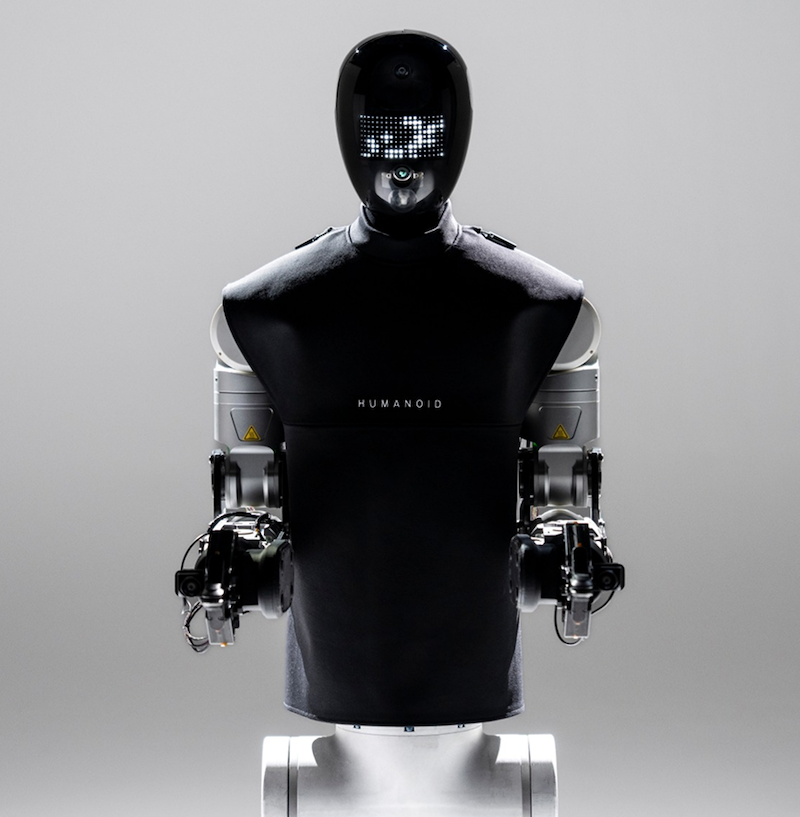
What happened
UK-based Humanoid, which builds industrial humanoid robots, closed a $152 million(約240億円) Series A round led by Prime Movers Lab, valuing the company at $1.35 billion(約2200億円) post-money. The funding brings total capital raised to $270 million(約430億円) and includes participation from Schaeffler, Bosch, Fubon Financial Holding Venture Capital, and Aglaé Ventures.
Why it matters
Humanoid is now Europe's first pure-play humanoid robotics unicorn, signaling that the region can produce globally competitive AI and robotics companies at the cutting edge—a field until now concentrated in the United States and China. The company has already secured major partnerships with Fortune 500 firms (SAP, Nvidia, Bosch, Siemens) and signed the industry's largest publicly announced commercial agreement with Schaeffler for large-scale robot deployment in manufacturing.
What to watch
Humanoid will roll out Beta version robots beginning in Q4 2026, with deployments across logistics, manufacturing, retail, and other sectors. The company is also starting mass manufacturing of wheel-based humanoid robots and advancing its proprietary AI brain, KinetIQ, toward a general-purpose robot for industrial applications.
Summaries like this, in your inbox every morning.
Humanoid's $152 million(約240億円) Series A marks a watershed moment for European robotics, demonstrating that the region can compete with the United States and China in a sector previously dominated by those markets. The company's valuation—reaching unicorn status in just two years from founding—reflects not just investor enthusiasm but tangible commercial traction: partnerships with four Fortune 500 firms and an industry-leading deployment agreement with Schaeffler signal that industrial customers are moving beyond proof-of-concept to real-world adoption. The backing of established industrial heavyweights like Bosch and Schaeffler themselves (both as investors and commercial partners) suggests confidence that humanoid robotics has crossed a threshold from experimental technology to deployable solution. This is significant because it indicates the market perceives a path to solving acute labor shortages in manufacturing and logistics—concrete operational problems rather than speculative futures.
The funding allocation speaks to Humanoid's strategic priorities: beyond developing its next-generation platform, the company is investing heavily in the transition from prototyping to scale. The planned Q4 2026 rollout of Beta robots across multiple sectors, combined with the start of mass manufacturing for wheel-based models, suggests the company is preparing for near-term commercial ramp. The emphasis on KinetIQ—a proprietary AI brain that combines with vertically integrated hardware—positions Humanoid to defend margins and differentiation as the market scales. For European tech investors and industrial companies, this validates the region's capacity to lead in Physical AI (the application of AI to robotic systems), a field previously seen as locked to Silicon Valley and China.
For example, today's edition would include:
AI-summarized, only the topics you pick — one digest a day via Email, Slack, or Discord.
Free · 30 seconds with Google · unsubscribe anytimeWhat is AIToday? →
Ask AI anything about this article. Q&As are published on this page for other readers too.
In the NEXER Group and LISKILLING survey, 90.7% said they had no workplace AI or DX training experience, while…

Nvidia guided to $108 billion in quarterly revenue, up from $96.2 billion

Google will invest at least €13 billion ($15.1 billion) in Finland over the next two years for three new data…

Simply Wall St's most-followed KLA narrative sets fair value at $232.43 versus a $176.99 close, with the stock…
Nvidia founder and CEO Jensen Huang told CBS News that AI development should move 'as fast as we can irrespect…

Broadcom projected roughly $58 billion in AI semiconductor revenue for fiscal 2026, about $115 billion in fisc…