What happened
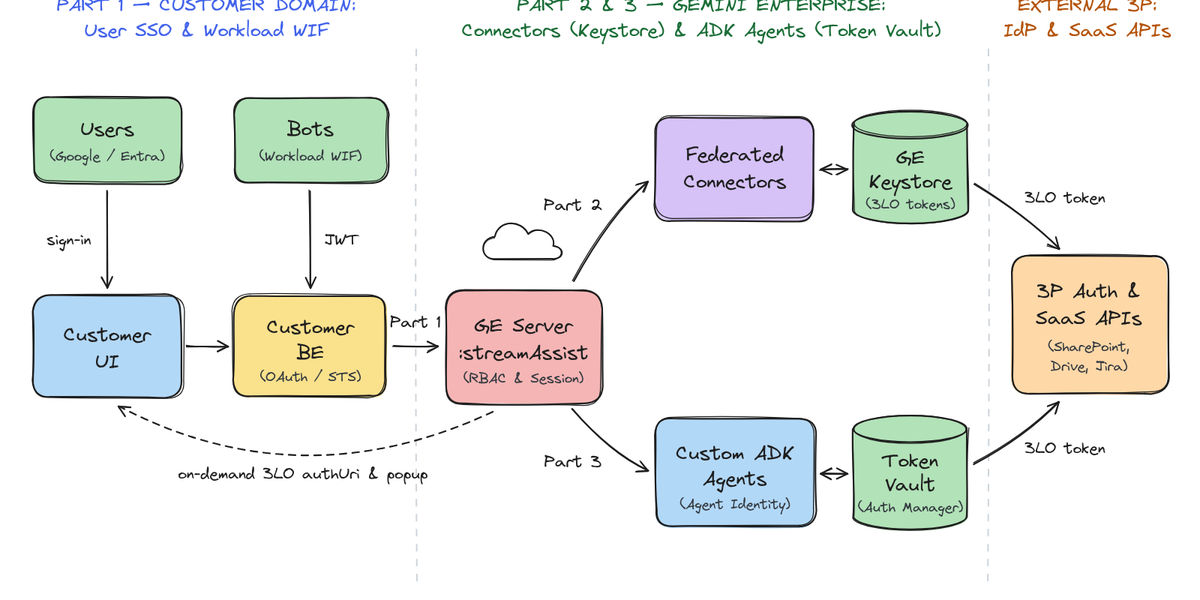
Google detailed three keyless authentication patterns for calling the StreamAssist API: Google Identity, Workforce Identity Federation with Microsoft Entra ID or Okta, and Workload Identity Federation for backend bots.
Why it matters
Enterprises building their own portals now carry the burden of authentication that the out-of-the-box web app handled automatically, so the guide gives them a concrete architecture to follow.
Summaries like this, every morning.
The guide draws a clear line between the out-of-the-box Gemini Enterprise web application and a custom-built Customer UI. In the built-in app, identity and access management happen behind the scenes: employees sign in through Google Identity or Workforce Identity Federation, search results respect per-user access controls, and third-party login prompts appear automatically. Once an application calls the StreamAssist API directly, those three authentication flows become the responsibility of the Customer UI and Customer BE.
The document then breaks the problem into three layers. Part 1 covers authenticating to StreamAssist with three keyless patterns: pure Google Identity, Workforce Identity Federation via Google STS, and Workload Identity Federation for backend bots. Part 2 walks through an 11-step 3-Legged OAuth flow for Federated Connectors, including a note that custom domains need a flag enabled so the callback page posts back to the Customer UI. Part 3 addresses custom ADK agents, explaining that root-level OAuth blocks the entire agent upfront and recommending instead wrapping protected tools with GcpAuthProvider and deploying with Agent Identity turned on, which triggers an on-demand popup only when a protected tool is called.
A runnable code blueprint is packaged in the gemini-enterprise-custom-ui-auth GitHub repository, with standalone Python scripts and curl commands for the user and workload auth patterns, a CLI helper and interactive web test UI for the Federated Connector flow, and a multi-agent ADK implementation with deployment script for the on-demand tool OAuth flow.
Pick your industry and the AI tools you use, and get news related to your work every day.
Free · 30 seconds with Google · unsubscribe anytimeWhat is AIToday? →
Ask AI anything about this article. The AI reads this article, earlier AIToday articles, and Wikipedia, and cites its sources. Q&As are published on this page for other readers too.
Citi added a section to its online user agreement this month stating that any access or transactions by a thir…
Interpreter Sara Campos lost a longtime Berlin client to AI, which the company chose because it is cheaper and…
Broadcom disclosed a long-term agreement in April 2026 to develop and supply future Google TPUs and networking…

Goldman Sachs noted the S&P 500 has fallen 3.59% to 6,918.45 for a seventh straight loss, and its AI stock bas…

Argent Capital Management's Q3 2026 investor letter said Dell Technologies posted a significant earnings beat…

Tesla hacker green (@greentheonly) found that in firmware 2026.44.1, Tesla renamed the AI Computer (HW4/AI4) t…