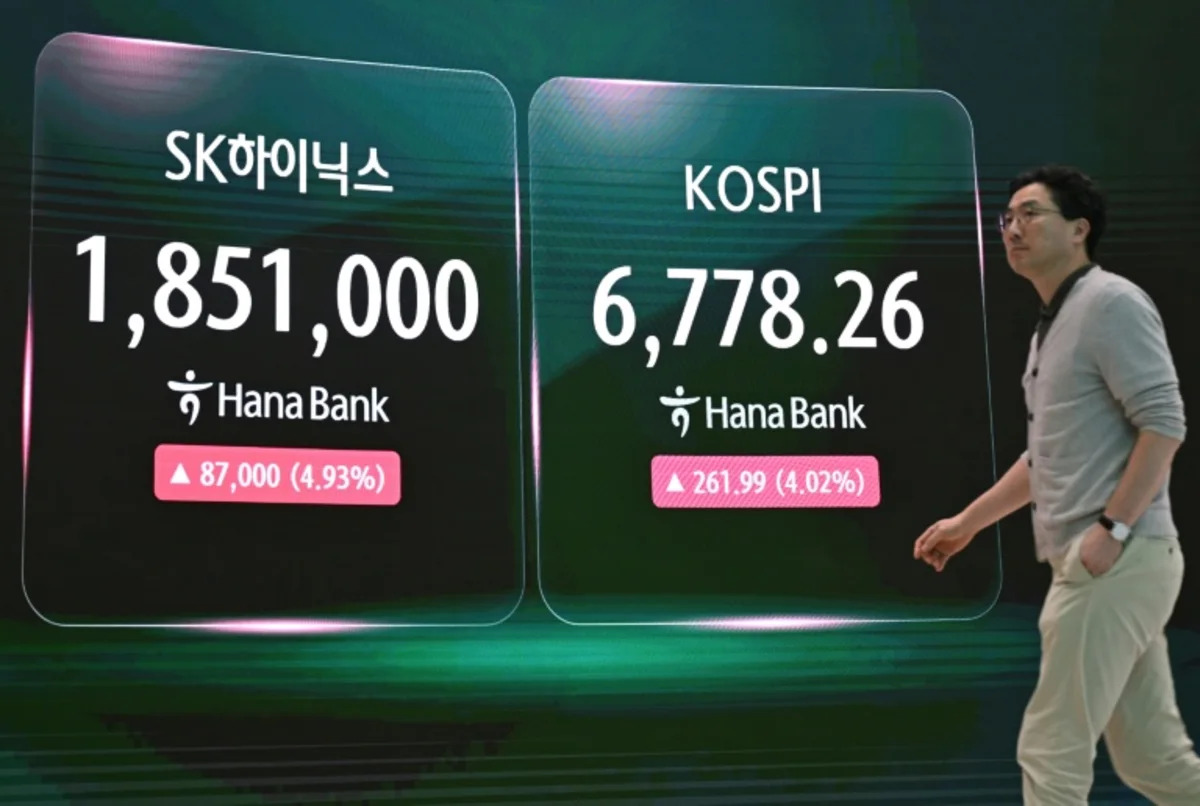
SK hynix, a key supplier of advanced memory chips to Nvidia, reported a 1,242 percent surge in second-quarter net profit to 94 trillion won ($64 billion(約10兆円)), powered by soaring demand from companies building AI data centres. The company recently raised $26.5 billion(約4.2兆円) in a US listing and plans to invest 40 trillion won this year, though it acknowledged concerns about potential slowdown in AI infrastructure spending—a concern executives attribute to optimization of existing capacity rather than a genuine pullback in investment.
Summaries like this, in your inbox every morning.
Sign up free →What happened
South Korea's SK hynix reported second-quarter net profit of 94 trillion won ($64 billion(約10兆円)), a 1,242 percent increase year-on-year, driven by explosive demand for its high-bandwidth memory chips used in AI infrastructure. The company also raised $26.5 billion(約4.2兆円) through an American Depositary Receipt listing in the US earlier this month.
Why it matters
SK hynix is a specialist supplier to Nvidia and a pillar of South Korea's tech-led economy. The surge reflects the global race to build data centres for AI infrastructure, though the company acknowledged concerns about potential slowdown—including firms exploring data centre rental rather than construction and the emergence of more efficient AI requiring lower memory demands. Management framed these as optimization of existing infrastructure, not a pullback.
What to watch
SK hynix intends to invest in the 40 trillion won range this year, betting that AI infrastructure investments will remain supported by revenue from AI services. Despite this bullish outlook, the company's share price has fallen 33 percent over the past month, mirroring a 41 percent drop for larger rival Samsung Electronics.
SK hynix, headquartered in Icheon, South Korea, reported Wednesday that second-quarter net profit soared to 94 trillion won ($64 billion(約10兆円)), a 1,242 percent jump from the same period last year. Operating profit for the April-to-June quarter climbed 557 percent to 60 trillion won, while revenue reached 79 trillion won. The company described these figures as "an all-time high quarterly performance."
The extraordinary growth stems from global demand for SK hynix's high-bandwidth memory chips, which are essential components in the AI data centres being built by major technology companies. As a specialist supplier to US chip giant Nvidia, SK hynix has become a critical beneficiary of the race to construct AI infrastructure. The firm's fortunes have risen meteorically alongside the sector's expansion, though questions linger about whether the market is overvalued.
Much of the net profit boost came from a one-off gain: SK hynix sold its 20 trillion won stake in flash memory maker Kioxia, another firm benefiting from the AI boom. This contributed substantially to the gap between operating profit and net profit figures.
When asked about mounting concerns that AI infrastructure investment might be slowing, Park Joon-deok, marketing chief of SK hynix's AI microchip division, pushed back on a call with investors and reporters. He acknowledged "jitters over firms exploring data centre rental—rather than construction—and the emergence of new high-efficiency AI requiring a lower memory taskload." However, he reframed these developments: "We view these developments not as a scaling back of AI investment, but rather as a process of maximising the utilisation of the massive AI infrastructure built to date and accelerating its monetisation." In a statement, SK hynix said it expects "momentum in memory demand" to persist, underpinned by revenue generated from AI services themselves.
Looking ahead, SK hynix said it intends to invest in the 40 trillion won range this year. The company attributes continued growth to expanding investments in AI infrastructure as the technology evolves into more complex forms requiring higher high-bandwidth memory capacity. "With major tech companies increasing their AI infrastructure investments, additional supply requests continue to mount," the firm stated.
Earlier this month, SK hynix raised $26.5 billion(約4.2兆円) through an American Depositary Receipt listing in the US, one of the world's largest-ever equity offerings. Parent firm SK Group also announced plans for a new $500 billion(約80兆円) collaboration with Nvidia to invest in AI infrastructure. Yet despite these aggressive investments and record earnings, shares of SK hynix have fallen 33 percent over the past month, while its larger South Korean rival Samsung Electronics has dropped 41 percent, suggesting investor caution about the sustainability of the AI boom.
SK hynix's 1,242 percent year-on-year profit surge reflects the intensity of the current race to build AI infrastructure globally. As a specialist supplier of high-bandwidth memory chips to Nvidia—a central player in the AI hardware ecosystem—the company sits at a critical chokepoint in the supply chain for data centres. The second-quarter net profit of 94 trillion won ($64 billion(約10兆円)) represents what management called an "all-time high quarterly performance," underpinned not just by strong revenue (79 trillion won) but also by a one-off gain from the sale of its 20 trillion won stake in flash memory maker Kioxia.
Yet the company is acutely aware that the AI infrastructure boom may face headwinds. Management flagged jitters over some firms exploring data centre rental models instead of construction, and the emergence of more efficient AI systems that require lower memory workloads. Rather than read these as a contraction, SK hynix frames them as a maturation phase—a shift from building capacity to maximizing the returns on infrastructure already in place. This interpretation is consistent with the company's stated confidence: it plans investments in the 40 trillion won range this year and expects memory demand to persist as long as AI service revenues support infrastructure spending.
A striking disconnect appears in the stock market reaction: despite record profitability and a $26.5 billion(約4.2兆円) US listing—one of the world's largest equity offerings—SK hynix shares have fallen 33 percent over the past month, and its larger rival Samsung Electronics has dropped 41 percent. This suggests investors may harbour deeper concerns about valuation or sustainability than management's reassurances address.
AI-summarized, only the topics you pick — one digest a day via Email, Slack, or Discord.
Free · takes 30 seconds · unsubscribe anytime
No comments yet. Be the first to share your thoughts!
Log in to join the discussion




Get curated AI news from 200+ sources delivered daily to your inbox. Free to use.
Get Started FreeFree · takes 30 seconds · unsubscribe anytime
