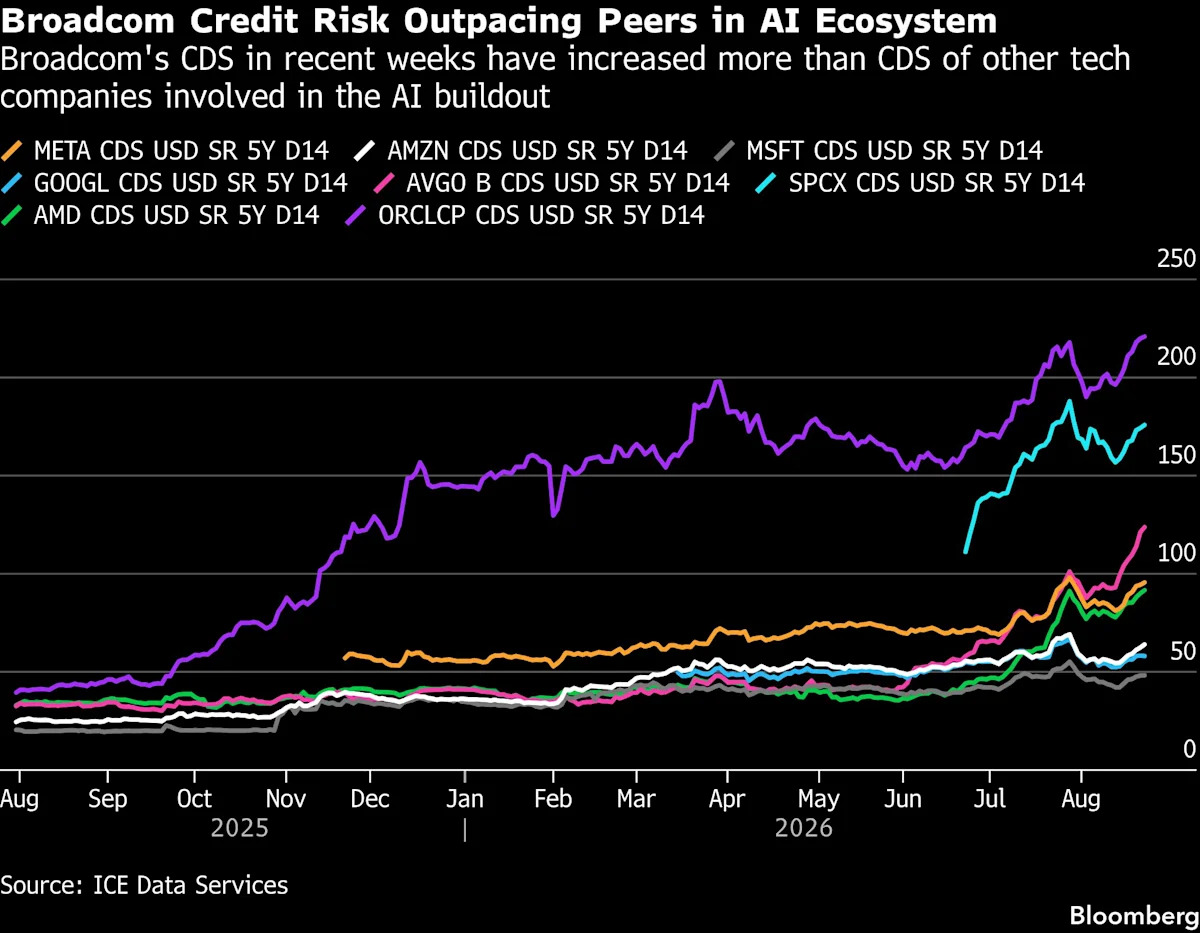
Broadcom's credit risk has risen as it backs large AI financing deals.
Yields on its 2031 bonds rose 14 basis points in August.
Credit default swaps climbed 28 basis points, more than Oracle or SpaceX.
What happened
Bond traders have raised credit risk measures for Broadcom Inc. as it backs mega financing for AI buildouts. Its 5.15% bonds maturing in 2031 saw yields rise about 14 basis points in August, and five-year credit default swaps climbed 28 basis points — more than Oracle or SpaceX.
Why it matters
Broadcom is in talks to raise over $60 billion in debt for an AI chip financing deal expected to benefit Anthropic PBC and others, potentially guaranteeing part of a senior-secured tranche. This follows an earlier agreement to backstop most of a $35 billion package with investors like Apollo and Blackstone financing custom AI chips leased to Anthropic. Guarantees let chipmakers lend their balance-sheet strength to clients, but also hide risks that could force them to honor billions in pledges during a downturn.
What to watch
JPMorgan strategist Tarek Hamid warns this adds to 'phantom leverage' under the AI ecosystem, with backstops like leases and purchase commitments poised to stretch into the trillions. Tony Trzcinka of Impax Asset Management sees the CDS rise as specific to Broadcom's balance sheet, linked to expectations of more guarantees.
Ask the AI about this article →
Broadcom's rising credit risk reflects a broader trend this year of tech companies using guarantees and financial support to expand cloud-computing capacity. These agreements effectively let chipmakers like Broadcom or Nvidia lend their balance-sheet strength to clients, boosting purchasing power. However, this also means risks are accumulating outside visible balance sheets, and in a downturn, such backstops could force companies to honor billions in pledges when earnings are under pressure.
The specific moves — a 14 basis point rise in yields on Broadcom's 2031 bonds and a 28 basis point climb in five-year credit default swaps — outpaced Oracle and SpaceX, signaling market jitters tied to Broadcom's potential $60 billion financing deal. JPMorgan's Tarek Hamid frames this as part of a growing layer of 'phantom leverage' under the AI ecosystem, with backstops like leases and residual value guarantees stretching into the trillions. Meanwhile, Impax's Tony Trzcinka sees the CDS rise as more about Broadcom's balance sheet than general AI investment angst, tied to expectations of additional guarantees.
As Broadcom negotiates the terms — potentially guaranteeing a portion of a senior-secured tranche — the outcome will test how far chipmakers are willing to extend their financial backing for AI infrastructure, and what that means for their own credit profiles.
For example, today's edition would include:
AI-summarized, only the topics you pick — one digest a day via Email, Slack, or Discord.
Free · takes 30 seconds · unsubscribe anytimeWhat is AIToday? →
Ask AI anything about this article. Q&As are published on this page for other readers too.
AI system scaling has pushed interconnect requirements inside data centers from chips and boards up to racks…
Chinese large-model developer Z.ai says it can now support large-scale inference using roughly 100,000 domesti…

Analyst Ming-Chi Kuo says Nvidia has revived the Rubin CPX AI accelerator with a substantially redesigned arch…
Palantir Technologies stock has posted multi-year gains, including an 11x return over 3 years

Apple has escalated its legal battle against OpenAI, claiming in a new court filing that OpenAI is actively de…
Samsung Electronics has locked up as much as 70% of its memory production capacity under long-term supply agre…