What happened
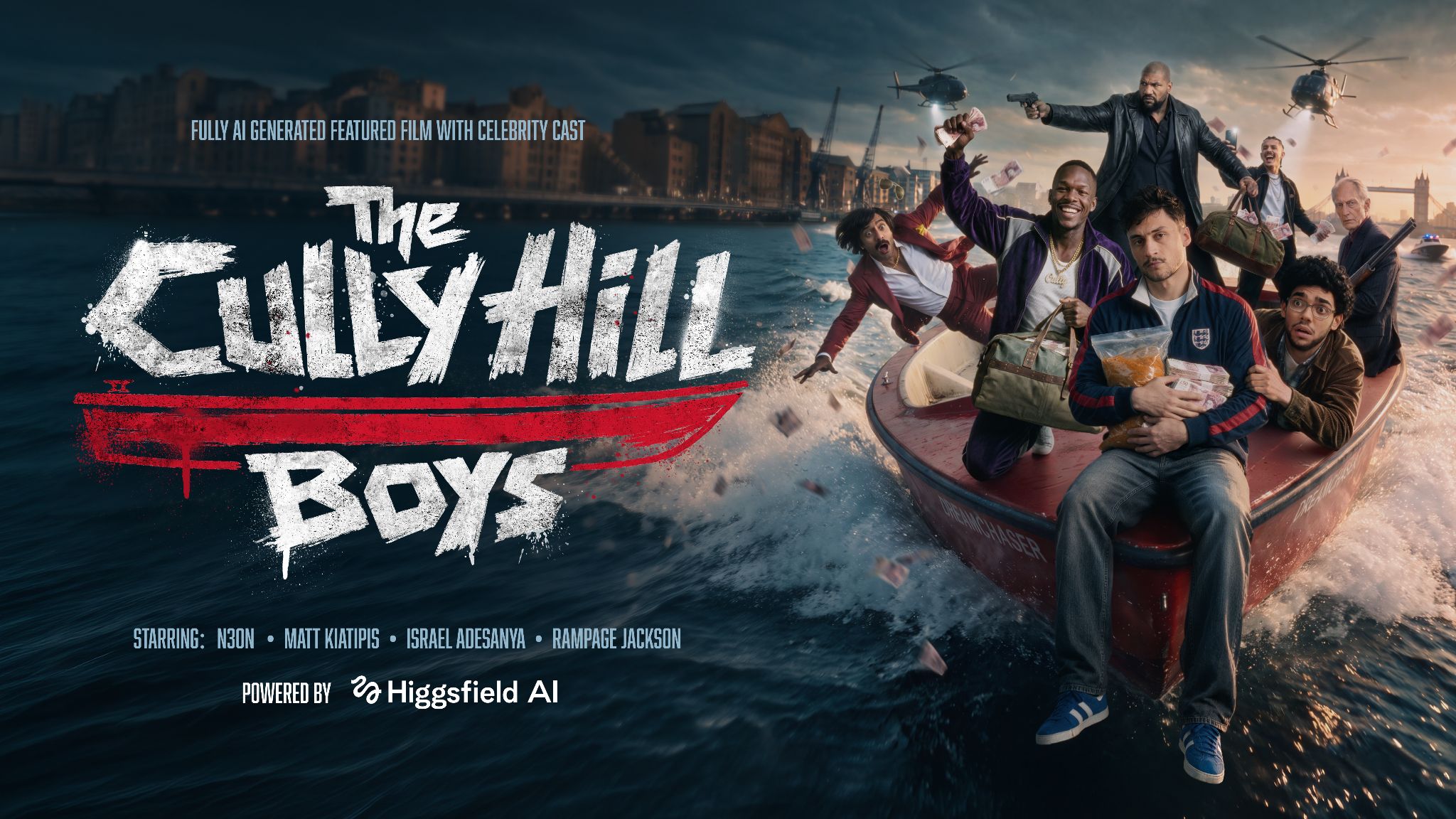
Higgsfield AI, a startup, produced The Cully Hill Boys, a 110-minute action-comedy featuring licensed celebrity likenesses, in just four weeks with a budget of $2 million—half spent on AI tokens. The film follows East London rappers who steal a boat for a music video and get caught between crime cartels.
Why it matters
The film demonstrates AI video production can now scale to feature length, a shift from short clips. While the technology still shows visible flaws—unrealistic polish, occasionally obvious AI generation, and inconsistent character reactions—the human screenwriter's dialogue and story structure indicate AI tools may be moving toward democratized, cost-effective long-form production for creators.
What to watch
Higgsfield AI says it plans to provide scalable AI workflows for creators, signaling the company sees a market opportunity in bringing down the cost and time required for video production. The film's mixed execution—strong writing, visible generation artifacts—shows where the technology still needs refinement.
Summaries like this, in your inbox every morning.
The Cully Hill Boys represents a significant milestone in AI filmmaking: the first feature-length movie produced primarily with AI tools, completed in a timeframe and budget that would be impossible under traditional film production. The $2 million budget, with half allocated to AI tokens rather than traditional production costs like crew, equipment, or location rental, underscores how drastically AI is reshaping the economics of video creation. What makes this achievement noteworthy is not merely that the film exists, but that it demonstrates a scalable workflow—Higgsfield AI's stated goal to democratize long-form video production suggests the startup sees replicable processes, not one-off stunts, in its future.
The film's mixed execution is equally instructive. The human screenwriter's involvement—adding dialogue and narrative structure—reveals that current AI remains strongest when paired with human creative direction; the script is described as the film's strongest element, while purely AI-generated visual moments betray the technology's current limits. Prompt inconsistency (what the article terms "prompt fatigue") produces moments where character reactions feel unmotivated or artificial, suggesting that the gap between coherent storytelling and coherent performance direction is still significant. Yet the progress from 2023's viral Will Smith spaghetti clip—where AI could not reliably render human hands—to a film where characters possess the correct anatomical details shows rapid capability gains.
Pick your industry and the AI tools you use, and get news related to your work every day.
Free · 30 seconds with Google · unsubscribe anytimeWhat is AIToday? →
Ask AI anything about this article. The AI reads this article, earlier AIToday articles, and Wikipedia, and cites its sources. Q&As are published on this page for other readers too.
In Q2, billionaires or their funds sold six 'Magnificent Seven' AI stocks
Nvidia was rising early Friday, even as the wider chip sector kept falling, Barron's reported

ElevenLabs completed a $300 million employee tender at a $22 billion valuation, and co-founder Mati Staniszews…

On October 15, OpenAI announced the Rosalind Academic Plan, giving approved US university labs free access to…

Neostellar Capital principal Evan Schlossman said CoreWeave's $103.7 billion in remaining performance obligati…
Supermicro Computer appointed Mark Long as chief financial officer, bringing an experienced technology finance…