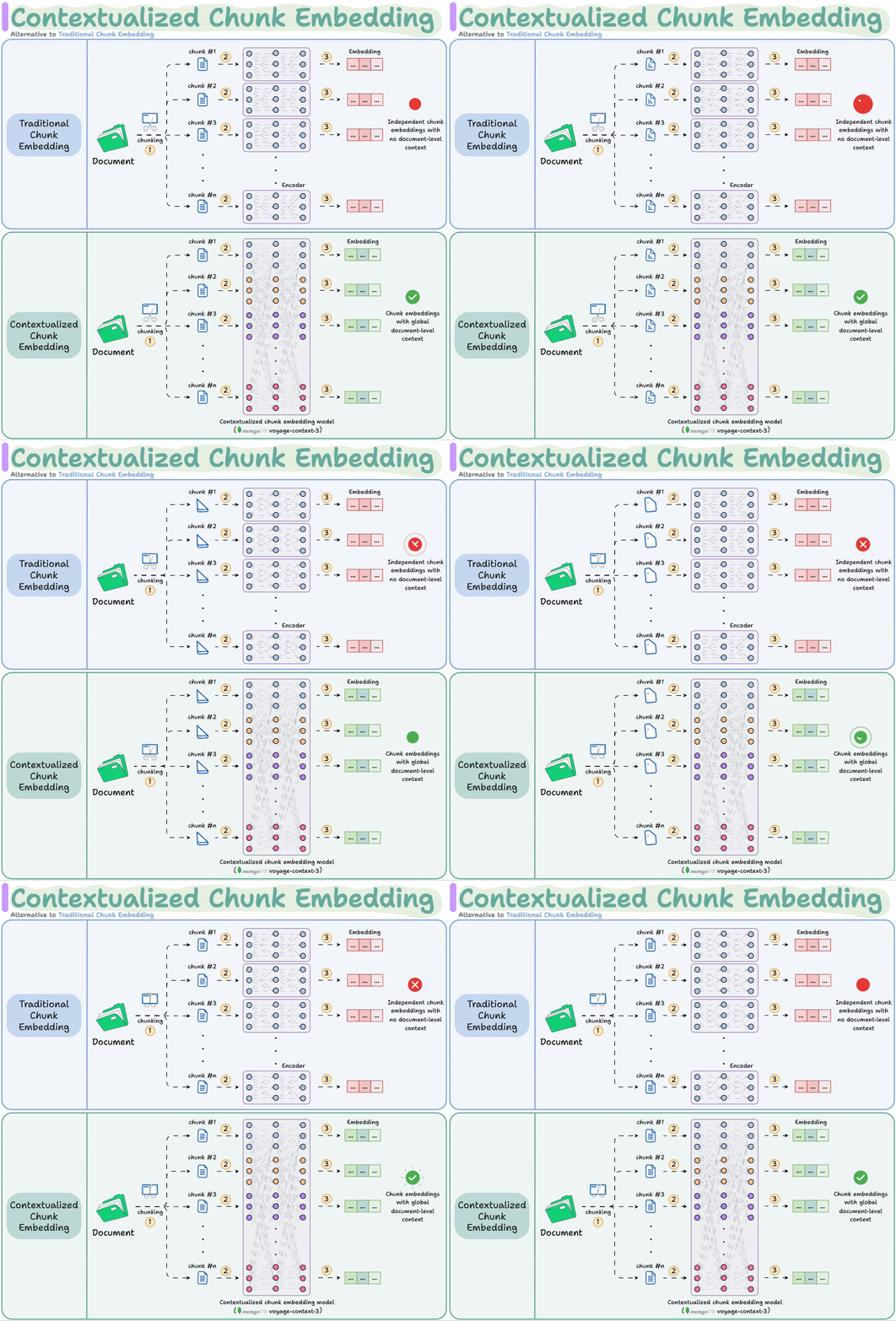
A new technical guide shows how to build an audio retrieval system using voyage-context-3, a contextualized embedding model that embeds text with full document context rather than in isolation, reportedly achieving 200x cheaper vector database costs.
The system combines speech-to-text transcription, semantic search, and an LLM to let users upload and query audio files directly.
The article also surveys eight prompting techniques—from few-shot examples to a structured method called ARQ—that can boost LLM output quality by improving reasoning depth, format consistency, and response diversity.
What happened
A technical tutorial demonstrates building a retrieval-augmented generation (RAG) system for audio using voyage-context-3, a contextualized chunk embedding model that embeds text with full document context—unlike standard models that embed chunks independently. The system combines Speechmatics for transcription, MongoDB for vector storage, Llama Index for orchestration, and DeepSeek V3.2 as the language model, wrapped in a Streamlit interface.
Why it matters
Contextualized embeddings improve retrieval accuracy in RAG systems, and the article claims this approach achieves 200x cheaper vector database costs compared to conventional setups. For businesses building search or Q&A systems over audio or document data, this cost reduction could significantly improve the economics of production deployments.
What to watch
The article also covers eight prompting techniques for improving LLM output quality—including few-shot prompting, chain-of-thought reasoning, and a newer technique called ARQ that achieved 90.2% instruction adherence versus 81.5% for direct prompting in testing across 87 scenarios. These methods can be combined to address specific failure modes like inconsistent formatting or shallow reasoning.
Building reliable AI systems for audio data requires both a sound architecture and tight control over model outputs. The article walks through a complete RAG (retrieval-augmented generation) pipeline designed to let users upload audio files and ask questions about them.
The core innovation is the use of voyage-context-3, a contextualized chunk embedding model. Unlike standard embedding models that encode each chunk of text in isolation, voyage-context-3 preserves the full document context during embedding, which significantly improves the relevance of retrieved chunks. The system flow is straightforward: first, Speechmatics transcribes the audio (handling real-world challenges like accents, background noise, and overlapping speakers). The resulting transcript is then embedded using voyage-context-3 and stored in MongoDB Atlas Vector Search. When a user poses a query, the system converts that query to an embedding, searches the vector database for relevant context, and feeds that context plus the query into DeepSeek V3.2 (an LLM accessed via OpenRouter) to generate a final answer. The entire interface is wrapped in Streamlit to provide a simple web UI for upload and chat. The article claims this architecture achieves vector database costs that are 200× cheaper than conventional approaches, though the specific cost baseline is not detailed.
Beyond the infrastructure, the article addresses a perennial problem: LLM outputs are often inconsistent in format, shallow in reasoning, or repetitive. The author surveys eight prompting techniques, each a distinct lever for improving output quality. Few-shot prompting shows the model a few input-output examples instead of describing the desired format in words; three to five examples typically suffice for tasks like SQL generation or text classification. Chain-of-thought (CoT) prompting instructs the model to reason step by step before answering; on GSM8K math benchmarks, adding "Let's think step by step" improved accuracy from 17.7% to 78.7% with PaLM 540B. Role-specific prompting assigns a persona (e.g., "You are a financial advisor") to shift the model's vocabulary and reasoning toward a particular domain. Negative prompting specifies what to avoid rather than what to do, acting as a hard constraint during generation. JSON schema prompting embeds a JSON template in the prompt to enforce structured outputs, achieving ~90%+ compliance on capable models without API-level setup. ARQ is a structured variant of CoT designed for multi-turn agent workflows; instead of free-form reasoning, it presents a predefined JSON checklist of domain-specific questions the model must answer before responding. In testing across 87 scenarios within the Parlant framework, ARQ achieved 90.2% instruction adherence compared with 86.1% for standard CoT and 81.5% for direct prompting. Verbalized Sampling forces the model to generate multiple candidate responses with their associated probabilities rather than collapsing to a single "safe" output; in experiments, this improved diversity by 1.6–2.1× while human evaluation scores rose by 25.7%. The article emphasizes that these techniques are not mutually exclusive—few-shot plus CoT is common, and JSON prompting can be combined with negative prompting for both structure and explicit constraints. The choice of technique depends on the specific failure mode: inconsistent format calls for JSON prompting, shallow reasoning for CoT or ARQ, lack of diversity for Verbalized Sampling, unwanted content for negative prompting, and missing domain expertise for role assignment.
The article presents two distinct but related advances in AI applications. The first is a practical architecture for audio RAG that leverages contextualized embeddings—voyage-context-3—to improve retrieval accuracy while cutting vector database costs to 200× cheaper levels. This cost reduction matters because vector search has become a bottleneck for production RAG systems; cheaper storage and retrieval lower the barrier to deploying semantic search over large audio or document collections. The choice of Speechmatics for transcription underscores a real-world constraint: handling "messy real-world audio with accents, noise, and overlapping speakers," which standard speech-to-text systems struggle with.
The second part of the article shifts to the output quality problem: even with a well-architected retrieval pipeline, LLM responses often fail to meet user expectations due to inconsistent formatting, shallow reasoning, or narrow answer diversity. The article catalogs eight distinct prompting techniques—few-shot, chain-of-thought, role assignment, negative prompting, JSON schema prompting, ARQ, and Verbalized Sampling—each targeting a specific failure mode. ARQ is positioned as a 2025-era refinement: it replaces free-form chain-of-thought reasoning with a structured JSON checklist, achieving 90.2% instruction adherence versus 81.5% for direct prompting. Verbalized Sampling, which asks the model to generate multiple responses with probabilities rather than a single answer, improved diversity by 1.6–2.1× while raising human evaluation scores by 25.7%. Together, these techniques address the gap between raw LLM capability and production-grade reliability.
AI-summarized, only the topics you pick — one digest a day via Email, Slack, or Discord.
Free · takes 30 seconds · unsubscribe anytime
Ask AI anything about this article. Q&As are published on this page for other readers too.
Eli Lilly and Company has committed to roll out Veeva Vault CRM across its global operations, adopting Veeva's…

Visa, the global payments network, is positioning itself to profit from AI-driven commerce by securing its rol…

Oracle Health released a redesigned patient portal that includes new AI-powered capabilities

McDonald's CEO Chris Kempczinski announced on August 4 that the company is consolidating customer data from 70…

S&P Global announced an expanded partnership with Microsoft to embed its proprietary data and analytics direct…

S&P Global announced an expanded collaboration with Microsoft to integrate its data, insights and analytics di…

The AI news that matters, in one minute each morning.
Sign up free