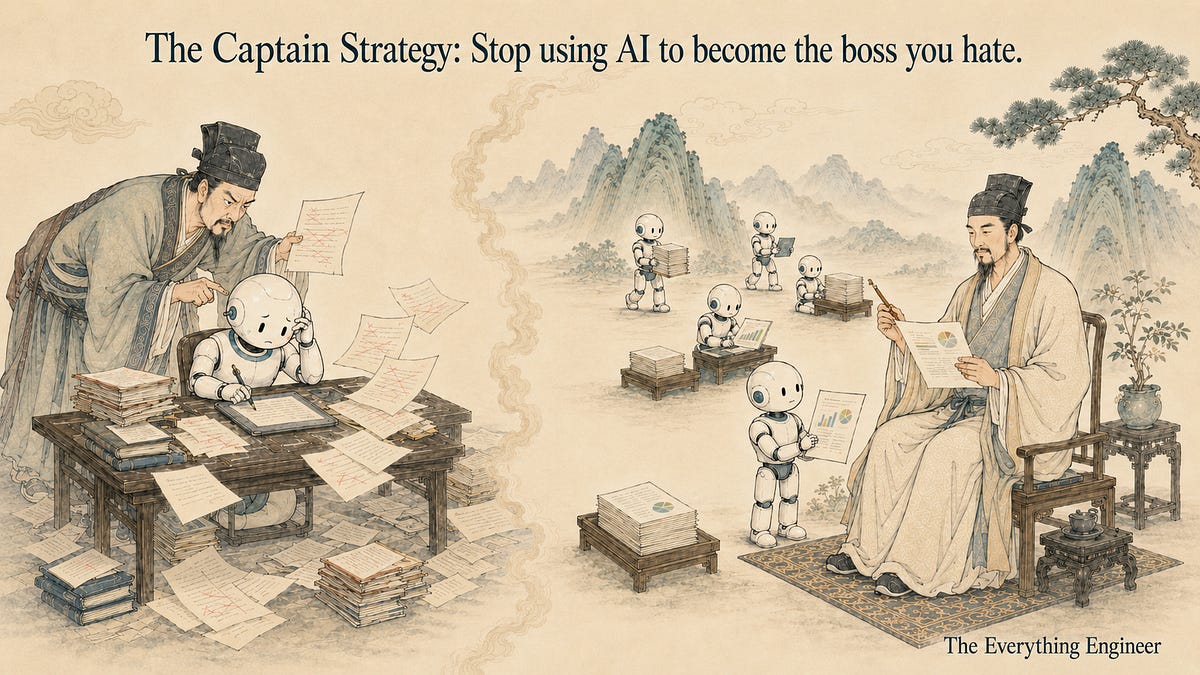
Michael Carroll argues that treating AI like an assistant leads to exhausting micromanagement where users constantly feed missing information and approve each step. Instead, he advocates reframing AI as a software function with defined inputs and outputs that you evaluate once, then improve iteratively—eliminating the need to monitor every intermediate decision and unlocking real productivity gains.
Summaries like this, in your inbox every morning.
Sign up free →What happened
Michael Carroll, founder of Coolhand Labs, argues that most AI users are stuck in a frustrating loop of constant back-and-forth with AI assistants—asking for missing information, clarifying ambiguous details, approving each step—rather than letting AI work autonomously. He contrasts this with treating AI as a defined function (like a software routine or an Accounts Payable process) that produces outputs you evaluate once, rather than oversee at every step.
Why it matters
The assistant paradigm turns users into micromanagers who blame the model for low productivity gains, when the real problem is the interaction model itself. By reframing AI as a function with defined inputs and expected outputs, users can focus on improving the overall process rather than correcting each intermediate step—leading to higher quality and productivity with each refinement, and eventually to outputs you can trust without reviewing them at all.
What to watch
Carroll promises a follow-up post next week on the "Captain Strategy"—a new interface and workflow designed to let AI do its work, let humans review outputs without frustration, and build confidence in the system's improvement. He notes the hardest part is surrendering control, especially for experts, and that removing the chat interface is key to breaking the micromanagement habit.
Michael Carroll, founder of Coolhand Labs (which recently received recognition from Ruby Central at RubyConf as a top startup in the Ruby AI ecosystem), identifies a central friction point in how most people use AI today: they treat it like a personal assistant, which creates an exhausting cycle of back-and-forth interaction.
The problem is structural. When a user invokes an AI skill with documents and context, the AI typically asks for clarification, missing details, or approval at each stage. The human provides the missing information, the AI asks about ambiguities, the human answers, the AI proposes a plan and asks permission to proceed, the human says yes but also mentions forgotten context, and this loop repeats until a final output is produced. Carroll describes this as "infuriating" and notes that it mirrors micromanagement—a manager hovering over an employee's desk, watching in real time and jumping in to correct every mistake. The result, paradoxically, is that productivity gains are minimal, and users conclude the model itself is inadequate when the real culprit is the interaction paradigm.
Carroll's solution is to stop thinking about AI as an assistant and start thinking about it as software—specifically, as a function. A function has defined inputs, follows a set of instructions, and produces an evaluable output. The simplest example is add_numbers: give it 1 and 4, you get 5. A more complex example is an Accounts Payable function that takes invoices as input, validates and approves them according to rules and judgment, and outputs on-time payments. The key insight is that once you trust a function works, you stop double-checking every intermediate step; you only validate outputs and periodic spot-checks.
Applying this to AI, Carroll argues, shifts the user's role from manager to optimizer. Instead of sitting inside the AI's reasoning process, correcting it at each turn, you set the function up with clear instructions and data sources, let it run, and then evaluate the output. If results are outdated, you adjust the source recency requirement. If it recommends discontinued products, you fix the data it can access. This approach yields low initial quality (because you're no longer correcting every step), but higher productivity and quality as you refine the system—until eventually the function becomes trustworthy enough that you never need to review outputs at all.
The hardest part of this shift is surrendering control, especially for experts who instinctively want to intervene. Carroll emphasizes that the key to success is removing the chat interface entirely, because if humans can monitor the AI's work in real time, they will inevitably slip back into micromanagement. Instead, he points to an emerging new interaction model he calls the Captain Strategy, which he promises to detail in a follow-up post next week—one that lets AI work autonomously, lets humans review outputs without frustration, and builds confidence in the system's continuous improvement.
Carroll's critique reflects a widespread pattern in how organizations have adopted large language models: treating them as sophisticated chatbots that mimic human assistants rather than as computational tools. The assistant framing is intuitive and aligns with how many people have learned to interact with AI through consumer products, but it creates a structural misalignment between what users want (higher productivity) and how they're actually working (constant context-switching and correction). The comparison to software functions and organizational processes grounds his argument in proven frameworks—a CFO doesn't supervise the Accounts Payable department by watching each invoice approval in real time, but by setting clear rules and periodically validating outputs.
What makes this relevant is that it cuts against much of the current AI productivity discourse, which either celebrates wholesale workforce displacement or dismisses AI as hype. Carroll occupies that "middle ground" he identifies: acknowledging genuine capability gains while explaining why they don't translate to the productivity leaps people expect. His framing suggests the bottleneck isn't model quality but rather the interaction layer and mental model users bring to AI work.
AI-summarized, only the topics you pick — one digest a day via Email, Slack, or Discord.
Free · takes 30 seconds · unsubscribe anytime
No comments yet. Be the first to share your thoughts!
Log in to join the discussion


Get curated AI news from 200+ sources delivered daily to your inbox. Free to use.
Get Started FreeFree · takes 30 seconds · unsubscribe anytime
