What happened
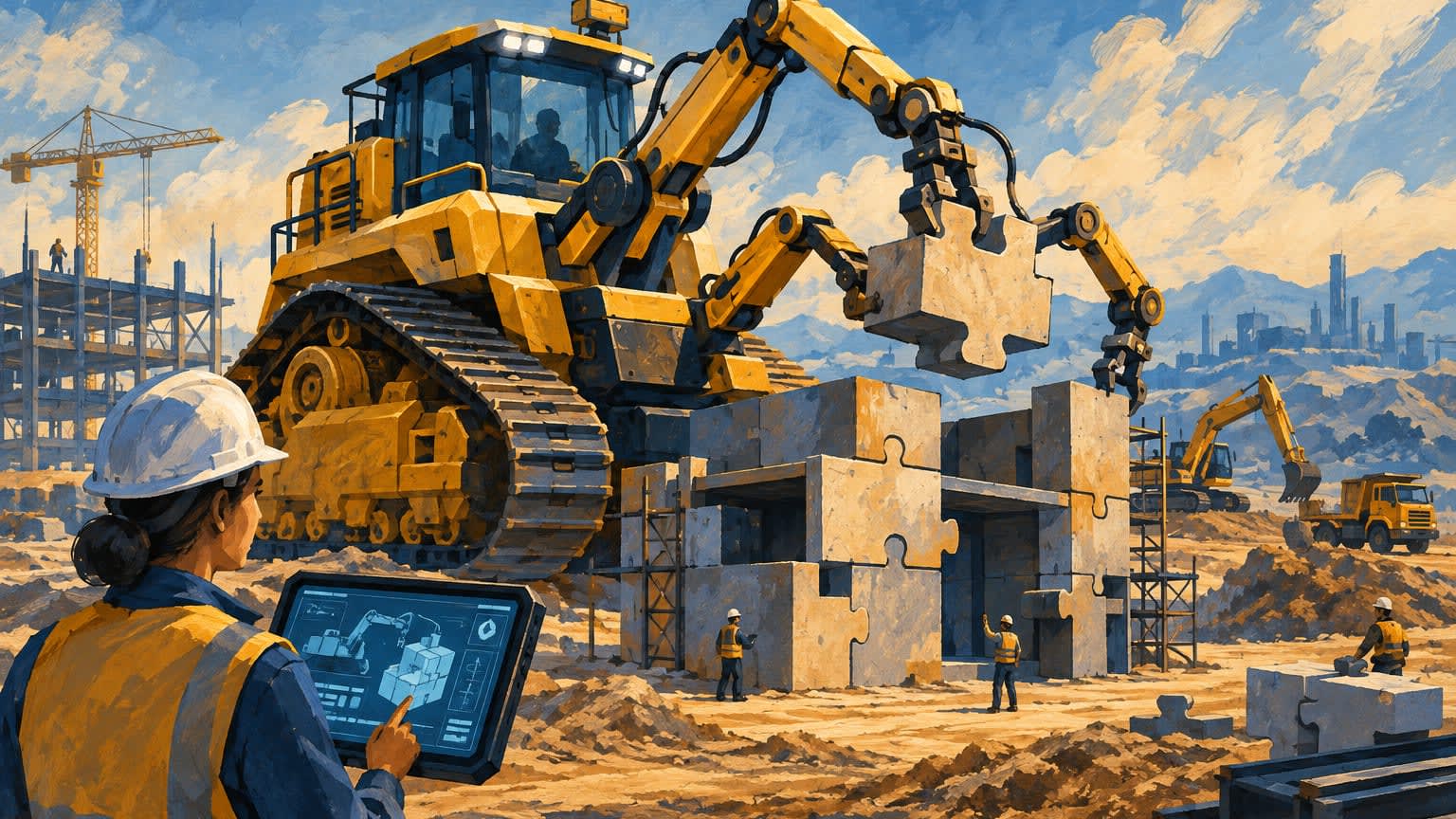
Caterpillar announced on Sept. 5, 2026 a collaboration with robotics company FieldAI to bring physical AI and autonomous systems to construction sites and industrial environments.
Why it matters
The stated goal is to extend automation beyond the controlled environments of conventional production lines, with potential uses including autonomous inspections and digital twins.
What to watch
The report disclosed no timeline, deployment sites or financial terms, so the test is whether pilot deployments follow. Whether robot-agnostic models transfer across equipment remains unproven.
WHO IT HITSConstruction and industrial operations teams evaluating automation for site safety and equipment monitoring may see new options here, while robotics and autonomy engineers at equipment makers could face a new reference architecture built on FieldAI's robot-agnostic models and NVIDIA's digital twin stack.
Ask the AI about this article →
Summaries like this, in your inbox every morning.
The announcement is a pairing of two different kinds of assets. Caterpillar brings decades of industrial expertise, engineering capabilities and operational data from real machines; FieldAI brings AI-enabled robot foundation models that Automation News described as robot-agnostic — meant to work across robotic platforms using models that combine data-driven learning with physics-based reasoning. On top of that sits NVIDIA's stack: accelerated computing, NVIDIA Omniverse and digital twins built from operational data.
The stated ambition is to move automation out of the controlled environments of conventional production lines and into construction sites and complex industrial environments. The applications named so far are autonomous inspections intended to improve safety and operational visibility, digital twins for insight into equipment and infrastructure, and AI-driven simulation for industrial operations. Caterpillar also told Automation News the technology could improve situational awareness and help identify risks earlier.
This lands in a sector where interest in automation predates the deal. A 2021 Construction Executive article cited a 2018 U.S. Chamber of Commerce report finding that more than half of surveyed contractors used some form of automation to manage onsite safety, with 74% of respondents planning to add more technology. That same article noted concerns among workers and business leaders about displacement and stress, alongside potential benefits for safety and data collection — figures that describe general industry survey findings, not this collaboration. How far this partnership goes likely hinges on whether the robot-agnostic models hold up across Caterpillar's equipment in the field, since no timeline, deployment sites or financial terms have been disclosed.
For example, today's edition would include:
AI-summarized, only the topics you pick — one digest a day via Email, Slack, or Discord.
Free · 30 seconds with Google · unsubscribe anytimeWhat is AIToday? →
Ask AI anything about this article. Q&As are published on this page for other readers too.
Former OpenAI and Anthropic researcher Jacob Coxon's X post warning AI could kill us all drew 170 million impr…
PCAST co-chair David Sacks posted on X on September 12 in response to Anthropic CEO Dario Amodei's essay "We M…

The Motley Fool laid out a $5,000 AI portfolio split across three layers: $2,500 in Amazon, $1,750 in Taiwan S…

ServiceNow AI crossed $1 billion in annual contract value in the second quarter, and the author predicts it tr…

Fortinet acquired Virtue AI, a move aimed at extending its AI security and strengthening real-time protection…

A Korean office worker wrote on the community "リメンバー" that he asked ChatGPT about chest tightness and breathin…