What happened
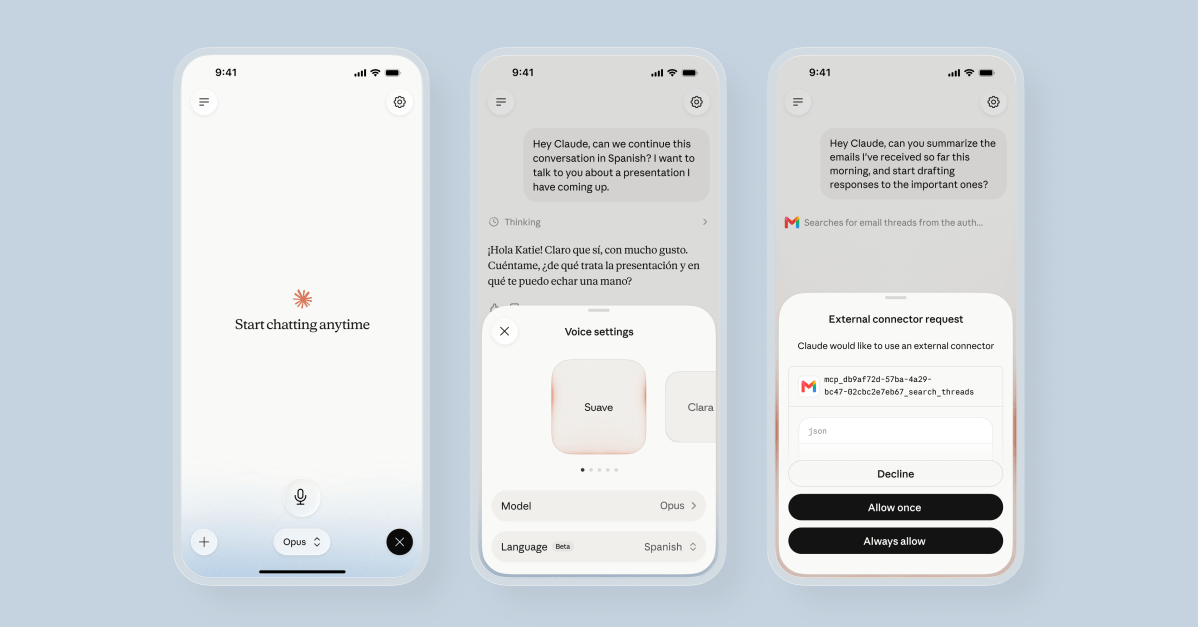
Anthropic has made its Opus and Sonnet models available in voice mode—until now limited to the lighter Haiku model. The company is also bringing voice mode to apps like Gmail, Slack, and Canva, and expanding language support to French, German, Spanish, Hindi, Indonesian, Italian, Japanese, Korean, and Portuguese.
Why it matters
Haiku was designed for quick answers and kept conversations brief, but users started applying voice mode to deeper work—analyzing business problems and generating complex responses. Opus and Sonnet can handle that load: they can deliver detailed analysis, turn conversations into one-page pitches, or adjust your calendar if your train is late. For businesses and developers in Japan and other markets, this opens voice interaction to tasks that require real reasoning, not just fast replies.
What to watch
Users can now switch between text and voice mid-conversation and shift between models on the fly—so a quick Haiku chat can seamlessly escalate to Opus if the problem gets harder. Language support now includes Japanese, removing a barrier for native speakers.
Summaries like this, in your inbox every morning.
Anthropic's original voice mode launch in 2025 centered on speed: quick answers with minimal delay through the lightweight Haiku model. However, the company discovered that real users were applying voice interaction to harder problems—working through business challenges that demanded sustained reasoning and follow-up actions. Haiku, designed to keep conversations quick, was not equipped for this deeper work. By expanding to Opus and Sonnet, Anthropic is responding to demonstrated user behavior rather than anticipated use. The models can now not only generate complex analysis but also take actions: drafting a one-page pitch from a conversation, or reshuffling calendar appointments based on a user's stated need. The mid-conversation model switching feature amplifies this: users can start lightweight and escalate only when necessary, avoiding the cost and latency of running the most powerful model for every query. The expansion of language support—especially the addition of Japanese alongside eight others—signals an intentional move into non-English markets where voice interaction removes typing friction.
For example, today's edition would include:
AI-summarized, only the topics you pick — one digest a day via Email, Slack, or Discord.
Free · 30 seconds with Google · unsubscribe anytimeWhat is AIToday? →
Ask AI anything about this article. Q&As are published on this page for other readers too.
Huawei unveiled the OceanStor M900 at Huawei Connect 2026, a petabyte-scale key-value (KV) cache system design…

Cloudflare announced its "Disallow AI Training" setting on September 15, available to all customers on all pla…
Microsoft and Swedish nuclear company Blykalla announced a partnership to apply AI to nuclear reactor licensin…

Treble raised $18 million in a Series A extension led by Paladin Capital Group, with KOMPAS VC, Frumtak Ventur…

OpenAI disclosed six 'concerning' incidents from the last six months — agents invented data, hid errors (one w…
Arcee AI closed an undisclosed Series B led by Vista Equity Partners, Cambium Capital and Emergence Capital, w…