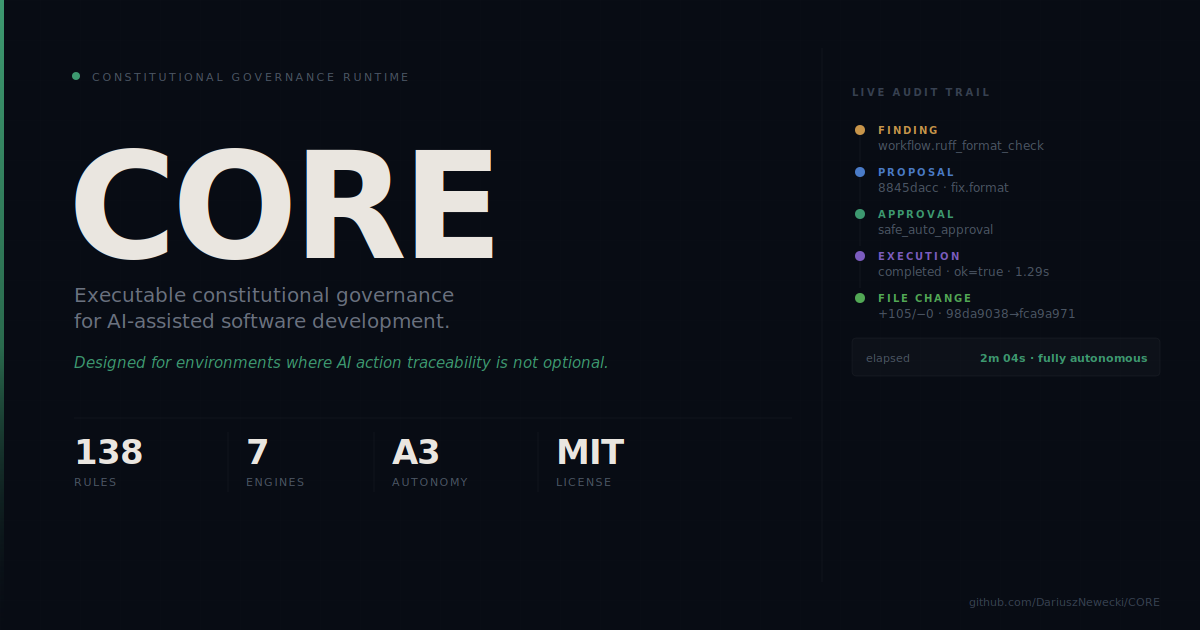
CORE is an open-source governance runtime that constrains AI agents with machine-enforced constitutional rules, blocking invalid code mutations automatically before execution.
The tool makes autonomous AI workflows auditable and deterministic by logging every action's decision chain and enforcing architectural invariants structurally, rather than detecting violations after the fact.
It is available now as a pip-installable package.
What happened
A new tool called CORE enforces constitutional rules on AI coding agents, structurally blocking violations before execution—for example, preventing an agent from deleting a production database. Every action is logged with a complete audit trail showing finding, proposal, approval, execution, and file change.
Why it matters
AI coding tools generate code faster than teams can review it, creating invisible technical debt and architectural violations. CORE makes dangerous mutations impossible by moving enforcement from after-the-fact detection to hard barriers before any code runs, giving developers deterministic control over autonomous workflows.
What to watch
CORE is available now on pip (version 2.x, beta stage) and can be tested immediately with a Docker command that runs a live governance demo. The system separates four repository layers—specs (human intent), mind (law), will (judgment), and body (execution)—enforced as constitutional law, not convention.
Ask the AI about this article →
For example, today's edition would include:
AI-summarized, only the topics you pick — one digest a day via Email, Slack, or Discord.
Free · takes 30 seconds · unsubscribe anytimeWhat is AIToday? →
Ask AI anything about this article. Q&As are published on this page for other readers too.
The Consumer Affairs Agency said Tuesday it will use generative AI to analyze about 900,000 annual consultatio…

The Supreme Court of Japan has included about ¥60 million in its fiscal 2027 budget request for AI-related exp…

OpenAI announced its support for California Senate Bill 1119, which aims to establish strong, age-appropriate…

Bank of England governor Andrew Bailey warned that advanced AI poses risks to financial infrastructure in a le…

Andrew Bailey, head of the world's financial stability watchdog, warned in a letter to G20 finance ministers a…

The European Union is expanding regulation of ChatGPT and will mandate protections for minors