What happened
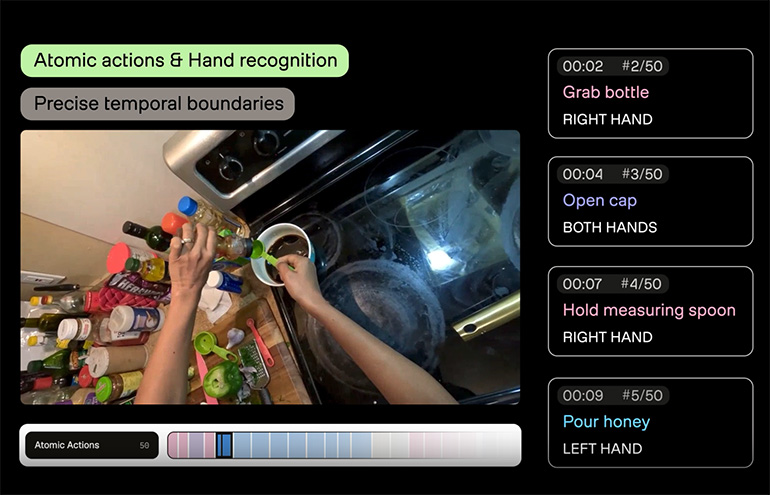
TwelveLabs released Pegasus 1.6, which it says is its first model built for egocentric video. It supports five workflows: action segmentation and labeling, dense caption labeling, quality scoring, search and curation, and consent and compliance flagging.
Why it matters
The new release is meant to turn first-person footage into structured, reviewable training data. TwelveLabs says this material is easier to collect and scale than teleoperation data.
What to watch
The model needs no specific camera or proprietary hardware, so the test is whether robotics teams can generate useful training data from footage they already have. TwelveLabs says the model also offers faster, more cost-efficient processing for high-volume video workloads.
WHO IT HITSRobotics developers and data teams, especially those working on dexterity and manipulation tasks like packaging, assembly, and cleaning, can use Pegasus 1.6 to label and filter existing first-person video rather than collecting teleoperation data.
Summaries like this, in your inbox every morning.
TwelveLabs, founded in 2021 and based in Seoul, has built a video intelligence platform around its Marengo and Pegasus models. With Pegasus 1.6, the company is extending that platform beyond enterprise video libraries into physical AI — a step it describes as its first model for egocentric, or first-person, footage. That footage is the type a worker would capture while cooking, assembling parts, or operating a robot remotely, and TwelveLabs argues it is easier to gather at scale than teleoperation data, which typically requires dedicated hardware and operators.
The release builds on Pegasus 1.5, whose Time-Based Metadata feature lets users define a custom schema and receive timestamped, structured data from video. Pegasus 1.6 adds improved entity recognition for tracking hands, objects, and tools across clips, plus faster, more cost-efficient processing for high-volume workloads. It arrives alongside existing collaborations with robotics labs and data teams, though the body does not name those customers or quantify the results they have seen.
The stakes hinge on whether robotics teams can turn ordinary first-person footage into training data that improves real machine behavior. TwelveLabs is explicit that it is not replacing a robot's tactile or actuator-level sensing; its role is to describe what happens in the video so teams can combine that with their own sensor data. Whether that combination speeds up robot training — and whether egocentric video proves as scalable as the company claims — is likely to determine how quickly the approach spreads beyond the labs already testing it.
Pick your industry and the AI tools you use, and get news related to your work every day.
Free · 30 seconds with Google · unsubscribe anytimeWhat is AIToday? →
Ask AI anything about this article. The AI reads this article, earlier AIToday articles, and Wikipedia, and cites its sources. Q&As are published on this page for other readers too.
Chinese logistics robots are spreading in Japan, and Toyota, Komatsu and others have adopted them, with the la…
Mitsubishi Heavy Industries and Algomatic Dynamics built an AI video-analysis tool for TIG welding that compar…
AppLovin faces a federal securities fraud class action after disclosures about delays in its generative AI vid…

Daiwa House's corporate venture capital arm invested in Persona AI, a US company developing industrial humanoi…
Research from The University of Texas at Austin, led by Rohan Ghuge, found an autonomous vehicle can get most…
A team led by PhAI Labs, with collaborators from Stanford, Oxford, and Princeton, introduced JEPA-Anything, bu…