What happened
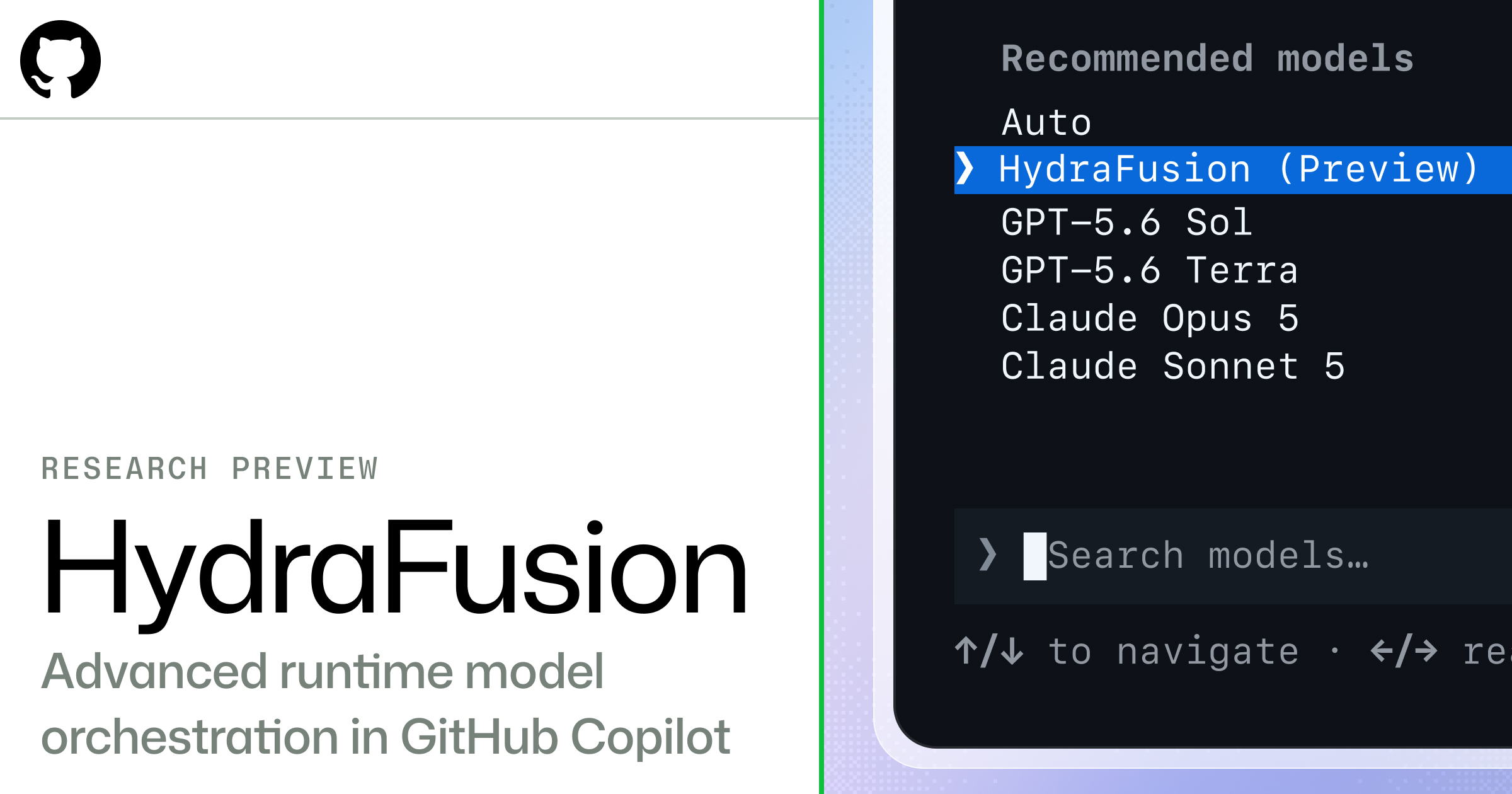
GitHub introduced Project HydraFusion, a research preview that automatically chooses and orchestrates models from multiple providers to handle coding tasks. It can draft, critique, and revise, or escalate to stronger models as needed.
Why it matters
In tests, HydraFusion delivered frontier-level quality while cutting costs: on TerminalBench 2.1 it improved verified task quality by 4.9 percentage points at 67% lower estimated cost compared to Claude Opus 5. On DeepSWE it came within 1.5 points of Opus 5 while reducing cost by 36%.
What to watch
HydraFusion is a research preview, not a full rollout, so the test is whether runtime orchestration holds up outside benchmark settings. Watch whether developers in autopilot mode report quality and cost tradeoffs that match the 67% cost reduction seen on TerminalBench 2.1.
Summaries like this, in your inbox every morning.
HydraFusion represents a new approach to AI coding assistance: instead of just choosing a single model, it dynamically orchestrates multiple models from different providers to handle tasks. The system treats workflow selection as an optimization problem, balancing quality, cost, and latency for each request. While the examples here are technical, the underlying idea is about getting the best result without always paying for the most powerful model.
The research preview is part of GitHub's effort to bring automated semantic routing between local, cloud, and compound models to developers. Early internal testing suggests the capability is at or better than the comparison model, but the official results are mixed. On TerminalBench 2.1, HydraFusion improved quality while cutting cost, but on DeepSWE and CheckpointBench it was slightly lower in quality, though still at similar levels while reducing costs.
The preview is designed to learn which tasks benefit from compound workflows. For now, GitHub recommends starting with well-scoped, single-prompt coding tasks. The company plans to improve multi-turn performance next. HydraFusion remains an active research project, and its results, models, and availability may change based on feedback.
Pick your industry and the AI tools you use, and get news related to your work every day.
Free · 30 seconds with Google · unsubscribe anytimeWhat is AIToday? →
Ask AI anything about this article. The AI reads this article, earlier AIToday articles, and Wikipedia, and cites its sources. Q&As are published on this page for other readers too.
On October 12, CNBC's Jim Cramer said combining CrowdStrike, Palo Alto Networks and Okta makes an AI "kill swi…

Sam Jenkins of Punchcard Systems cites a 2025 Microsoft survey of 1,725 data security leaders finding nearly t…

American Express launched its Intent Intelligence framework, which captures and authenticates purchase instruc…

Forrester argues that MuleSoft's Agent Fabric, an agentic AI control plane for governing AI agents, is Salesfo…

Vertiv Holdings Co and the Deloitte Center for Integrated Research released an AI infrastructure deployment gu…

Arista's August 4 results showed second-quarter revenue of $3.036 billion, up 37.7%, and a 45.4% GAAP operatin…