What happened
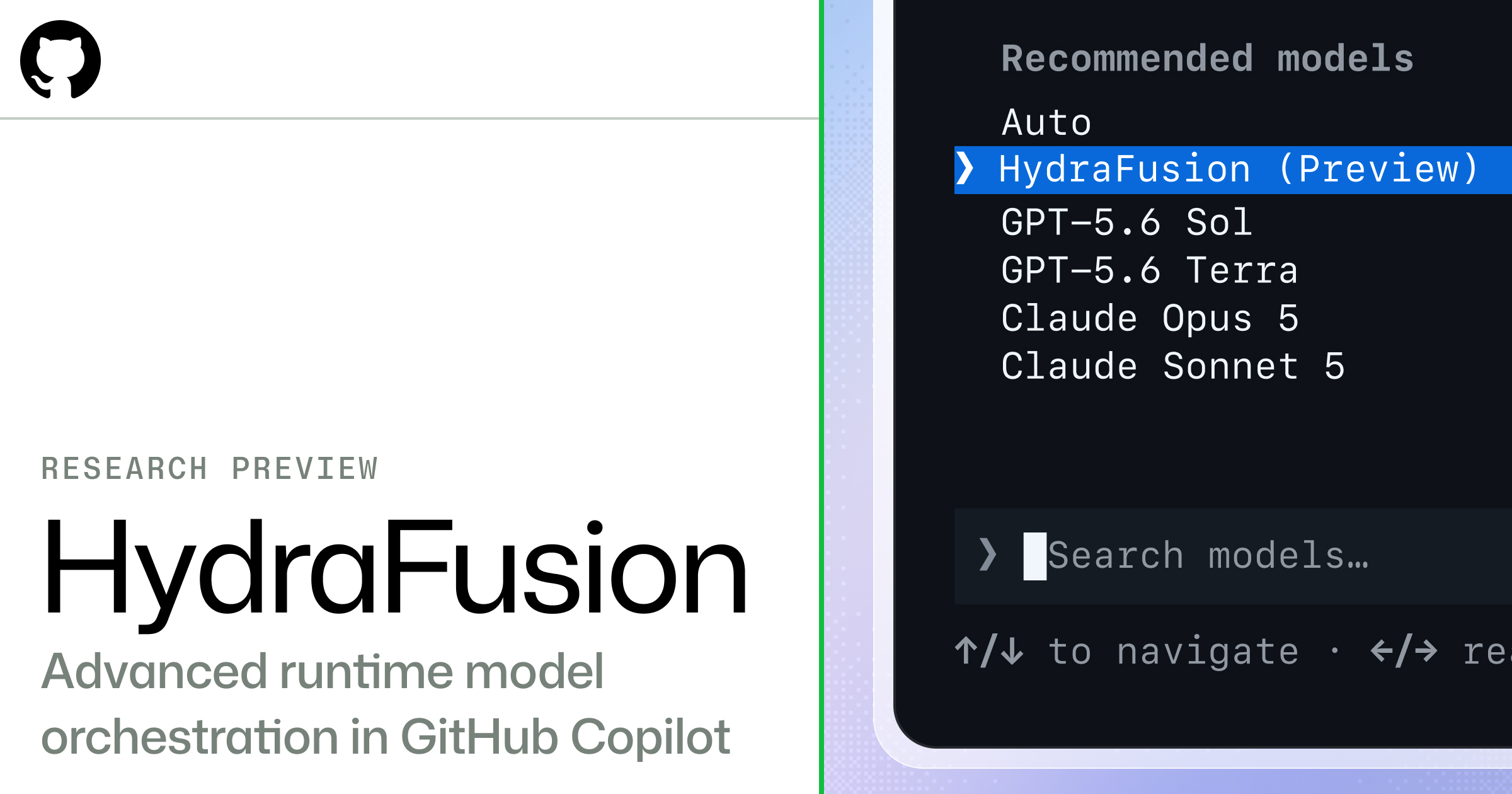
GitHub introduced Project HydraFusion, a research preview that automatically selects and orchestrates models from multiple providers to handle coding tasks. It chooses from three execution patterns—Single, Cascade, and Critique—to balance performance, cost, and latency.
Why it matters
In offline tests, HydraFusion matched or improved on the frontier model Claude Opus 5 while cutting costs significantly—for example, it delivered 4.9 percentage points higher quality on TerminalBench 2.1 at 67% lower estimated cost. This suggests developers could get top-tier coding help for less money.
What to watch
The preview’s value hinges on whether runtime orchestration holds up beyond single-prompt tasks, where it currently excels. GitHub’s next test is whether multi-turn sessions can deliver the same cost-quality gains without added latency.
Summaries like this, in your inbox every morning.
HydraFusion is GitHub's latest step beyond Auto model selection, which already matched tasks to a single best model. The new approach treats workflow selection as an optimization problem, dynamically constructing a plan that can involve drafting, reviewing, and escalating across models from different providers. This addresses a key real-world need: developers already manually coordinate models for complex tasks, but HydraFusion aims to automate that orchestration behind the scenes, keeping the interface as simple as picking any other model.
The benchmark results provide early evidence that such orchestration can deliver frontier-level quality at a lower cost. For instance, on DeepSWE, a demanding repository-level coding benchmark, HydraFusion came within 1.5 percentage points of Claude Opus 5's quality while cutting costs by 36%—a compelling tradeoff for complex engineering tasks. However, these are controlled offline results, and GitHub acknowledges that the research preview is designed to validate how they translate to real developer workloads, with an eye toward optimizing for production quality, latency, and reliability.
As a research preview, HydraFusion is an active effort, and its results, models, and workflows may change based on user feedback. GitHub's ambition is to move from choosing the best model to dynamically constructing the best way to solve each task, a bet that could redefine how developers interact with AI coding assistance in the future.
Pick your industry and the AI tools you use, and get news related to your work every day.
Free · 30 seconds with Google · unsubscribe anytimeWhat is AIToday? →
Ask AI anything about this article. The AI reads this article, earlier AIToday articles, and Wikipedia, and cites its sources. Q&As are published on this page for other readers too.
Vertiv Holdings Co and the Deloitte Center for Integrated Research released an AI infrastructure deployment gu…

On October 12, CNBC's Jim Cramer said combining CrowdStrike, Palo Alto Networks and Okta makes an AI "kill swi…

Charles Schwab CEO Rick Wurster expressed skepticism that AI agents will trade stocks autonomously while inves…

Arista's August 4 results showed second-quarter revenue of $3.036 billion, up 37.7%, and a 45.4% GAAP operatin…

American Express launched its Intent Intelligence framework, which captures and authenticates purchase instruc…

Forrester argues that MuleSoft's Agent Fabric, an agentic AI control plane for governing AI agents, is Salesfo…