What happened
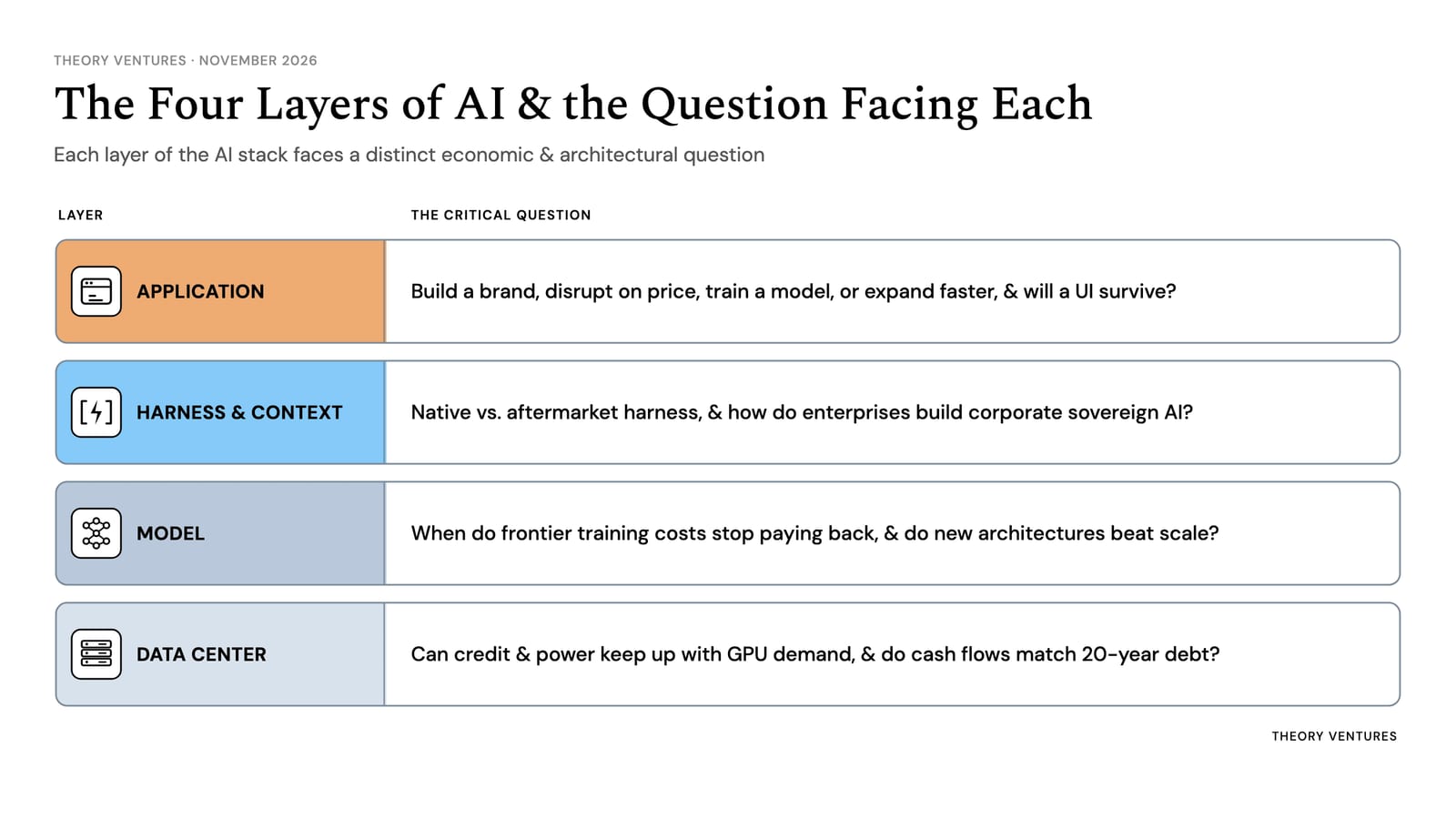
Tom Tunguz laid out four layers — application, harness and context, model, and data center — and the defining question hanging over each one, from whether interfaces survive to whether credit and power can keep up with GPU demand.
Why it matters
The layers feed each other, so a profit boom at the application top can inflate GPU prices and borrowing costs at the bottom, while cheaper architectures can ease demand for concrete and copper below.
Summaries like this, every morning.
Tunguz frames the AI stack as four layers, each with its own unresolved question, and stresses that none stands alone. At the top, breakout applications appear overnight but a new model release can erase them just as fast, leaving app companies to choose between building a brand, disrupting incumbents through pricing, developing their own models, or expanding faster than competitors.
In the middle, the fight moves to the harness and context layer. Tunguz notes that input context is up to 98% of all tokens, so a smart harness can cut the cost of the same answer by 71% and lift gross margin from 38% to 75%, which helps explain why enterprises are starting to lay claim to the harness to keep memory and permissions in house. For foundation models, training costs run into the billions, and recursive self-improvement has not yet bailed out the big labs: AI writes 75% of Google DeepMind's production code, yet Google sees no end-to-end speedup in AI research. Challengers are attacking that bill through process and architecture — one startup pre-trained a competitive coding model with a single researcher for under $10m, and a 109m-parameter JEPA model beat 72b LLMs with 42x less data.
Below the models, Tunguz answers the data-center question for now as no: concrete prices up 3x, strained grids, and turbine backlogs stand in the way, while unrestrained growth would require $4t in new debt over five years. He compares the whole arrangement to a double pendulum — simple in each part, yet complex, chaotic, and unpredictable in motion.
Pick your industry and the AI tools you use, and get news related to your work every day.
Free · 30 seconds with Google · unsubscribe anytimeWhat is AIToday? →
Ask AI anything about this article. The AI reads this article, earlier AIToday articles, and Wikipedia, and cites its sources. Q&As are published on this page for other readers too.
Casap announced a $56 million Series B led by Base10 Partners, with Experian and Synchrony as strategic invest…

Kindai University will give 4,000 Paperpal licenses to full-time faculty and doctoral students at all campuses…

HIX AI's connector update on 11月4日 links Microsoft 365 (Outlook Mail, Outlook Calendar, OneDrive), Google Work…

Xentron and Holon System began a partnership linking Xentron's physical AI data platform NEXUS with Holon's ma…
Darfon Electronics is consolidating its production capacity in China and Southeast Asia and shifting some reso…
Alibaba, Tencent, Bytedance and other Chinese AI and cloud majors ordered about 6 million Nvidia RTX Pro 5500…