AIToday

Gritt raises $32.4M for AI-powered construction robotics

Robotics & Automation News4h ago
Gritt raises $32.4M for AI-powered construction robotics

Key takeaway

Gritt, a startup combining robotics and AI for outdoor construction, has launched with $32.4 million(約52億円) in funding to address a critical labor shortage—over 41 percent of the US construction workforce is expected to retire by 2031, and the industry is facing a 46 percent productivity decline. The company's robotic arms attach to existing equipment and work in unpredictable outdoor conditions with millimeter precision; tasks that once took months to program now take days. Gritt's machines are already operating on real construction sites with major US builders.

Summaries like this, in your inbox every morning.

Sign up free →

3 Key Points

  • What happened

    Gritt, a robotics and AI company, launched with $32.4 million(約52億円) in pre-seed and Series A funding. The $26 million(約42億円) Series A was led by Obvious Ventures, with participation from Union Square Ventures and Active Impact Investments, backed by First Round Capital, Climactic, Congruent Ventures, and VSC Ventures.

  • Why it matters

    Construction has seen a 46 percent decline in productivity while facing major labor shortages—more than 41 percent of the US construction workforce is expected to retire by 2031. Gritt's robotic arms attach to existing jobsite equipment (skid steers, forklifts) and can pick, place, assemble, and transport materials with millimeter precision in outdoor conditions. The system learns quickly: tasks that took months to train initially now take only days to retrain.

  • What to watch

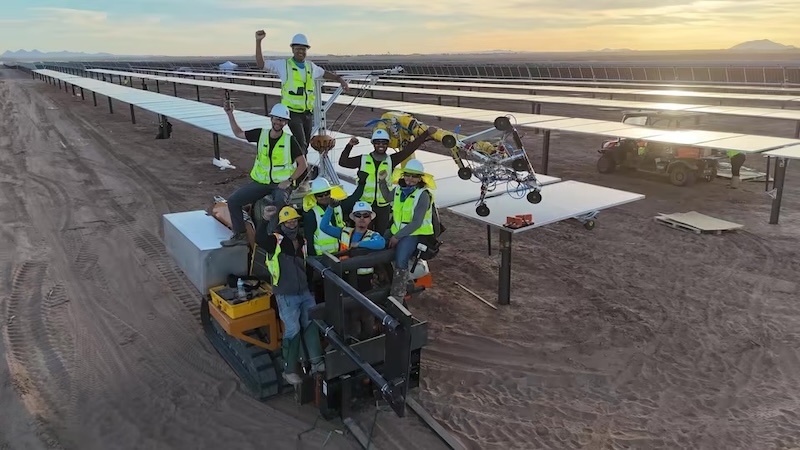
    Gritt's machines are already deployed on real sites with top 10 US construction companies, including massive solar farm builders. The system has enabled autonomous placement of tens of thousands of solar panels with zero breakages. The company aims to expand its decision-making intelligence layer to help site supervisors manage resource flows and anticipate problems.

In Depth

Gritt, a startup building intelligent systems that combine robotics and AI for outdoor construction, announced its launch with $32.4 million(約52億円) in pre-seed and Series A funding. The Series A round of $26 million(約42億円) was led by Obvious Ventures, with participation from Union Square Ventures and Active Impact Investments. Previous investors—First Round Capital, Climactic, Congruent Ventures, and VSC Ventures—also contributed to the round.

The company addresses a critical gap in construction automation. More than 41 percent of the US construction workforce is expected to retire by 2031, and the industry is already facing major labor shortages. At the same time, construction has experienced a 46 percent decline in productivity, even as other industries have achieved significant gains through AI and automation. Puneet Puri, CEO and co-founder, frames Gritt's mission directly: "Infrastructure is what moves civilization forward, and now Gritt can help build it faster – including solar arrays, data centers, bridges, and roads."

Gritt's approach centers on robotic arms that attach to existing jobsite equipment such as skid steers and forklifts. The system enables the machines to pick and place, assemble, and transport materials with millimeter precision in ever-changing outdoor environments. Because the system learns quickly from every deployment and is highly adaptable, a task that initially took months to train now takes only days. By deploying across large-scale construction sites, Gritt captures and processes real-time data on completed work, material movement, and site conditions, using that intelligence to help supervisors make better decisions. The company's machines are already deployed on real sites, trusted by top 10 US construction companies, including those building massive solar farms. The autonomous placement of tens of thousands of solar panels has achieved zero breakages.

Vishal Dugar, CTO and co-founder, emphasized the technical challenge: "We need an intelligence layer that can complete dexterous tasks and make decisions in an environment that changes every hour. This is one of the most challenging frontiers in physical AI." Andrew Beebe, managing director at Obvious Ventures, highlighted the compounding advantage of field deployment: "Every site they deploy builds the flywheel that makes the system smarter and more capable. That's a compounding advantage that's challenging to replicate from the outside." Gritt's long-term vision extends to a decision-making intelligence layer that can act as a powerful agent for site supervisors, understanding resource flows, anticipating problems, and directly making operational calls to keep projects moving.

Context & Analysis

The construction industry faces an unprecedented challenge: over 41 percent of the US construction workforce is expected to retire by 2031, combined with a documented 46 percent decline in productivity. Unlike manufacturing or other industries that have successfully automated through AI, outdoor construction presents singular obstacles—unpredictable weather, unforgiving terrain, variable site conditions, and the chaotic logistics of large-scale buildouts make traditional automation approaches impractical. Gritt's funding reflects investor confidence that this frontier is solvable through a combination of proprietary AI and practical hardware design.

What distinguishes Gritt's approach is its pragmatic integration with existing equipment. Rather than requiring construction companies to replace proven tools, the system attaches to skid steers, forklifts, and other standard jobsite machinery. This lowers adoption friction and safety risk, since crews can operate alongside the autonomous systems within defined safety bounds. The company's emphasis on learning speed—retraining tasks from months down to days—suggests the system's intelligence compounds with each deployment: more sites mean more real-world data, which improves the AI's adaptability to new conditions. This flywheel dynamic, which Andrew Beebe of Obvious Ventures explicitly highlighted, represents a structural advantage that is difficult for competitors to replicate without equivalent field experience.

FAQ

How does Gritt's system actually work on construction sites?
Gritt's robotic arms connect to existing jobsite equipment such as skid steers and forklifts, enabling the system to pick and place, assemble, and transport materials with millimeter precision in changing outdoor environments. Rather than replacing existing equipment, the systems attach to the proven hardware that crews already own and know how to maintain, allowing them to operate safely alongside workers within strict safety bounds.
Is Gritt already being used on real projects?
Yes. Gritt's machines are already on real sites, trusted by top 10 US construction companies, including those building massive solar farms. The system has enabled the autonomous placement of tens of thousands of solar panels with zero breakages.
How quickly can Gritt's system learn new tasks?
Gritt's system learns quickly from every deployment and is highly adaptable—a task that took months to train the first time now only takes days.

Get the latest Robotics news every morning

AI-summarized, only the topics you pick — one digest a day via Email, Slack, or Discord.

Free · takes 30 seconds · unsubscribe anytime

Discussion

No comments yet. Be the first to share your thoughts!

Log in to join the discussion

Related Articles

Stay ahead with AI news

Get curated AI news from 200+ sources delivered daily to your inbox. Free to use.

Get Started Free

Free · takes 30 seconds · unsubscribe anytime

1 minute a day. The AI essentials.

200+ sources · Email / LINE / Slack

Get it free →