What happened
FieldAI is reportedly seeking $700 million in funding at a valuation that could reach $10 billion, five times its worth last August, and is believed to have signed a term sheet.
Why it matters
The reported jump suggests investors see map-free robot navigation as a way to cut the cost of automation, with existing backers like Bezos Expeditions and Nvidia's NVentures fund already on the roster.
What to watch
The round hinges on the term sheet, which is nonbinding and does not name the expected investors; the trajectory to watch is FieldAI's revenue and customer contracts, which it says topped $135 million.
WHO IT HITSThis lands on industrial automation teams in construction, energy and the public sector that deploy robots for inspection and other tasks, since map-free navigation could reduce the setup work and cost of those projects.
Summaries like this, in your inbox every morning.
FieldAI's pitch rests on a specific operational problem. Engineers usually have to supply their robots with a map of the environment where they will operate, and that preparation is time-consuming, especially across large areas. Static maps also age badly: environments such as construction sites change regularly, which can create significant accuracy gaps. FieldAI says its models need no map, no GPS, no internet connection and no user-defined travel paths, which reduces the work of building a robot's navigation stack.
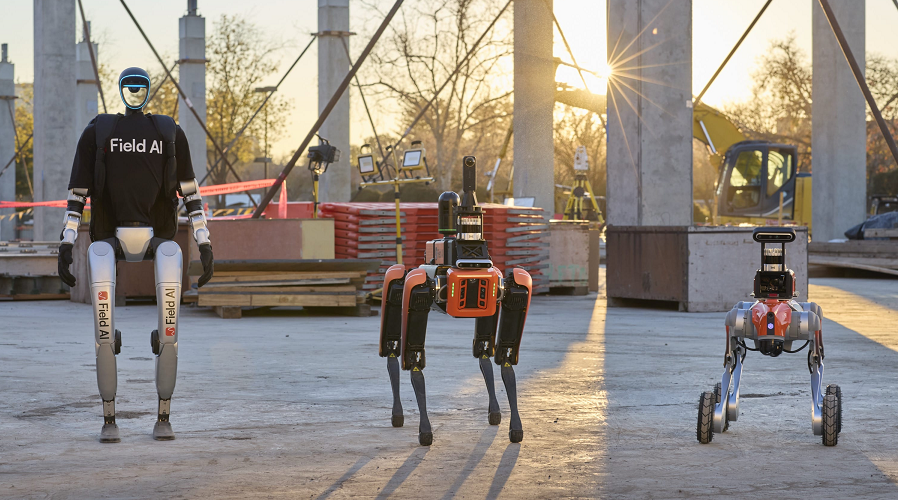
FieldAI has also built out partnerships and a customer base beyond that core claim. In March it partnered with Boston Dynamics to add support for the four-legged Spot robot, an integration aimed at automating certain equipment inspection tasks for industrial customers. On the product side, FieldAI turns sensor data from cameras, lidar, radars and other equipment into a digital twin — continuously updated with real-world data, unlike a static simulation — which customers can use to test site changes virtually or to train AI. FieldAI has more than 30 customers across construction, energy and the public sector.
The funding story and the commercial story are intertwined. The reported $700 million round could value FieldAI at $10 billion, five times its valuation last August, and the company is believed to have signed a term sheet, which is nonbinding. What that term sheet ultimately converts into may hinge on whether FieldAI's reported growth holds: its revenue and customer contracts passed $100 million this past June, and according to today's report have since topped $135 million. For the industrial customers FieldAI targets, the practical test looks likely to be whether map-free navigation translates into cheaper, more reliable automation.
Pick your industry and the AI tools you use, and get news related to your work every day.
Free · 30 seconds with Google · unsubscribe anytimeWhat is AIToday? →
Ask AI anything about this article. The AI reads this article, earlier AIToday articles, and Wikipedia, and cites its sources. Q&As are published on this page for other readers too.
SpaceX finished its first full quarter as a public company on Sept
After OpenAI staff raised concerns on Slack, president Greg Brockman abandoned the second half of his $50 mill…

Cloudflare's Day 4 announcements made AI Search and the Cloudflare Basin data platform generally available, op…

A Zenn essay says AI makes your own vague hunch sound right, and its author's Tappin app, launched on the App…
Grab published how it moved over 500 internal agent services onto one in-house framework, LLM-Kit, cutting pro…
The author calculates one AI prompt costs about 0.01 yen in electricity — ChatGPT at 0.34 Wh and Gemini at 0.2…

