What happened
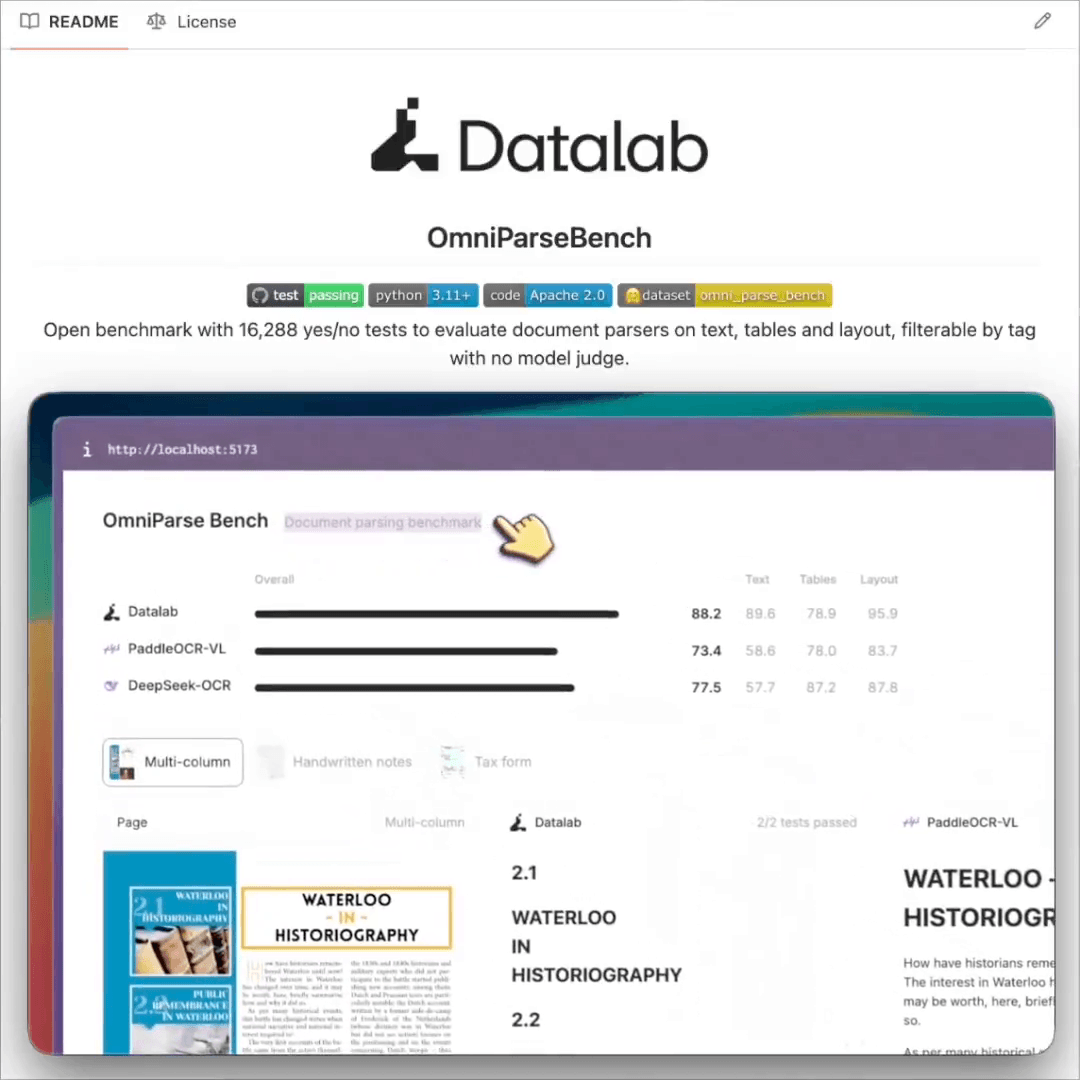
On 150 pages, Datalab's Surya scored 88.2 overall, ahead of DeepSeek-OCR at 77.5 and PaddleOCR-VL at 73.4, but DeepSeek-OCR led tables at 87.2 versus Datalab's 78.9.
Why it matters
A team whose documents are mostly dense tables would pick a different parser than the average suggests, since no single parser won on every page type.
Summaries like this, every morning.
The benchmark's design reflects a simple problem with most OCR comparisons: one number per parser tells you who is ahead on average, but not where a parser breaks. OmniParse Bench replaces that single score with thousands of pass/fail unit tests, each carrying a reason for failure such as "text missing" or "marked as table, not heading." The scoring runs as open code, and no LLM judges the output.
The page-level results show how differently parsers can fail. On the filled 1040 tax form, PaddleOCR-VL returned only the form's title and passed 0 of 8 tests, while Datalab passed 8 of 8 and DeepSeek-OCR passed 6 of 8. On handwritten notes, Datalab passed 5 of 6 tests while the other two passed 0. A single average folds a parse that returns only a title and one with a few wrong cells into the same number.
The benchmark builds on what olmOCR-bench showed, that pass/fail unit tests are a simple proxy for parsing quality anyone can check. Datalab's view is that olmOCR-bench has saturated, and what now separates top systems there is mostly output conventions and overfitting rather than reading. Each test also records how its answer was established, such as the publisher's own markup or agreement across a panel of independent models, so users can judge how solid a given test is.
Pick your industry and the AI tools you use, and get news related to your work every day.
Free · 30 seconds with Google · unsubscribe anytimeWhat is AIToday? →
Ask AI anything about this article. The AI reads this article, earlier AIToday articles, and Wikipedia, and cites its sources. Q&As are published on this page for other readers too.
Anthropic says the stretch Claude Code keeps working on one instruction grew 3.3-fold from March to September…

Nishika began offering an "AI agent" feature on SecureMemoCloud on October 13, 2026, available on all plans at…

HIX AI released Workspace 2.0, adding project-based task management, three agent modes (Lite, Full, Max), a li…
Oracle unveiled Oracle AI Workspace, which plugs OpenAI models and ChatGPT into Oracle Fusion Applications, Ne…

At the 先進的AI利活用アドバイザリーボード meeting on 2026年9月29日, officials presented a draft of items to flesh out guidelines…

Anthropic acquired Mithril Medicine, run solely by founder Cody Traumberger with Claude handling contracts and…