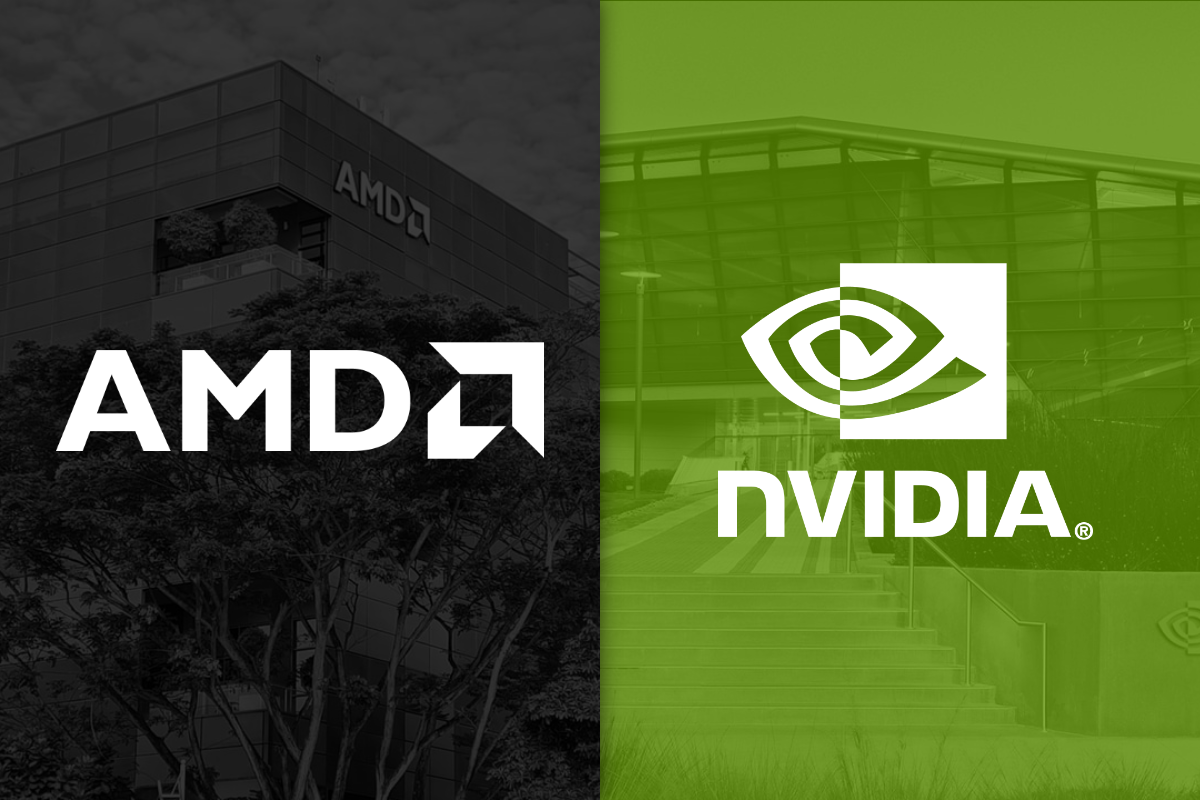
Nvidia and AMD have emerged as the largest AI stock winners of the past decade, up over 16,320% and 9,770% respectively, but they are now positioned in different parts of the AI value chain. Nvidia dominates AI model training through its entrenched CUDA software platform and has built an end-to-end AI infrastructure business, while AMD is gaining ground in inference (where AI produces outputs) and agentic AI. Although AMD trades at a much higher valuation (39.5x forward P/E versus Nvidia's under 16x), its smaller size and positioning in two rapidly growing segments suggest it may have more upside over the next decade.
Summaries like this, in your inbox every morning.
Sign up free →What happened
A strategic analysis compares Nvidia and AMD's AI chip positions. Nvidia built dominance in AI model training through its CUDA software platform and has expanded into a complete AI infrastructure company through acquisitions including Mellanox and Groq. AMD, historically behind in training, has strengthened its position for inference (where AI produces answers) and announced an acquisition of MEXT, a memory optimization company, to compete in cost-effective AI server solutions.
Why it matters
The two chips address different parts of AI's value chain. Nvidia's forward price-to-earnings ratio stands at under 16 times fiscal 2028 estimates, while AMD trades at a 39.5x one-year forward P/E, reflecting different growth expectations. AMD's smaller market cap—less than $900 billion(約140兆円) compared to Nvidia's $5 trillion(約800兆円)—and positioning in two emerging areas (inference and agentic AI, which requires CPUs) suggest it may face less headwind from sheer scale, though at a higher current valuation.
What to watch
AMD has two $100 billion(約16兆円) GPU inference deals in place and sees a $120 billion(約19兆円) addressable market in agentic AI as the GPU-to-CPU ratio shifts from 8:1 for training to 1:1 for agentic AI. The inference market is expected to eventually grow larger than the training market. Both companies remain well-positioned for long-term AI infrastructure demand, but their near-term growth drivers differ significantly.
No comments yet. Be the first to share your thoughts!
Log in to join the discussion



Get curated AI news from 200+ sources delivered daily to your inbox. Free to use.
Get Started FreeFree · takes 30 seconds · unsubscribe anytime
5 minutes a day. The AI essentials.
200+ sources · Email / LINE / Slack
