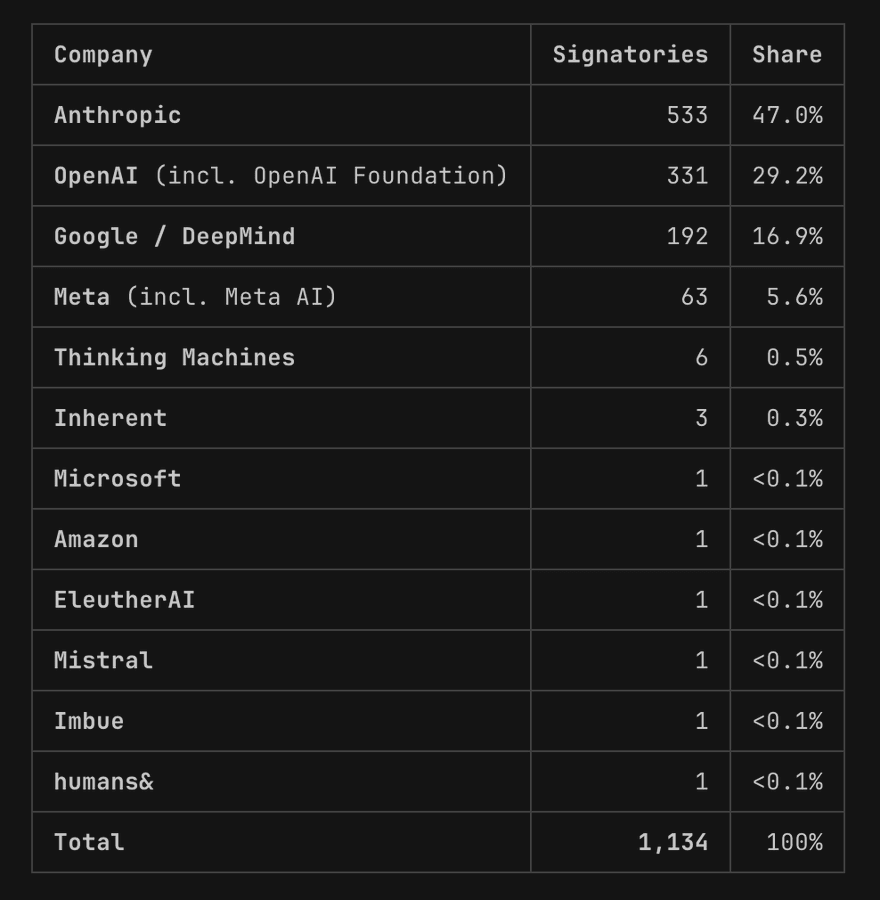
More than 1,200 employees of frontier AI labs, including senior staff, have signed an open letter calling for the ability to pace AI capability development. The letter warns that leading AI companies may be close to automating AI research itself, creating a risk that progress could accelerate beyond the industry's ability to understand or control the resulting systems. Both OpenAI and Anthropic have already endorsed the letter.
Summaries like this, in your inbox every morning.
Sign up free →What happened
An open letter signed by 1,224 employees across leading AI companies—including many senior figures—and endorsed by both OpenAI and Anthropic calls for the ability to pace AI capability development. The letter expresses concern that AI companies may be approaching the automation of AI research itself, which could accelerate capability development beyond their ability to understand or control resulting systems.
Why it matters
The letter signals that significant portions of the workforce inside frontier AI labs themselves believe the industry needs mechanisms to slow down and manage risks as capabilities grow. This internal pressure from employees—rather than external advocacy—may carry weight in influencing how leading AI companies approach safety and development velocity going forward.
What to watch
The letter has already secured endorsement from both OpenAI and Anthropic, the two largest frontier AI companies named in the signatories. Whether other major AI companies endorse it and whether it translates into concrete policy or governance changes at these labs remains to be seen.
On the preceding day before publication, an open letter signed by 1,224 employees across frontier AI labs circulated. The signatories include many senior and prominent figures within those organizations. The letter has been endorsed by both OpenAI and Anthropic. The core claim is straightforward: while AI could help create a dramatically better future, that outcome is not guaranteed. The letter states that the world's leading AI companies believe they could be close to automating AI research itself. The authors acknowledge it is difficult to predict exactly how much this will accelerate AI progress, but they identify a real risk that capability development could rapidly accelerate beyond the industry's ability to understand or control the resulting systems. The letter argues that to realize AI's potential and address emerging risks, industry, government, and society at large may need the option to buy time. The letter was framed by at least one prominent observer as the most important open letter in years, and its circulation increased confidence that organizations could secure a positive future, both because of the potential impact of the letter itself and because it provides evidence that such a letter can gain this level of institutional support from inside frontier labs.
The letter represents a notable moment in AI governance discourse: it is internal pressure from employees themselves, not external activists or regulators, calling for mechanisms to manage the pace of AI development. The fact that 1,224 workers across multiple frontier labs were willing to sign—and that both OpenAI and Anthropic moved quickly to endorse—suggests a shared acknowledgment within the industry that uncontrolled acceleration of capability development poses genuine risks. The specific concern about automating AI research itself reflects a technical threshold the industry may be approaching; if AI systems begin to meaningfully advance AI research without human oversight, the feedback loop between capability and deployment could become difficult to manage. Whether this letter translates into binding governance structures or remains symbolic remains unclear, but its internal origin and rapid endorsement by the two largest named companies suggest it may carry more organizational weight than typical external safety advocacy.
AI-summarized, only the topics you pick — one digest a day via Email, Slack, or Discord.
Free · takes 30 seconds · unsubscribe anytime
No comments yet. Be the first to share your thoughts!
Log in to join the discussion


Get curated AI news from 200+ sources delivered daily to your inbox. Free to use.
Get Started FreeFree · takes 30 seconds · unsubscribe anytime