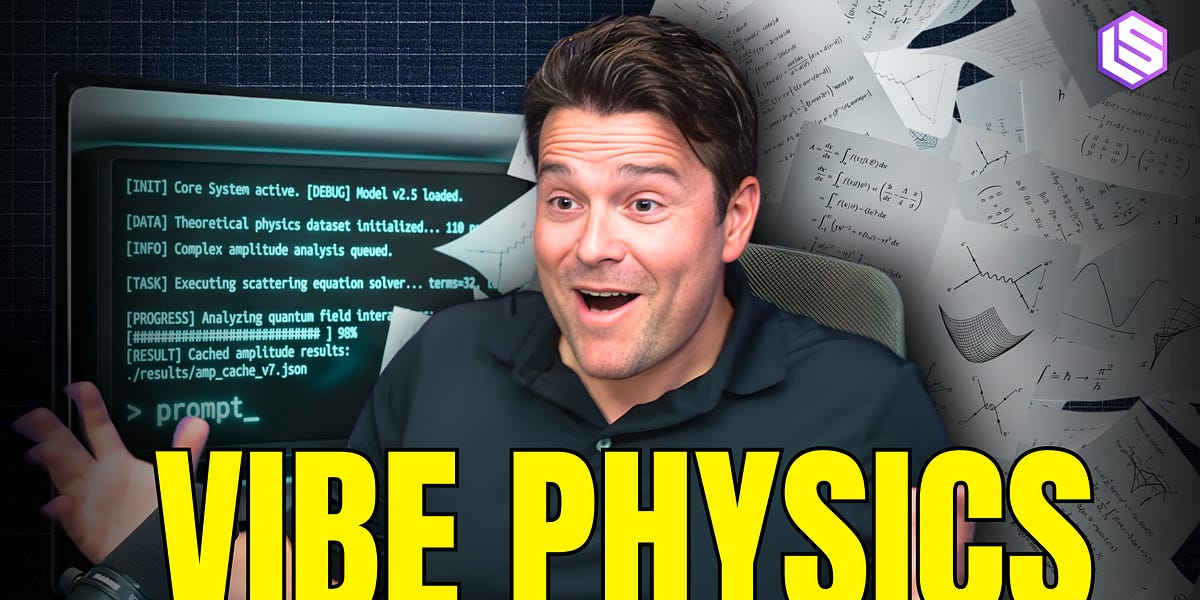
Alex Lupsasca, a theoretical physicist who won the 2024 New Horizons in Fundamental Physics Breakthrough Prize, joined OpenAI's Science team in October 2025 to push AI's ability to accelerate physics research. Working with Prof. Andrew Storminger at Harvard and collaborators from the Institute for Advanced Study, Vanderbilt University, and Cambridge University, the team used GPT-5.2 to derive a new result about gluon tree amplitudes—quantities that physicists expected would not occur under certain conditions—which a human team had spent over a year unable to solve.
ChatGPT solved the gluon problem in one week by identifying a limiting case (the 'half-collinear regime') that simplified the problem into an intuitive formula, then proved it using a technique unknown to the authors. In a separate effort, the team prompted ChatGPT to generate equivalent research for gravitons (proposed particles combining gravity and quantum mechanics), and the model produced 110 pages of novel physics, new calculations, and novel techniques over the course of a day, generating results in less than three days total that the team spent the next three weeks verifying.
The key difference Lupsasca emphasized is that this 'vibe physics' extends the frontier of human knowledge rather than recombining existing work—the graviton results imported new techniques necessary due to gravitons' nature and applied them correctly, yielding physics that had never been done before, even though the results appear in retrospect as natural extensions of existing knowledge.
Summaries like this, in your inbox every morning.
Pick your industry and the AI tools you use, and get news related to your work every day.
Free · 30 seconds with Google · unsubscribe anytimeWhat is AIToday? →
Ask AI anything about this article. The AI reads this article, earlier AIToday articles, and Wikipedia, and cites its sources. Q&As are published on this page for other readers too.
In Q2, billionaires or their funds sold six 'Magnificent Seven' AI stocks

Nvidia was rising early Friday, even as the wider chip sector kept falling, Barron's reported

ElevenLabs completed a $300 million employee tender at a $22 billion valuation, and co-founder Mati Staniszews…

On October 15, OpenAI announced the Rosalind Academic Plan, giving approved US university labs free access to…

Neostellar Capital principal Evan Schlossman said CoreWeave's $103.7 billion in remaining performance obligati…

A Qiita article compared automated red-teaming methods for LLM apps — GCG, PAIR, and TAP — using mock implemen…


