What happened
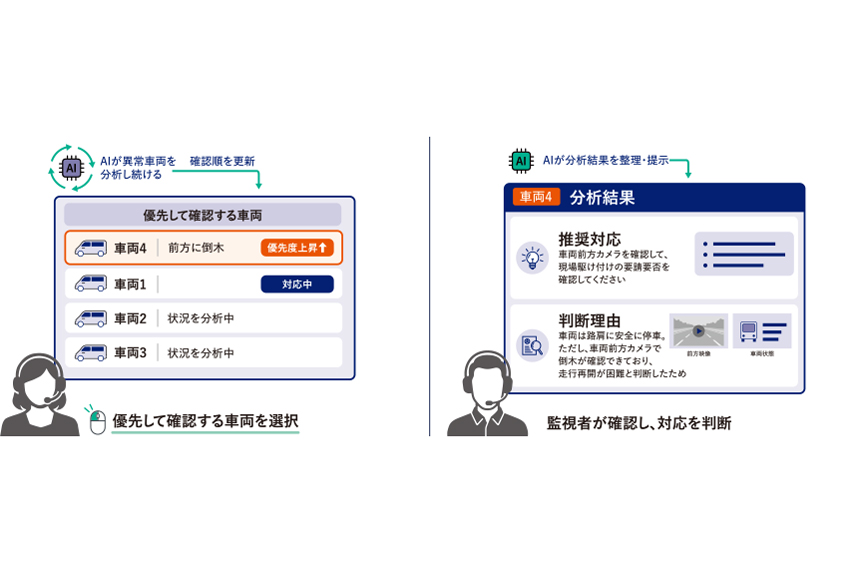
KDDI developed an AI agent for 1対N remote monitoring in レベル4 autonomous driving. It analyzes each stopped vehicle's situation and changes, ranks response priority, and shows supervisors recommended actions with reasons.
Why it matters
Level 4 remote-monitoring operations require a certified supervisor and are meant to scale despite labor shortages. If one person can safely watch many vehicles, operating costs could fall as fleets grow.
What to watch
KDDI starts a demonstration at モビリティコントロールセンター in November, simulating many simultaneous anomalies, and targets early social implementation from 2027 onward.
WHO IT HITSIt lands on operators of remote-monitoring centers for autonomous and on-demand transport services, where a limited number of certified supervisors must cover growing fleets, and on the municipal and transport-operator clients KDDI and KDDI Smart Mobility support.
Summaries like this, in your inbox every morning.
KDDI's move sits inside a regulatory setup: remote-monitoring Level 4 services must have a remote monitoring system and a 特定自動運行主任者 who checks vehicle status and handles anomalies. That requirement makes the supervisor a bottleneck as fleets grow, which is why KDDI frames 1対N型遠隔監視 as important for expanding autonomous vehicle deployment while reducing operating costs under labor shortages.
The hard part KDDI targets is not spotting a single anomaly but handling several at once. When multiple vehicles stop, a supervisor has to grasp each vehicle's condition and surroundings in real time and decide quickly which one to handle first. The agent keeps analyzing conditions after a stop — such as debris flying in or surrounding traffic changing — and updates priority even while the supervisor is busy with another vehicle, using a VLM (vision-language model) to combine camera images with vehicle data and show the recommended action and its reasoning.
KDDI and KDDI Smart Mobility already support municipalities and transport operators from introduction through operation of autonomous and on-demand transport, including remote monitoring via the モビリティコントロールセンター. The November demonstration there, simulating simultaneous anomalies and post-stop changes, is positioned as the validation step before KDDI aims for early social implementation from 2027 onward.
Pick your industry and the AI tools you use, and get news related to your work every day.
Free · 30 seconds with Google · unsubscribe anytimeWhat is AIToday? →
Ask AI anything about this article. The AI reads this article, earlier AIToday articles, and Wikipedia, and cites its sources. Q&As are published on this page for other readers too.
OpenAI's GPT-5.6 Sol found two critical PHP vulnerabilities, CVE-2026-109618 and CVE-2026-109619, collectively…

Impress is publishing a book on October 22 featuring 100 practical "oshi-waza" ideas for Gemini Notebook (form…

KDDI, Okinawa Cellular and KDDI Digital Life added ChatGPT 5.5, ChatGPT 5.5 Pro and ChatGPT 5.5 Thinking to po…

Anthropic released a research preview of Claude Duet, an always-on agent built on Claude Opus 5.5, first for U…

Google and OpenAI said the GPT-6 Astra, GPT-6.1 Sol and GPT-6 Luna models will be offered via Model Garden, wi…

OpenAI expanded ChatGPT ads to 26 new countries, reaching 89 markets worldwide, and says over 100,000 advertis…