AIToday
Large Language ModelsAI Coding AssistantsDaily Dose of Data SciencePublished: Aug 10, 2026, 06:00 JST6 min read

10-week roadmap teaches engineers to deploy LLMs in production

10-week roadmap teaches engineers to deploy LLMs in production

Key takeaway

  • A new 10-week learning plan teaches AI engineers how to deploy and optimize large language model inference services in production, covering everything from memory-bound decoding to load testing and cost modeling.

  • The curriculum emphasizes that most work is harness design—measuring latency, throughput, and queue depth, tuning quantization and caching strategies—rather than choosing a model, and encourages a phased approach where teams start with non-ML baselines and simple models before moving to complex architectures.

3 Key Points

  1. What happened

    A structured 10-week learning plan with 50 sessions teaches AI engineers how to build, deploy, and optimize inference services for large language models, covering topics from the roofline model and vLLM to load testing at 1,000+ concurrent requests and building a reproducible benchmark published on GitHub.

  2. Why it matters

    Most AI engineers lack a systematic path to production-grade inference work; this roadmap bridges theory and hands-on practice, showing how to measure performance (TTFT, inter-token latency, throughput, queue depth) and tune for cost and latency rather than jumping straight to deep learning or model selection, which often wastes effort.

  3. What to watch

    The roadmap also surfaces a broader principle—ML systems should evolve through phases starting with non-ML baselines (rules, heuristics) before adding simple models (logistic regression, decision trees), then tuning features and hyperparameters, and only then moving to complex deep learning—encouraging teams to validate each stage before scaling complexity.

In Depth

Read the full story

The newsletter contains two major sections: a detailed technical comparison of agent design patterns, and a 10-week learning roadmap for inference engineers.

On agent design, the authors contrast two approaches used in web navigation tasks. ReAct (Reasoning-Acting) is a single loop in which one model writes a thought about what to do next, takes an action, reads the observation, and appends all three to the same prompt, repeating until the task is done. Nothing leaves the prompt. When a search from step three fails, that failure stays in the context, competing with the original objective for the model's attention. Plan-and-Act splits this into two jobs: a planner reads the user query and initial page and writes high-level steps, while an executor reads the plan, task, and current HTML, then emits one grounded action. After each step, the executor strips the HTML it no longer needs, so the context does not grow like a ReAct trace.

The efficacy of Plan-and-Act depends heavily on plan granularity and specificity. A good step covers one unit of work—"search for the product in the search box"—rather than a single click or an abstract directive like "analyze the search results." The planner must also name actual values: the paper asks for "input New York as the arrival city" instead of "input the arrival city," because the latter leaves the executor to guess. Critically, the authors found that a badly trained planner makes things worse than no planner at all. On WebArena-Lite, a ReAct-style executor with no planner scored 36.97%, but the same executor with a naively finetuned planner scored just 20.60%, because the planner wrote steps that sounded correct but matched nothing on the page. A properly trained planner reached 43.63%. Even then, a plan written once and never revised fails: if a search for "library at CMU" returns no results, the executor still holds a step that cannot work and keeps trying it anyway. When the planner replanned after each action and rewrote the step to "libraries near CMU," the score rose to 53.94%. The cost is one planner call per executor step, though the authors suggest letting the executor decide when a replan is needed. The core insight is that nearly all of this is harness design, not model choice.

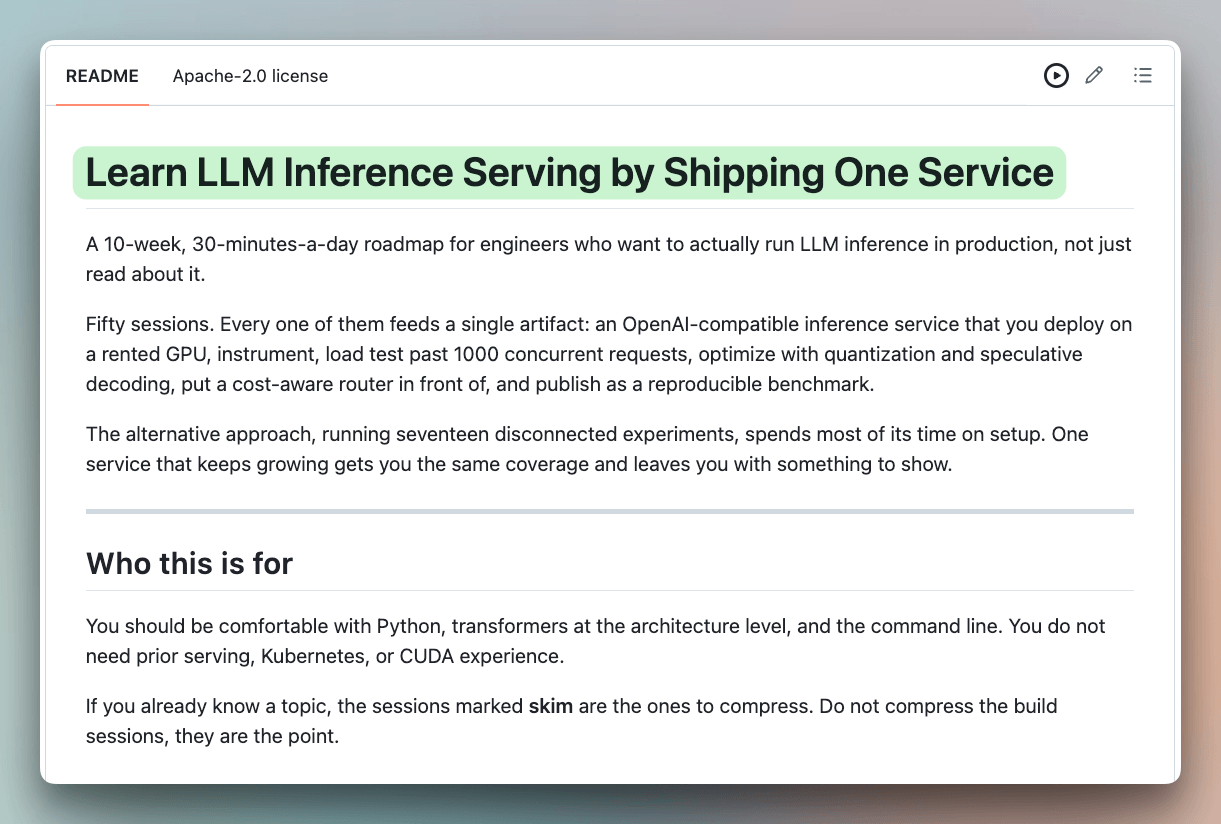
The second section outlines a 10-week roadmap for AI engineers to learn inference engineering. The plan consists of 50 sessions at 30 minutes a day, splitting between reading theory and building an inference service deployed, instrumented, load tested beyond 1,000 concurrent requests, tuned, and published as a reproducible benchmark on GitHub. Key topics include the roofline model and why decode is memory-bound; deploying vLLM and SGLang and reading their schedulers; understanding paged attention from code; building observability with TTFT (time to first token), inter-token latency, throughput, and queue depth tracked in Grafana and Prometheus dashboards; turning on prefix caching; learning continuous batching and chunked prefill; running load tests at 1,000+ concurrent requests and reporting p50, p95, p99 (never just the mean); mastering quantization tradeoffs (FP8, INT4, AWQ, GPTQ); learning speculative decoding and its limits; setting up KV cache eviction for long contexts; trying disaggregated prefill and decode serving; learning Kubernetes for AI workloads and autoscaling on queue depth; understanding how inference costs affect unit economics; building a model router based on cost, latency, and quality; and creating a token budgeting system per request.

The newsletter also outlines a phased approach to ML model development. Phase 1 begins with a non-ML baseline—a rule, heuristic, or deterministic strategy, such as recommending the top-10 most popular movies to every user. These are fast to build, easy to reason about, and set a minimum performance bar. Phase 2 introduces the simplest possible ML model: logistic regression, a shallow decision tree, k-nearest neighbors, or a basic linear model. The goal is not peak accuracy but to answer foundational questions: can we train on historical data and get sensible predictions, are the features informative, and does the model generalize better than the heuristic? Phase 3 focuses on extracting value from the existing approach through feature engineering, hyperparameter tuning, and more data—where returns on investment are often highest. Many real-world ML systems stop here; a well-tuned logistic regression, gradient boosted tree, or modest ensemble can meet production requirements without the complexity of deep learning. Phase 4 moves to fundamentally more complex models—deep neural networks, transformers, or large pretrained architectures—and should only be entered when simpler approaches are exhausted. At every phase, the previous phase's best model becomes the baseline, encouraging incremental progress and disciplined decision-making.

Context & Analysis

The newsletter addresses a critical gap in AI engineering: most engineers know how to train models, but far fewer know how to deploy them efficiently at scale. The 10-week roadmap tackles this by grounding the curriculum in observable, measurable outcomes—throughput, latency percentiles (p50, p95, p99), queue depth—rather than abstract best practices. It codifies the hard-won lessons of inference optimization: that decoding is memory-bound (not compute-bound), that prefix caching and continuous batching unlock real savings, and that speculative decoding has known limits.

The plan also embeds a second, quieter lesson about agent design and general ML systems. The comparison between ReAct and Plan-and-Act shows that a poorly designed harness—one that accumulates failed context—can hurt performance more than no planner at all (20.60% vs. 36.97%). This echoes the phased ML development framework: starting simple, validating incrementally, and resisting the urge to add complexity until earlier stages are exhausted. A well-tuned logistic regression often outperforms a hastily trained neural network, and a naively finetuned planner can drag down a competent executor. The lesson is consistent: engineering discipline and measurement beat raw model power.

FAQ

How long is the learning plan, and what does it teach?
The plan spans 10 weeks with 50 sessions at 30 minutes a day. It covers theory and hands-on building of an inference service, including the roofline model, vLLM and SGLang deployment, paged attention, observability dashboards, continuous batching, load testing at 1,000+ concurrent requests, quantization, speculative decoding, and KV cache eviction.
What is the Plan-and-Act pattern, and how does it differ from ReAct?
ReAct runs one model in a single loop, appending every thought, action, and observation to the same prompt; failed steps stay in context and compete for the model's attention. Plan-and-Act splits the task into two jobs: a planner writes high-level steps once, and an executor reads the plan and current state, takes one action, then strips unnecessary context before the next step. On WebArena-Lite, a properly trained planner with replanning after each action reached 53.94%, compared to 36.97% with no planner.
What are the phases of ML model development described in the newsletter?
Phase 1 is a non-ML baseline (rules or heuristics). Phase 2 introduces the simplest possible ML model (logistic regression, decision tree, k-nearest neighbors) to validate the end-to-end pipeline. Phase 3 extracts value through feature engineering, hyperparameter tuning, and more data—where returns on investment are often highest. Phase 4 moves to complex models like deep neural networks or transformers, only after simpler approaches are exhausted.
Daily Dose of Data ScienceRead Original Article

Get the latest Large Language Models news every morning

AI-summarized, only the topics you pick — one digest a day via Email, Slack, or Discord.

Free · takes 30 seconds · unsubscribe anytime

Ask AI

Ask AI anything about this article. Q&As are published on this page for other readers too.

Related Articles

Next articleWriting With AI Is Not New — The 2,400-Year Argument Against It

The AI news that matters, in one minute each morning.

Sign up free