What happened
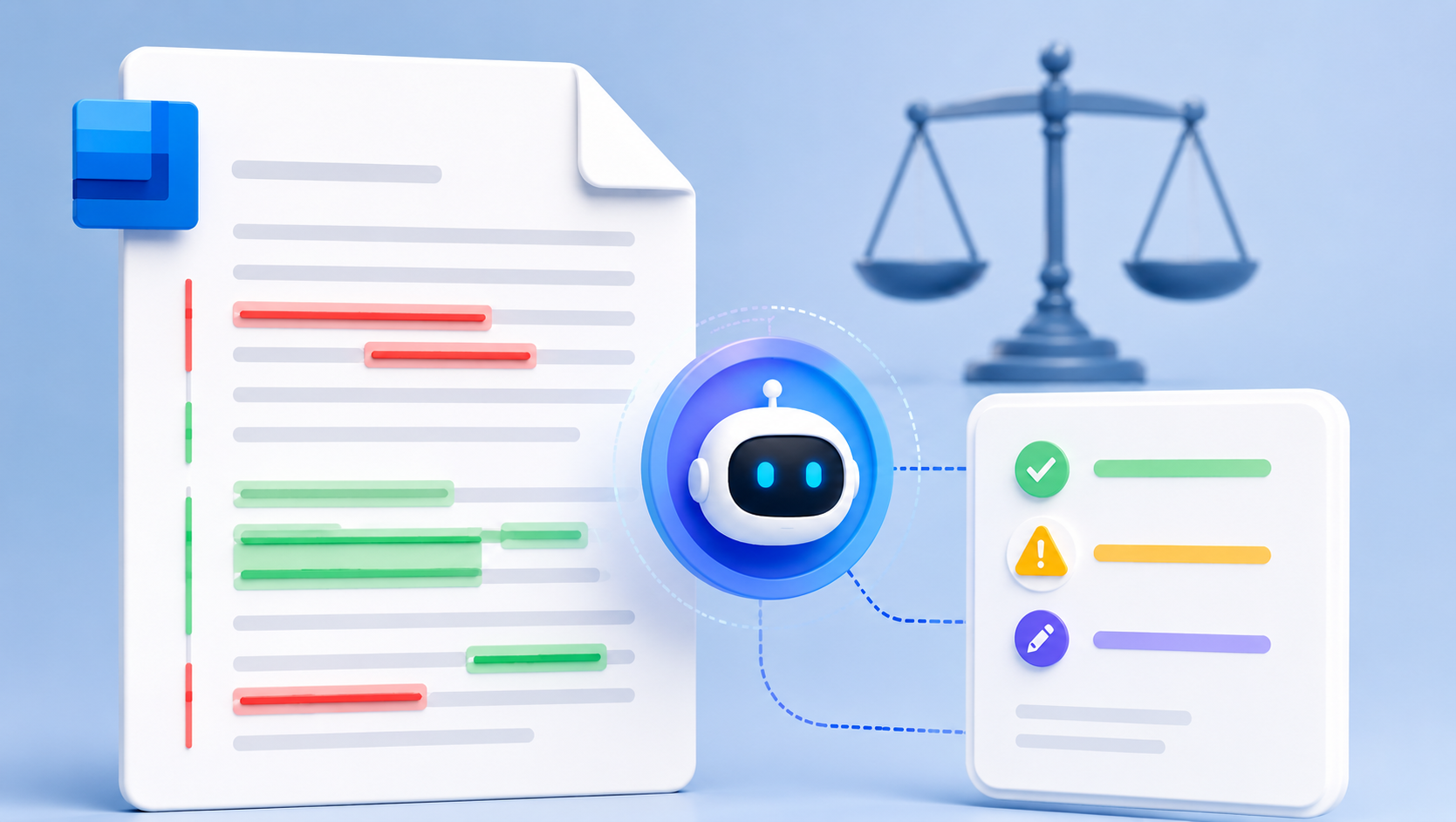
Uber built its Legal Redlining Agent inside Microsoft Word, and since launching with its Legal team it has seen an over 20% reduction in average contract review time and 91% accuracy in AI-generated decisions.
Why it matters
The agent reviews client edits, recommends policy-aligned responses and flags risks while leaving the final call to lawyers, so legal teams may free up time for complex judgment calls rather than losing oversight.
WHO IT HITSIn-house legal teams handling high-volume contract negotiations are the clearest beneficiaries, since the agent drafts recommendations and comments while lawyers keep the accept, reject or modify decision. Legal operations and AI platform teams building similar tools may also look to Uber's iterative approach.
Summaries like this, in your inbox every morning.
Uber says it started building the first generation of the Legal Redlining Agent in early 2024 and continued through 2025, before today's agent harnesses were widely available. The team began with the business problem rather than the model: a steady stream of contract negotiations involving substantial repeatable redline work. That framing shaped a key design choice, building the assistant as a Microsoft Word add-in rather than a standalone web application, on the reasoning that asking lawyers to copy-paste between tools would kill adoption.
The first attempt was a RAG system built on Legal team playbooks and negotiation examples. Uber reports it ran into three problems: imprecise semantic similarity, tone that swung between overly defensive and excessively positive, and effectively random responses on scenarios the playbooks did not cover. That pushed the team toward a self-learning loop capturing the lawyer's decision, expected action, comments and final modified text. Uber describes this granular data as a turning point, letting the system map a counterparty's intent to the lawyer's precise language. Later iterations added a dedicated tone-modulation step and an agentic workflow for drafting counter-proposals, plus a rules database for frequently modified template language.
Under the hood, Uber describes a thin-client architecture: the Word add-in handles document interaction, while a Python back end orchestrates the AI work, using OpenSearch vector stores as the memory layer and Redis for session state. A hybrid decision engine separates non-negotiable policies, handled by a deterministic rules engine, from negotiable nuances handled by the probabilistic feedback loop. Uber says it is now exploring agentic harnesses such as Claude Code and OpenCode, along with legal ontologies and knowledge graphs.
Pick your industry and the AI tools you use, and get news related to your work every day.
Free · 30 seconds with Google · unsubscribe anytimeWhat is AIToday? →
Ask AI anything about this article. The AI reads this article, earlier AIToday articles, and Wikipedia, and cites its sources. Q&As are published on this page for other readers too.
The Lost Bros, founded in 2016 by brothers Cody and Colton Tapolerm, posted side-by-side comparisons on Instag…

The Motley Fool named six stocks — Bloom Energy, Plug Power, Eaton, Vertiv, GE Vernova, and NextEra Energy — a…

Wells Fargo raised its Palo Alto Networks price target to a Street-high $475 from $420 on Aug

In a New York Times opinion essay, Steven Rattner argued the U.S

S&P Global introduced AI features to Capital IQ Pro, including ChatIQ research tools, AI-driven modeling capab…

Pfizer says broader roll out of AI and advanced analytics across R&D, manufacturing and commercial operations…