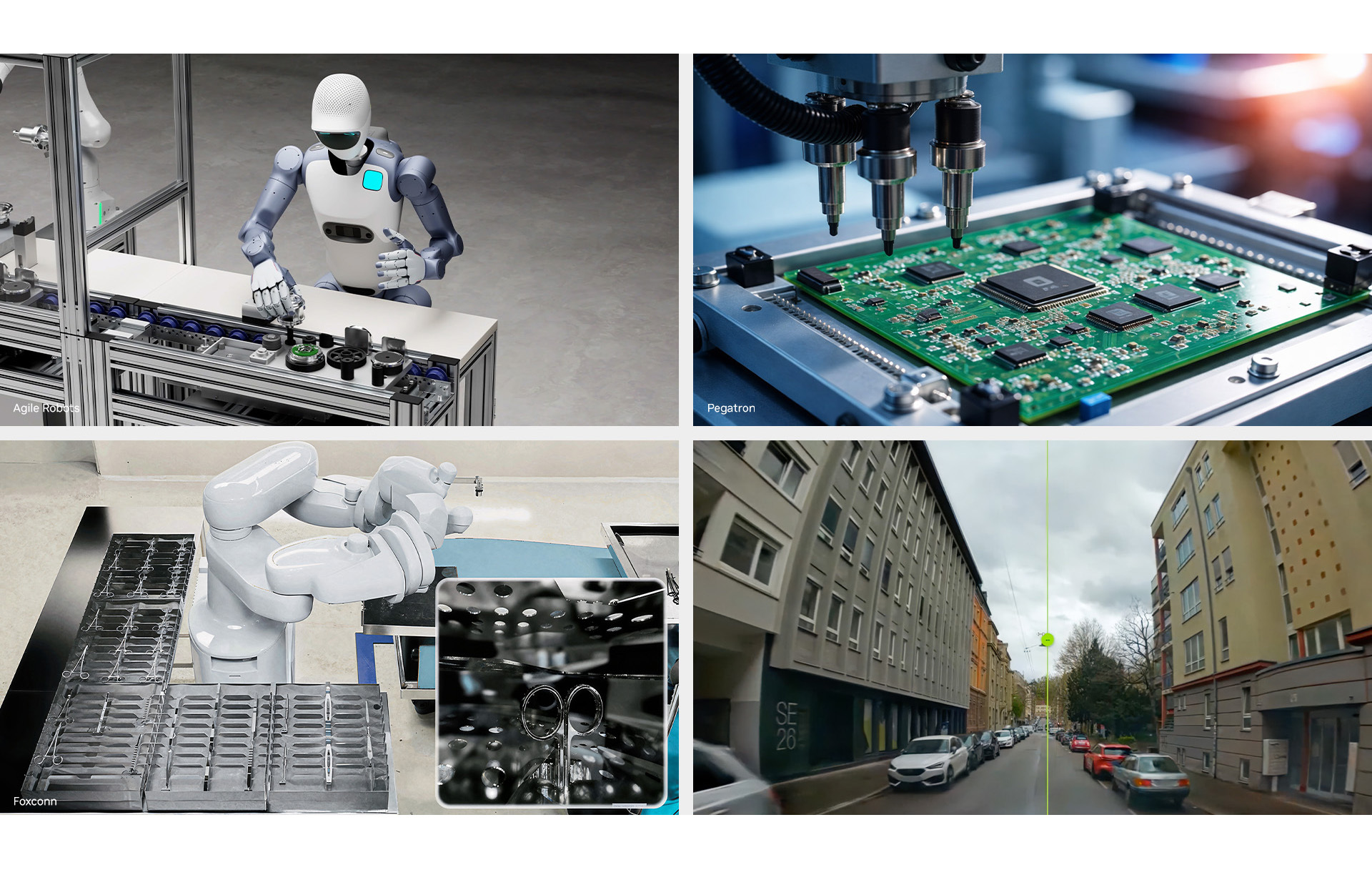
NVIDIA revealed open-source physical AI skills and tools at GTC Taipei and Computex, designed to help developers of robotics, autonomous vehicles, visual AI, and industrial digital twins reduce costs, time, and complexity of building physical AI workflows. The company is turning its libraries, models, and frameworks into agent-callable tools, including Cosmos 3 world foundation models, Omniverse libraries, Isaac for robotics, Metropolis for vision AI, Alpamayo for autonomous driving, and Jetson for edge AI.
The skills enable agents to automate repeatable development processes: robotics developers can generate perception and mobility training data and run simulations; autonomous vehicle teams can reconstruct fleet data into simulations and run closed-loop reinforcement learning; industrial software developers can convert CAD data into digital twin simulation environments. Developers can safely deploy agents using the NVIDIA NemoClaw blueprint and OpenShell runtime, which provides policy-based security and privacy governance.
Robotics companies including 1X Technologies, Agile Robots, Agility, FieldAI, Hexagon Robotics, NEURA Robotics, Skild AI, and Universal Robots are already using the stack. Pegatron reduced model training and deployment time by 67% using synthetic data from the Defect Image Generation skill; Delta Electronics improved detection rate by 17%; Inventec reduced defect data collection effort by 30%. Alpamayo 2 Super has been downloaded over 500,000 times.
Summaries like this, in your inbox every morning.
Pick your industry and the AI tools you use, and get news related to your work every day.
Free · 30 seconds with Google · unsubscribe anytimeWhat is AIToday? →
Ask AI anything about this article. The AI reads this article, earlier AIToday articles, and Wikipedia, and cites its sources. Q&As are published on this page for other readers too.
Mastercard is testing a new intelligence layer in its Agent Pay Trust Framework in the United States that prod…

The iShares Semiconductor ETF, which holds leading AI chip suppliers, is in bear territory after declining mor…

In a decision dated September 24, 2026, the Aachen Regional Court banned Google from spreading three false AI…

Three designs for turning encoded inputs into predictions: pooling all inputs into one shared vector, applying…

Across 24 counted runs of /code-review on a 41-line shopping-cart file with six planted bugs, --max-findings 1…

The tutorial, based on official Claude Code documentation and checked as of October 18, 2026, says failed fixe…

