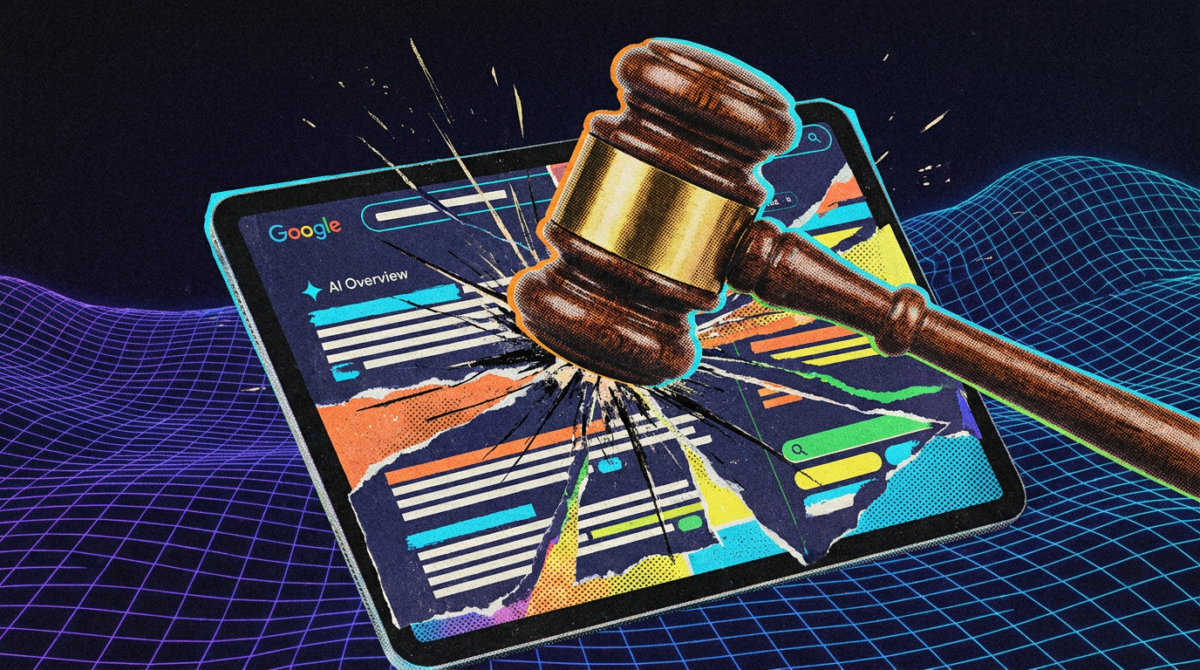
What happened
In a decision dated September 24, 2026, the Aachen Regional Court banned Google from spreading three false AI Mode text variants about a physician, citing the Munich Regional Court I's ruling that AI answers are Google's own statements; violations carry fines up to 250,000 euros.
Why it matters
The injunction treats AI-generated answers as Google's own content rather than neutral search results, so Google must answer for false statements its system produces; the decision is not yet final and Google can challenge it.
WHO IT HITSPublishers and individuals named in AI-generated search summaries gain a clearer route to court injunctions in Germany, while Google's legal teams face per-violation fines of up to 250,000 euros for failing to remove disputed AI text.
Summaries like this, in your inbox every morning.
The Aachen decision did not arrive in a vacuum. In late May, the Munich Regional Court I had already classified AI Overviews as Google's own statements rather than mere search results, in a case where Google's AI falsely linked two Munich-based publishers to fraud schemes. Google publicly announced an appeal, but that appeal never reached a decision — the case settled instead, leaving the Munich reasoning untested by a higher court.
The Aachen case shows that settlement did not bury the argument. A physician who had served as chief physician and professor of neuroradiology until late June 2026 was alerted on August 28 by a colleague that Google's AI was explaining his departure by citing an alleged sexual assault against his secretary. Additional searches returned detailed fabrications, and the court could confirm from its own records that the criminal case had actually been brought against someone else. Google declined to act on his late-August email and a formal legal demand the same day.
The court's reliance on Munich — noting that Google's AI produces "independent, new, and substantive statements" and could check them against source websites — suggests a consistent legal view is forming across German courts. A further risk for Google: if AI answers count as original content, publishers whose texts feed those answers could eventually assert their own claims, which in the most extreme scenario would require compensating creators for every AI-generated answer.
Pick your industry and the AI tools you use, and get news related to your work every day.
Free · 30 seconds with Google · unsubscribe anytimeWhat is AIToday? →
Ask AI anything about this article. The AI reads this article, earlier AIToday articles, and Wikipedia, and cites its sources. Q&As are published on this page for other readers too.
Anthropic's internal study shows junior new hires in technical departments fell from 27 percent to 9 percent s…
Mastercard is testing a new intelligence layer in its Agent Pay Trust Framework in the United States that prod…

Three designs for turning encoded inputs into predictions: pooling all inputs into one shared vector, applying…

Across 24 counted runs of /code-review on a 41-line shopping-cart file with six planted bugs, --max-findings 1…

The Real Invent CTO grouped reported AI-linked leaks into three types: the model itself broke in, AI became an…
The tutorial, based on official Claude Code documentation and checked as of October 18, 2026, says failed fixe…

