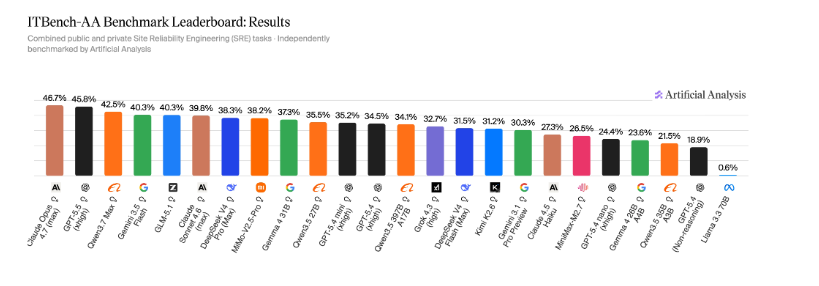
Artificial Analysis and IBM Software Innovation Lab released ITBench-AA, evaluating frontier AI models on agentic enterprise IT tasks starting with Site Reliability Engineering (SRE)—diagnosing Kubernetes incidents by reading logs, tracing dependencies, and identifying root-cause entities. Claude Opus 4.7 (Adaptive Reasoning, Max Effort) leads at 47%, followed by GPT-5.5 (xhigh) at 46% and Qwen3.7 Max at 42%.
The benchmark comprises 59 SRE tasks (40 public, 19 held-out) where models run in a sandboxed harness with shell access to incident snapshots. Scoring uses average precision at full recall: models must identify all ground-truth root causes or score 0.0 for that task repeat; if successful, they receive a precision score equal to true positives divided by true positives plus false positives.
All frontier models score below 50%, making ITBench-AA SRE one of the least saturated agentic benchmarks. Turn counts vary nearly 3x with no correlation to accuracy: GPT-5.5 (xhigh) averages 31 turns at 46%, while Gemini 3.1 Pro Preview averages 83 turns at 30%. Among open-weights models, GLM-5.1 (Reasoning) leads at 40%, tied with Gemini 3.5 Flash (high).
The benchmark and leaderboard are available at the ITBench-AA HuggingFace repo and artificialanalysis.ai/evaluations/itbench-aa; the Stirrup reference harness is open-source.
Ask the AI about this article →
For example, today's edition would include:
AI-summarized, only the topics you pick — one digest a day via Email, Slack, or Discord.
Free · takes 30 seconds · unsubscribe anytimeWhat is AIToday? →
Ask AI anything about this article. Q&As are published on this page for other readers too.
CBTS Technology Solutions LLC launched Forge Agents, a platform that turns a plain-language job description in…
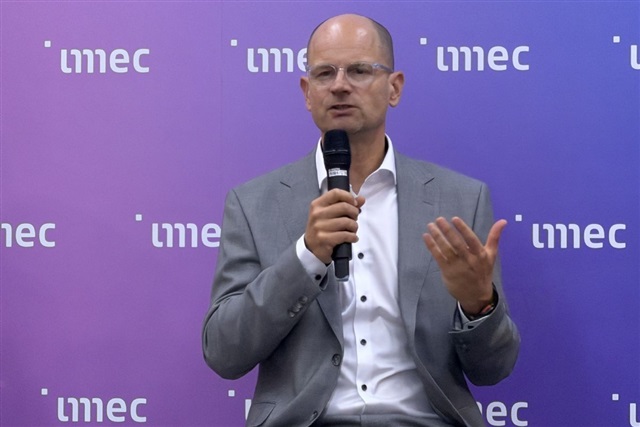
Imec CEO Patrick Vandenameele said at SEMICON Taiwan 2026 that the Belgian research center is broadening its c…
Alphabet's AI Overviews now reach over 2.5 billion monthly users through Google Search, and its ad business ge…
Visual Studio Code 1.135 now includes an experimental 'Rubber Duck' feature that lets developers request a sec…
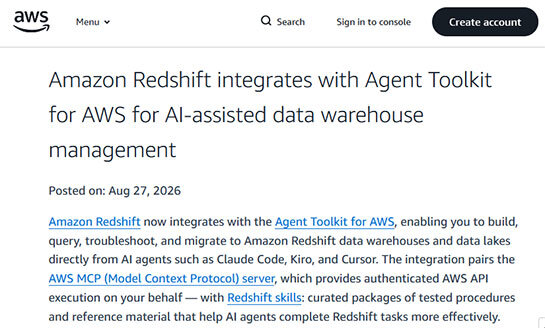
Amazon Web Services (AWS) has integrated its fully managed data warehouse service, Amazon Redshift, with Agent…
Sonos announced a new app update with generative AI features, a new soundbar called the Beam Ultra, and its se…