
What happened
In a piece published 2026.10.06, Thore Graepel said AlphaGo's Move 37 — which stunned commentators in Seoul in March 2016 and helped beat Lee Sedol 4-1 — came from its search mechanism, not intuition.
Why it matters
Graepel's point is that the machine's creativity did not come from a flash of instinct; it came from evaluating how proposed moves would unfold over future sequences, which is what made the move possible.
What to watch
The test is whether AI systems can show how they reached a conclusion — a capability Graepel says is needed in high-risk areas like medicine and science, and one he suggests may now be within reach.
WHO IT HITSResearchers and developers building AI for medicine and science are the ones who would need to demonstrate how a system reached its conclusion, since Graepel argues that verifiable reasoning — not just prediction — is what makes results trustworthy in those fields.
Summaries like this, in your inbox every morning.
The popular telling of AlphaGo's 2016 match against Lee Sedol often reduces Move 37 to a moment of pure machine intuition — a flash of insight so strange that some commentators initially suspected a bug. Graepel, who worked on the program, draws a different line: AlphaGo combined a policy network trained to guess human-like moves with a search mechanism that built a game tree of thousands of branches, letting it compare how proposed moves would play out. That pairing mirrors the distinction Daniel Kahneman popularized between fast, intuitive "System 1" thinking and slow, deliberative "System 2" thinking — with the search providing the deliberation.
The contrast Graepel draws is with today's LLMs, which keep predicting the next token rather than exploring alternatives. That difference matters most where the stakes are high. In medicine and science, he argues, it is not enough for a system to land on an answer; it must be possible to check how it got there. Whether that kind of verifiable reasoning can be built at scale is likely the central question for applying AI in those domains, and Graepel suggests recent progress may be making it more feasible.
Pick your industry and the AI tools you use, and get news related to your work every day.
Free · 30 seconds with Google · unsubscribe anytimeWhat is AIToday? →
Ask AI anything about this article. The AI reads this article, earlier AIToday articles, and Wikipedia, and cites its sources. Q&As are published on this page for other readers too.
Ghost AI raised $11 million, led by Andreessen Horowitz with Abstract, Audacious Ventures, Nova and SV Angel…

The Japanese Red Cross Society ran a survey on AI use in disaster relief

OpenAI will roll out invisible text watermarks to all ChatGPT and Codex plan users in the EU within weeks, and…
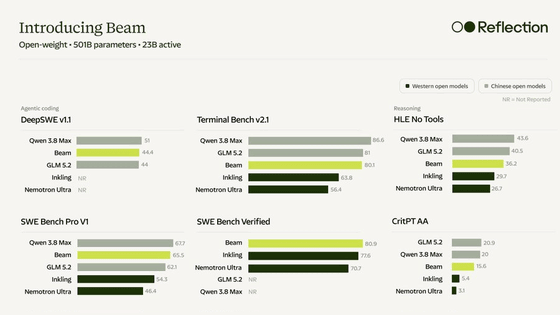
Reflection announced Beam, a 501B-parameter open-weight model with 23B active parameters, claiming parity with…
A Stanford, Carnegie Mellon, UC Berkeley, and Microsoft Research team ran 6,800+ math, coding, and science tas…

Reflection AI launched Beam, a 501 billion-parameter open-source LLM