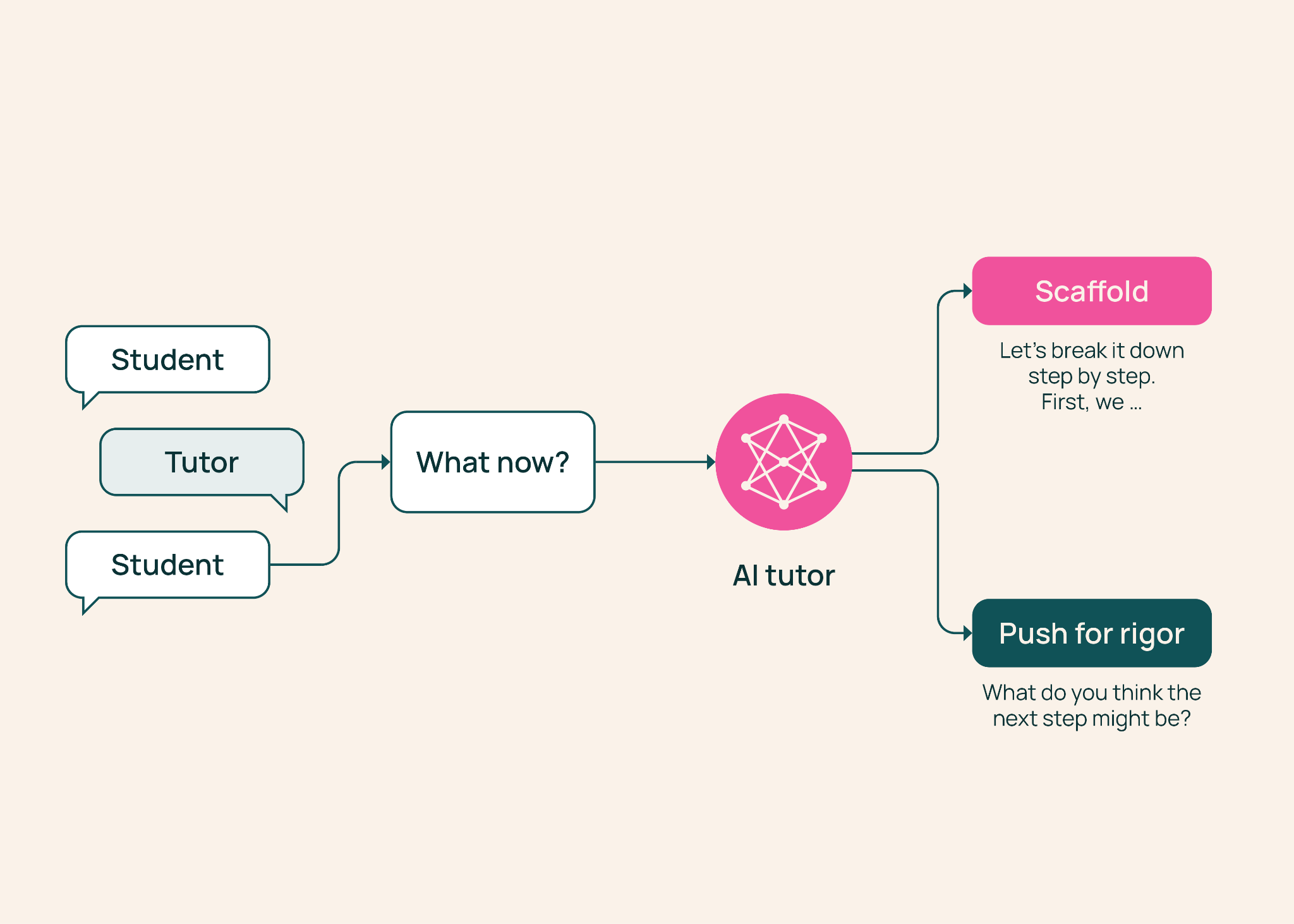
Researchers have created TutorMoments, an evaluation framework that measures how well AI language models make the hard pedagogical choice between scaffolding (simplifying a problem) and pushing students to do deeper reasoning.
Testing seven models on real tutoring transcripts, they found that models with no explicit guidance tend to over-help, and even with detailed prompts that spell out the trade-off, models still perform less reliably than human tutors at adapting to each student's moment—a gap the team is working to close as part of building AI tutors that support rather than substitute for student thinking.
What happened
Researchers introduced TutorMoments, a framework that tests whether large language models can balance two competing tutoring approaches—scaffolding (making problems easier) and pushing for rigor (encouraging deeper thinking). The evaluation uses 462 real tutoring transcripts from U.S. grades 2–7, with over 1,500 teacher-identified decision points where tutors chose between the two strategies.
Why it matters
When given only a generic instruction to "tutor well," models tend to over-help by offering too much support rather than letting students struggle productively. Even when a prompt explicitly spells out the scaffolding-versus-rigor trade-off, models still differ widely in reliability and fall short of human tutors' ability to read the moment—a gap that matters because learning research ties productive struggle to stronger understanding.
What to watch
The framework and dataset are being released for reproducibility. The team notes TutorMoments is still early (currently limited to U.S. elementary and middle-school math) and plans to build toward a larger, multimodal dataset and stronger scoring pipeline as feedback arrives.
TutorMoments emerged from a fundamental question about what makes a good tutor: the ability to read a student's moment and decide whether scaffolding (simplifying the problem) or a push for rigor (encouraging deeper thinking) is the right move. Most existing benchmarks for AI tutors don't capture this tension. They reward one behavior consistently—say, never giving away the answer—without asking whether that behavior fit the student's actual understanding. But tutoring is not a single fixed behavior; it's a judgment call.
The evaluation framework is built on 462 real tutoring transcripts from a U.S. high-dosage tutoring program serving students in grades 2–7, most of whom attend Title I schools. A pool of 27 experienced U.S.-based math teachers read these transcripts and flagged over 1,500 key decision points—moments where a tutor had to weigh scaffolding against pushing for rigor. To evaluate an AI tutor, TutorMoments pauses a transcript at one of these moments and hands the session to a language model, which takes over for five simulated turns with another language model playing the student. An LLM-based scoring pipeline then rates whether the model (1) scaffolded when the student needed support, (2) pushed for rigor when the student was ready, and (3) avoided over-scaffolding. The ground truth comes from teacher annotations: if the majority of annotators judged a moment as calling for rigor, that is the expected move.
Testing seven models with two prompts revealed a sharp divide. Under a plain prompt that only tells the model to "tutor well" using its knowledge of good tutoring, models scored between 0.39 and 0.68 on appropriate scaffolding, 0.04 and 0.18 on appropriate rigor, and 0.37 to 0.54 on avoiding over-scaffolding. When given an evaluation-aware prompt that explicitly spelled out the three options (scaffold, push for rigor, or avoid over-scaffolding), every model's scores rose—but the gains were uneven. The clearest pattern: prompting matters enormously. Models' default helpful-assistant behavior is not enough on its own. However, even the best-scoring models had substantial room for improvement, and they differed widely in how reliably they made the right call.
Breaking down the actual moves revealed another limitation: while the evaluation-aware prompt encouraged models to push for rigor, they relied on fewer strategies than human tutors did, often defaulting to asking students to explain their answers. Human tutors, by contrast, employ a much wider range of moves and are far more likely to step back and let students work independently. The researchers note several important caveats: human tutors scored below the models' best evaluation-aware results, but that's partly because the dataset is built from annotators looking for moments tutoring could have improved, not ideal practice. The numbers also measure tutor behavior at a decision point, not whether a real student actually learned. Finally, the dataset is narrow—U.S.-based, limited to elementary and middle-school math, and annotated by a single pool of educators—so findings may not generalize to other subjects, grade levels, or educational settings. The team is releasing the data, code, and model replays for reproducibility and has committed to building toward a larger, multimodal dataset and stronger scoring pipeline based on feedback.
The tension TutorMoments highlights sits at the heart of educational practice: helpful AI assistants are trained to do the hard work for the user, but in tutoring, doing the work for the student can short-circuit the "productive struggle" that learning research has long tied to deeper understanding. Most existing benchmarks for AI tutors reward single fixed behaviors (never give away the answer, always offer a hint) without checking whether those behaviors fit the student's actual moment. TutorMoments shifts the frame by grounding evaluation in real tutoring data and asking a harder question: can the model read the room and adapt?
The scoring results reveal two layers of limitation. First, models' default behavior under generic prompting is to over-help—a sign that the training objective (be helpful) conflicts with the pedagogical goal (let the student do the work). Second, even when the prompt spells out the trade-off in detail, models improve across the board but remain inconsistent and less reliable than human tutors. The gap is particularly stark on rigor: models rarely push students to explain their reasoning or work independently. The researchers note, importantly, that the evaluation uses a simulated student, so these numbers measure tutor behavior at a decision point, not actual learning outcomes—a limitation the team plans to address as the framework expands.
AI-summarized, only the topics you pick — one digest a day via Email, Slack, or Discord.
Free · takes 30 seconds · unsubscribe anytime
Ask AI anything about this article. Q&As are published on this page for other readers too.
Amazon and Google are intensifying competitive efforts against The Trade Desk (TTD), a major digital advertisi…

OpenAI introduced Premium Seats for ChatGPT Business, priced at $125 per user per month ($100 with annual bill…

Computer scientists at University of Tübingen, Max Planck Institute, MATS Research, and Snyk discovered a meth…

Anthropic pledged to embed machine-readable watermarks in Claude-generated text and digitally signed provenanc…

Anthropic has signed the EU AI Act Code of Practice and will embed invisible watermarks in Claude-generated te…

Meta CEO Mark Zuckerberg published a 6,500-word essay Monday outlining his vision for artificial intelligence…

The AI news that matters, in one minute each morning.
Sign up free