What happened
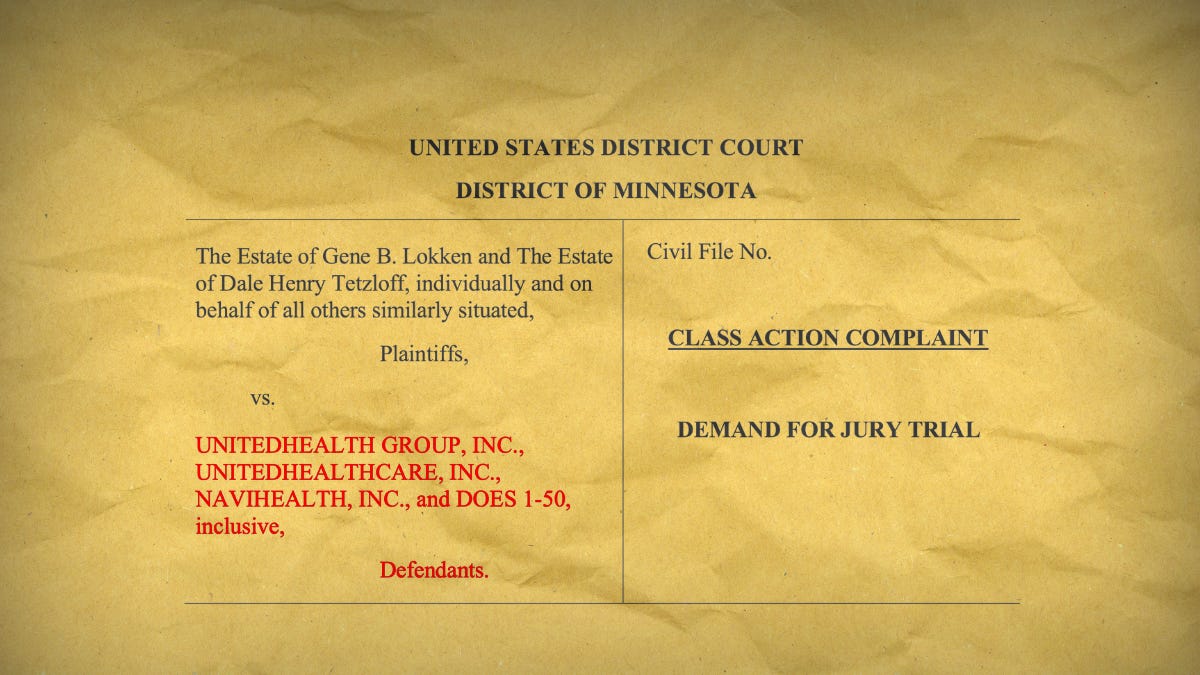
The Estate of Gene B. Lokken v. UnitedHealth Group case, filed in Minnesota federal court in November 2023, survived Judge John Tunheim's February 2025 ruling that federal preemption did not bar breach-of-contract claims, and in March 2026 a magistrate judge ordered UnitedHealth to turn over how nH Predict was built.
Why it matters
The complaint alleges roughly 90% of appealed denials were overturned while only about 0.2% of patients appealed — an asymmetry plaintiffs say the company understood, meaning the case could expose how coverage decisions were made if it proceeds.
What to watch
If the court certifies a class, the case stops being about two families and becomes about a potentially enormous group whose post-acute care was cut short; in the named cases alone, families paid around $220,000 out of pocket.
WHO IT HITSThis lands hardest on Medicare Advantage members who receive post-acute care denials and on the appeals staff and doctors at insurers using similar algorithmic tools, since a class certification could widen liability well beyond the two named families.
Summaries like this, in your inbox every morning.
The current wave of social media posts framed this as breaking news, but the underlying reporting dates to November 2023, when STAT first exposed the algorithm, and the lawsuit itself was filed that same month in Minnesota federal court. What has actually changed is the litigation's momentum: Judge Tunheim's February 2025 ruling that federal preemption did not bar the contract claims created an opening, a March 2026 magistrate order pried loose internal documents on nH Predict's design, and through the summer the case moved toward class certification.
The case sits inside a broader pattern the article lays out. The same nH Predict tool was also used by Humana, which now faces a nearly identical class action, and Cigna is defending a separate suit over a system called PxDx. Meanwhile, Medicare Advantage insurers made nearly 50 million prior authorization determinations in 2023, and post-acute care — where the Lokken denial occurred — has become a particular area of concern.
What the outcome hinges on is whether the court certifies a class and how far Judge Tunheim's preemption reasoning travels. A certified class would turn a two-family dispute into one covering a potentially enormous group of Medicare Advantage members, and a win for the plaintiffs could hand a roadmap to lawyers suing other insurers over algorithmic denials. The damages math, the article notes, turns serious once bad-faith exposure is added across a class.
Pick your industry and the AI tools you use, and get news related to your work every day.
Free · 30 seconds with Google · unsubscribe anytimeWhat is AIToday? →
Ask AI anything about this article. The AI reads this article, earlier AIToday articles, and Wikipedia, and cites its sources. Q&As are published on this page for other readers too.
HBM is approaching half the cost of a GPU-HBM CoWoS package, prompting the question of whether memory remains…

DeepSeek is bringing more of the software it uses to develop its AI models to Huawei Technologies' Ascend 950…

Among respondents at companies with 1,001+ employees, 50.0% said AI is used company-wide, and 46.0% flagged AI…

Oracle invoked "force majeure" to delay payment on its Project Jupiter data center, and its 2056 bonds then tr…

Nvidia released the Open Agent Safety Platform on September 28, days after CEO Jensen Huang called warnings fr…

The Tokyo District Court dismissed Kenjiro Tsuda's demand that TikTok remove AI voice-clone videos, citing pri…