What happened
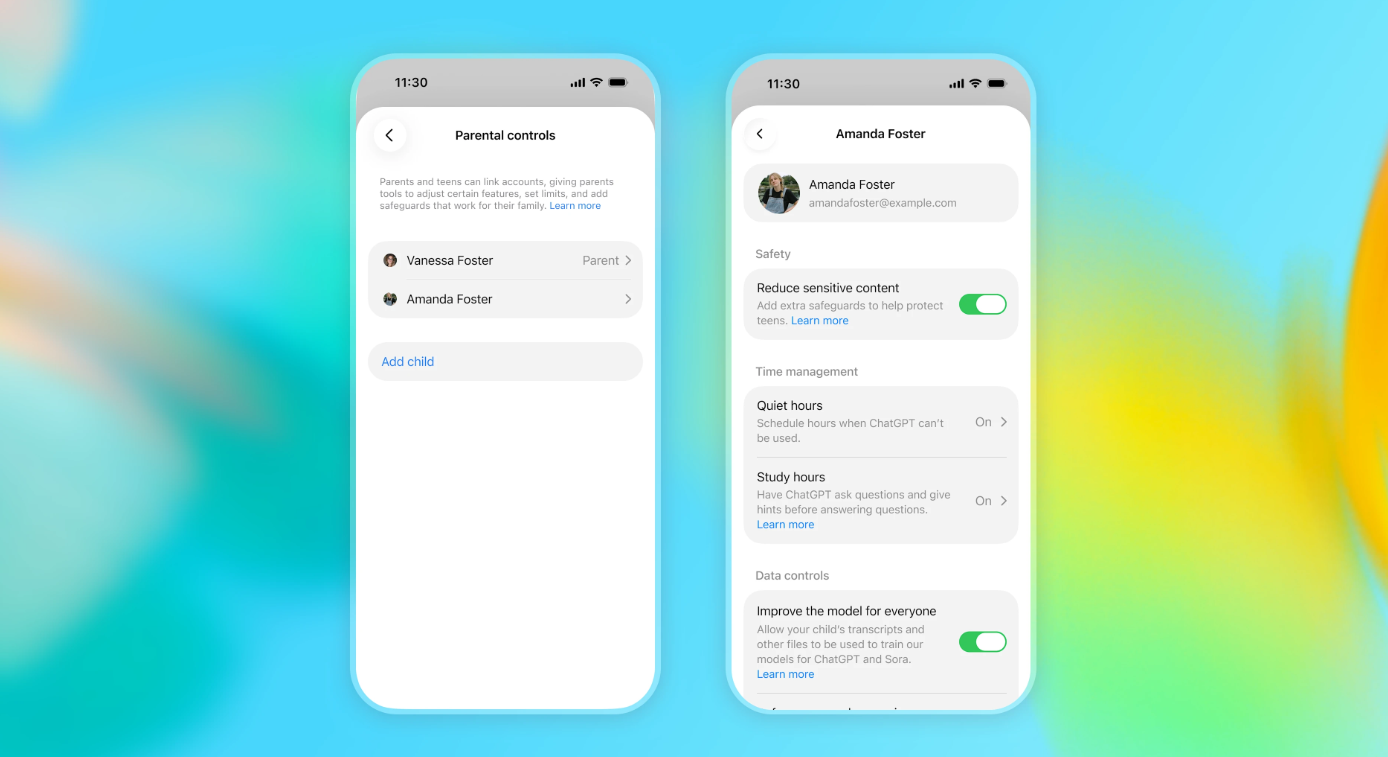
OpenAI announced ChatGPT for Teens, a version of its chatbot designed for users aged 13 to 17 with built-in guardrails that restrict conversations about violence, self-harm, sex, and mental disorders. The model includes a Study Mode for quizzes and study visualizations, and parents can enable parental controls to receive alerts if a teen attempts to engage with restricted topics or track Study Hours.
Why it matters
Lawsuits have alleged OpenAI's chatbot gave unsafe advice to younger users, and research shows as much as 70% of young users turn to chatbots for companionship—a practice OpenAI says can be problematic because teenagers' brains may be more vulnerable to acting on bad advice or forming unhealthy attachments to AI. OpenAI states the product is designed to support real-world relationships and healthy habits, with break reminders and consistent identification of ChatGPT as AI.
What to watch
OpenAI does not use age-verification tools but instead analyzes user inputs to detect age and automatically switch on teen mode if a young person is identified. The company asks all users to state their age at sign-up, though it acknowledges not every person is honest about their age.
Summaries like this, in your inbox every morning.
OpenAI's launch of ChatGPT for Teens comes amid growing legal and social pressure regarding AI safety for minors. The company is currently fighting multiple lawsuits alleging that its chatbot provided unsafe advice to younger users, creating an urgent need to demonstrate responsibility in this demographic. Research cited in the announcement reveals that as much as 70% of young users turn to chatbots for companionship, a trend OpenAI Chief Executive Sam Altman's team is actively studying under the framework of "emotional overreliance." The teen version's design—with guardrails, parental alerts, and study features—attempts to address two intersecting concerns: protecting teens from harmful content and encouraging healthy, bounded engagement with AI rather than unhealthy dependency.
The product's reliance on input analysis rather than age verification reflects a practical trade-off: while easier to deploy at scale, it assumes OpenAI's models can reliably infer user age from conversation patterns. The inclusion of Study Mode and Study Hours tracking signals OpenAI's positioning of AI as an educational tool, attempting to frame the product as supporting real-world learning and relationships rather than replacing them. OpenAI's stated emphasis on break reminders and explicit identification of ChatGPT as AI suggests the company is trying to counter the documented problem of users forming synthetic attachments to the chatbot.
Pick your industry and the AI tools you use, and get news related to your work every day.
Free · 30 seconds with Google · unsubscribe anytimeWhat is AIToday? →
Ask AI anything about this article. The AI reads this article, earlier AIToday articles, and Wikipedia, and cites its sources. Q&As are published on this page for other readers too.
The Motley Fool argues Amazon is the AI company of the two, since AWS was just 21% of first-half 2026 revenue…

Hewlett Packard Enterprise stock is down 5% at $55.87

Cammarata reinterprets InceptionV1's cat-car neuron as a V-shape detector, not two unrelated concepts
Google Deepmind's Gemini 4 Argon scored 97.5 percent on ARC-AGI-3 at a cost of $4,800, second only to GPT-6 As…
Microsoft's Surface Laptop Ultra, using Nvidia's RTX Spark platform, starts at $2,599 (up to $5,899)

Meta's new commercial terms, effective October 30th, appear to let it crawl and train AI on content from websi…