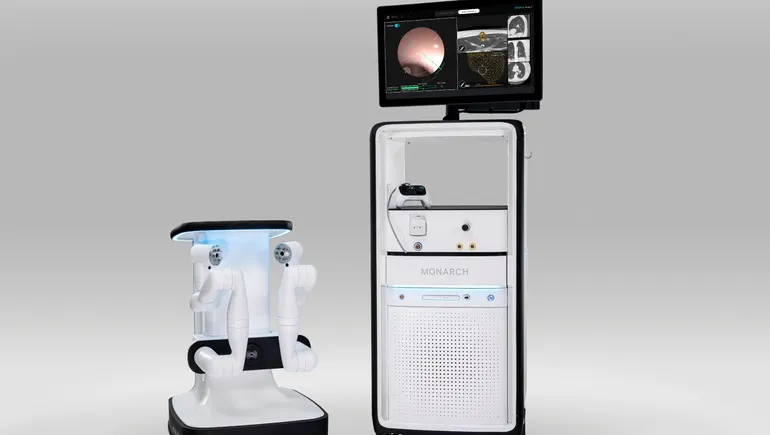
What happened
Johnson & Johnson announced Monday that its Monarch bronchoscopy robot received FDA clearance for a software update (Quest 3) that adds AI-powered pre-procedure planning, improved imaging system compatibility, and enhanced navigation and targeting capabilities. This is the platform's fourth major software launch in the past 18 months.
Why it matters
Monarch is the first robotic bronchoscopy platform on the market and is used to assist physicians in lung biopsy procedures and early lung cancer diagnosis. The AI features are designed to automatically generate more accurate nodule boundaries during planning and improve visual orientation for physicians, potentially making procedures more precise and efficient.
What to watch
Monarch competes with Intuitive's Ion system and Noah Medical's Galaxy system in the bronchoscopy market. J&J also received FDA authorization last month for its Ottava soft tissue robotic system, which will compete against Intuitive's da Vinci robot and Medtronic's Hugo system.
Summaries like this, in your inbox every morning.
Johnson & Johnson's Monarch bronchoscopy robot has been a cornerstone of the company's robotics strategy since its 2019 acquisition of Auris Health. As the first robotic bronchoscopy platform to reach market, Monarch established J&J's position in minimally invasive lung diagnostics. The Quest 3 update reflects the company's commitment to advancing the platform through frequent software iteration—four major releases in 18 months signals aggressive development. The addition of AI-driven planning and enhanced navigation tools addresses a core clinical need: helping physicians more quickly and accurately locate and sample suspicious lung nodules for cancer diagnosis.
The timing of this clearance also reflects J&J's broader expansion in robotic surgery. The company's recent FDA authorization for Ottava, a soft tissue robotic system targeting general surgery, shows J&J is competing across multiple surgical domains—Ottava will face off against Intuitive's established da Vinci platform and Medtronic's newer Hugo system. Together, these moves position J&J to capture share in a growing market for surgical and diagnostic robotics, where precision, ease of use, and clinical outcomes increasingly drive adoption.
Pick your industry and the AI tools you use, and get news related to your work every day.
Free · 30 seconds with Google · unsubscribe anytimeWhat is AIToday? →
Ask AI anything about this article. The AI reads this article, earlier AIToday articles, and Wikipedia, and cites its sources. Q&As are published on this page for other readers too.
Skild AI used Nvidia Isaac Sim to give its S1 model one objective — score a goal — and let it compete against…

Yamazaki Mazak and ABEJA said on the 16th they will start joint development of physical AI, using ABEJA's ABEJ…
OpenAI introduced the Rosalind Academic Plan, giving eligible academic labs at U.S

Wells Fargo hired an AI executive based in San Francisco, a move The Business Journals describes as part of em…

Amazon launched two Bee "personal AI" devices on Thursday: the $74.99 Bee Frontier wristband and the $99.99 Be…

Apple released MLX today, which runs the 816B-parameter Muse Spark Open on four Mac Studios at over 36 tokens…