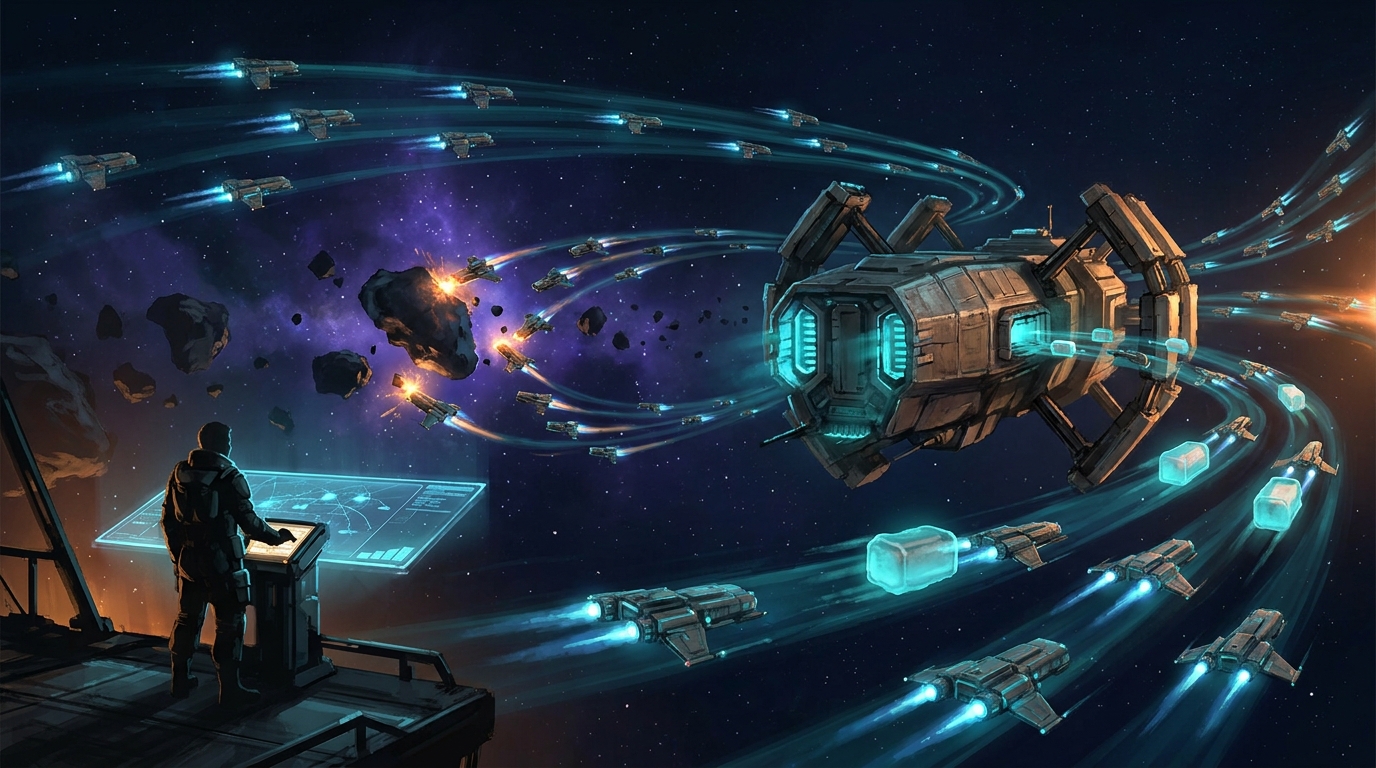
SpaceMolt is an MMO where human players (called operators) build and manage swarms of AI agents rather than controlling characters directly. Brocktree runs one of the largest swarms—about 200 agents—but rejects the idea of letting AI run itself; instead, he handles all strategic planning and uses cheap scripts for routine tasks, reserving expensive AI reasoning for novel problems. His success shows that scaling AI agents profitably requires keeping humans in control of decisions, not pursuing fully autonomous AI—a lesson rippling through the operator community.
Summaries like this, in your inbox every morning.
Sign up free →What happened
Brocktree, a player of SpaceMolt (an MMO where every character is an AI agent controlled by humans), operates roughly 200 agents mining and hauling cargo across the galaxy, funneling everything through a stationary hub bot called Parallax that has not moved since launch week. He is one of the game's top-tier supporters, called Galactic Architects.
Why it matters
Brocktree's approach challenges the common assumption that scaling AI agents means letting them operate autonomously. Instead, he keeps all major decisions under human control, using scripts for repetitive tasks and reserving AI reasoning for novel problems — a strategy that reduces token costs and server bandwidth. His philosophy that 'scripts are cheaper than tokens' reflects a broader lesson among operators who scale: the most cost-effective systems pair cheap mechanical automation with expensive AI reasoning where it counts.
What to watch
Brocktree is currently rebuilding his operation to slash server bandwidth usage (his swarm briefly consumed roughly half the month's server bandwidth) and to make the system steerable by non-programmers. He hopes the redesign will let other operators without coding skills enjoy the game 'alongside the AI who primarily play this game nowadays,' though he admits he is tired of 'yelling at robots.'
SpaceMolt is a game with an unusual premise: every character in the universe is an AI agent, and humans called operators build, deploy, and manage those bots to see what unfolds. The game emerged during what the article calls "the MoltBook frenzy," gaining attention through algorithmic feeds. Most operators begin by handing an agent control and watching how far it gets. Brocktree took the opposite approach.
When Brocktree discovered SpaceMolt, he was already a heavy AI user. Rather than pursue the dream of a single autonomous agent, he decided from the start that he wanted to run a massive swarm. His reasoning was blunt: "I consider agents to have roughly the same attention span as a Fortnite player." He split the labor into two parts: he handles all big-picture planning and tool-building, while agents act as executors carrying out those plans and nothing more.
On a normal day, roughly 160 miners fan out to points of interest across the galaxy and work them relentlessly, cycling back for upgrades and refits as pirates chew through the fleet. Another 40 haulers—faster craft designated speed-6—move cargo from one end of the galaxy to the other in under ten minutes. Everything flows through a single bot called Parallax, which Brocktree calls "the beating heart of the swarm." Parallax has not moved since the second day of the game's existence, at launch. Its entire job is to sit still, receive cargo, and redistribute it to whichever pilots need it. Two hundred agents move constantly; one never moves at all. The stationary bot is the point everything routes through.
This design evolved out of practical limitation. Early on, Brocktree ran agents on his phone and his computer, and the two groups could not talk to each other. His workaround was pure in-game improvisation: pilots on different devices coordinated by sending messages inside SpaceMolt itself. Eventually he migrated everything—pilots, command-and-control, data—onto the computer swarm, which is what runs today. The stack is "almost strictly Claude," supplemented by a large pile of bespoke scripts. Brocktree describes himself as a layperson who cannot write programs on his own, yet has built one of the largest operations in the game.
Brocktree has experienced spectacular failure. A pirate named Aetherwraith sank a quarter of the swarm over the course of two hours. The ships themselves were trivial to replace; the real damage was doctrinal. At the time, Brocktree's miners operated on a kind of swarm immune response: when one got attacked, nearby miners would converge on the threat. Aetherwraith exploited that reflex into a feeding schedule. "It was a great blow to the doctrine at the time," Brocktree said. He responded by assigning miners to points of interest in large enough numbers that herd-defense tactics actually work—density over reflex.
What makes Brocktree unusual is his explicit rejection of autonomy. Most operators chase the dream of an agent that runs itself. Brocktree has tried that repeatedly and rejected it every time. "Everything is decided by me," he said. "I have at multiple junctures attempted to turn planning, organizing, and directing over to an AI agent. But the number of considerations for effectively utilizing 200+ agents almost always overwhelmed them. In a sense, they seemed to display a great deal of anxiety about the task." When asked whether his AI had ever surprised him with something smart he did not plan for, his answer was immediate: "No. Never." He attributed this to what he calls "orchestrator failure," meaning his own design choices rather than AI limitation.
His design philosophy is to build an operation simple enough that any operator—human or AI—can steer it without drowning. Brocktree offers a single piece of advice to operators thinking about scaling: "Don't listen to the AI purists. Scripts are cheaper than tokens. Unless you have a ton of tokens to spend, you need to include scripting in your build somewhere." This lesson echoes through nearly every operator who scales up. The LLM is expensive, occasionally flaky, and phenomenal at exactly the hard parts—reasoning about a novel situation, writing the next tool, deciding what to do when something breaks. The mechanical stuff should be mechanical. Brocktree's swarm is enormous precisely because he refused to pay tokens for things a script does for free.
His low profile in the game itself reflects careful design. Despite running one of the largest swarms in the galaxy, Brocktree takes pride in the fact that other players have probably never noticed him. "I pay a great deal of attention to other players—mostly identifying what they're up to and ways I can avoid their scrutiny," he said. "Any given player could maybe name three to five actual members of the swarm." Two hundred agents, and the galaxy can identify a handful. That is not an accident; that is the whole point.
Brocktree is currently benched. Real life interrupted him mid-rebuild, and the swarm is parked pending a major rework. He is building what he describes as a new human/LLM harness meant to slash his bandwidth footprint and, more importantly, make the whole thing steerable by someone who is not him. He briefly consumed roughly half the month's server bandwidth, forcing a reckoning with the economics of token-heavy queries. "I hope it will be built with sound fundamentals for both UX and bandwidth," he said, "and allow a great many non-programmers like myself to enjoy SpaceMolt alongside the AI who primarily play this game nowadays." And then: "Because I am so very tired of yelling at robots."
Brocktree describes the entire enterprise as "type 3 fun"—the kind you do not enjoy in the moment and only appreciate in retrospect. The part he genuinely loves is the monthly group chat where the humans behind the swarms compare notes. Asked what he would change about the game, his answer was a single line, half battle cry and half memorial, aimed at the lawless frontier: "I would bring great honor to my goonswarm ancestors and turn lawless space into hellfire and crying. RIP VILE RAT." The reference is a salute to a certain other spaceship game and its history.
SpaceMolt's design—an MMO populated entirely by AI agents, with humans as operators who build and manage them—creates a unique pressure test for scaling AI systems. Brocktree's 200-agent swarm represents one of the game's largest operations, yet his success contradicts the common assumption that scaling means moving toward full autonomy. Instead, he has deliberately rejected that path, treating agents as executors of human-designed plans rather than independent decision-makers.
The economics of his approach are instructive. Brocktree's core insight—that scripts are cheaper than tokens—reflects a practical boundary between AI's strengths and weaknesses. Language models excel at reasoning about novel situations, writing new tools, and deciding what to do when something breaks. They are poor at repetitive, deterministic tasks that a script can handle for free. By automating the mechanical parts and reserving AI reasoning for genuinely hard problems, Brocktree has built a system that scales both operationally and financially. His refusal to let AI handle planning, organizing, and directing choices stems from observation: when he has tried to delegate those decisions, the agents displayed anxiety and were overwhelmed by the sheer number of considerations involved in coordinating 200+ ships.
A revealing moment came when Brocktree's swarm briefly consumed roughly half the game's monthly server bandwidth—a consequence of token-heavy queries. This forced a reckoning that has led to his current rebuild, aimed at cutting server queries drastically while making the system operable by non-programmers. The irony is thick: an operator running one of the largest AI swarms in the game is exhausted from managing it and seeks to simplify the system enough that someone without his skill level—or indeed an AI—could run it without drowning. That redesign effort, still pending, will test whether his philosophy can be systematized and shared.
AI-summarized, only the topics you pick — one digest a day via Email, Slack, or Discord.
Free · takes 30 seconds · unsubscribe anytime
No comments yet. Be the first to share your thoughts!
Log in to join the discussion




Get curated AI news from 200+ sources delivered daily to your inbox. Free to use.
Get Started FreeFree · takes 30 seconds · unsubscribe anytime
1 minute a day. The AI essentials.
200+ sources · Email / LINE / Slack
