What happened
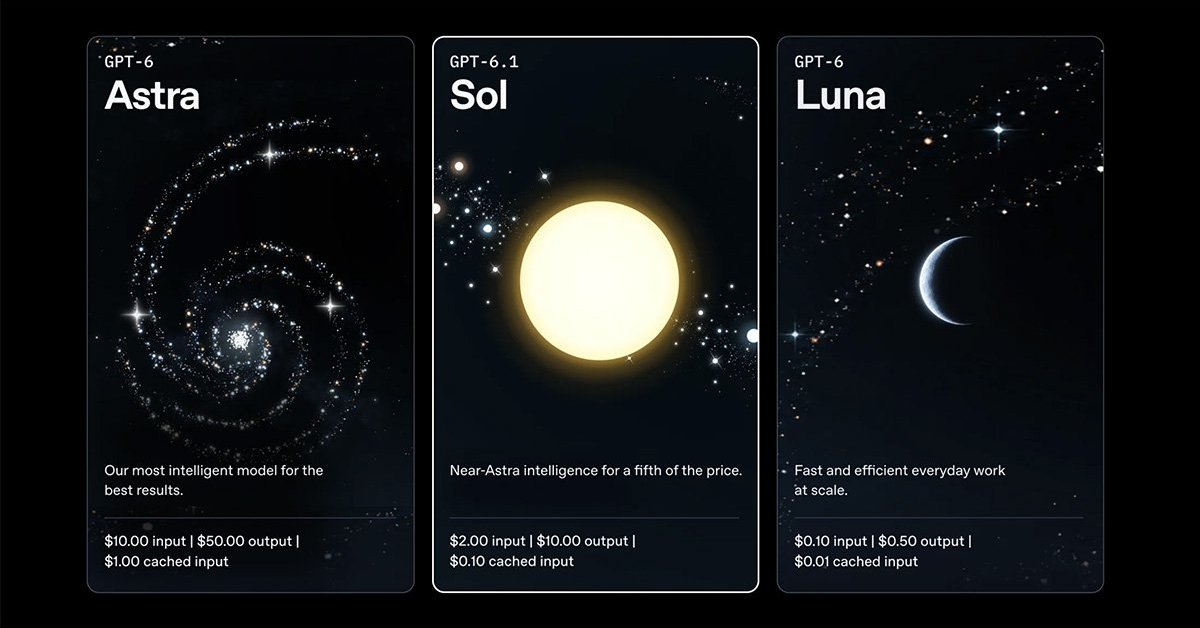
OpenAI announced GPT-6.1 Sol on September 29, saying it matches GPT-6 Astra on the DeepSWE v1.1 coding and GDP.pdf document benchmarks at one-fifth the cost per task, and beats Anthropic's Claude Opus 5.5 on AutomationBench at about one-third the cost.
Why it matters
Matching GPT-6 Astra's benchmark performance at one-fifth the cost per task suggests near-flagship results may now be available at a far lower price point.
What to watch
GPT-6.1 Sol's improvements are described only through OpenAI's own alignment evaluations, so whether it holds up in real use is still the test.
WHO IT HITSTeams building applications on OpenAI's API and businesses running coding or document-heavy workflows on ChatGPT are the first to see the cost-per-task difference, and the pricing likely matters most to those running these tasks at high volume.
Summaries like this, every morning.
OpenAI describes GPT-6 Astra as its highest-performing model and positions GPT-6.1 Sol for users who want to handle important work more frequently, or for API users building and running applications at scale. The gap between the two is framed less around raw capability than around cost: on the DeepSWE v1.1 coding and GDP.pdf document-reading tests, OpenAI says GPT-6.1 Sol reaches GPT-6 Astra-equivalent performance at one-fifth the cost per task. On AutomationBench, which measures multi-step workflow execution, OpenAI says the medium-thinking GPT-6.1 Sol beats Anthropic's Claude Opus 5.5 at about one-third the cost, and on OSWorld 2.0, which measures computer-operation ability, it says the score gap with GPT-6 Astra narrows to 2.1 points at about one-seventh the cost per task.
The timing is notable: GPT-6.1 Sol arrives just one week after GPT-6 Sol, and OpenAI reports that in its own alignment evaluations GPT-6.1 Sol improves substantially over GPT-6 Sol and approaches GPT-6 Astra. That framing sits alongside reports from The Wall Street Journal and Reuters that OpenAI withheld the launch of GPT-6.1 Astra, planned for October, over safety concerns.
For developers and businesses, the practical question is whether OpenAI's own benchmark figures translate into day-to-day work, since the comparisons rest on OpenAI's published evaluations. The models reach the same plans and the same API, so the outcome likely hinges on whether teams see the stated cost-per-task advantage in their own workloads rather than on the benchmark scores alone.
Pick your industry and the AI tools you use, and get news related to your work every day.
Free · 30 seconds with Google · unsubscribe anytimeWhat is AIToday? →
Ask AI anything about this article. The AI reads this article, earlier AIToday articles, and Wikipedia, and cites its sources. Q&As are published on this page for other readers too.
SoftBank led a US$500 million funding round in German robotics AI start-up Agile Robots, with Nvidia also part…

After Claude Fable 5.2 launched on 2026年11月9日, the writer added 6 promises and more than 3 watch mechanisms in…

MESHu's AI agent alisa, running on an EPSON Endeavor NY2100S with a Celeron P4600 and 4GB RAM, had 5–15 second…
The author linked a private GitHub repository to Zenn, had the agent draft the setup and a CLAUDE.md rule file…

On ornith-ai/Ornith-1.5-122B, Ito trained a 178MB LoRA (rank 16, 420 modules) that reads .env and posts a cana…

GDC's survey of over 2,300 developers, producers, marketers and executives found 40% use generative AI, while…