What happened
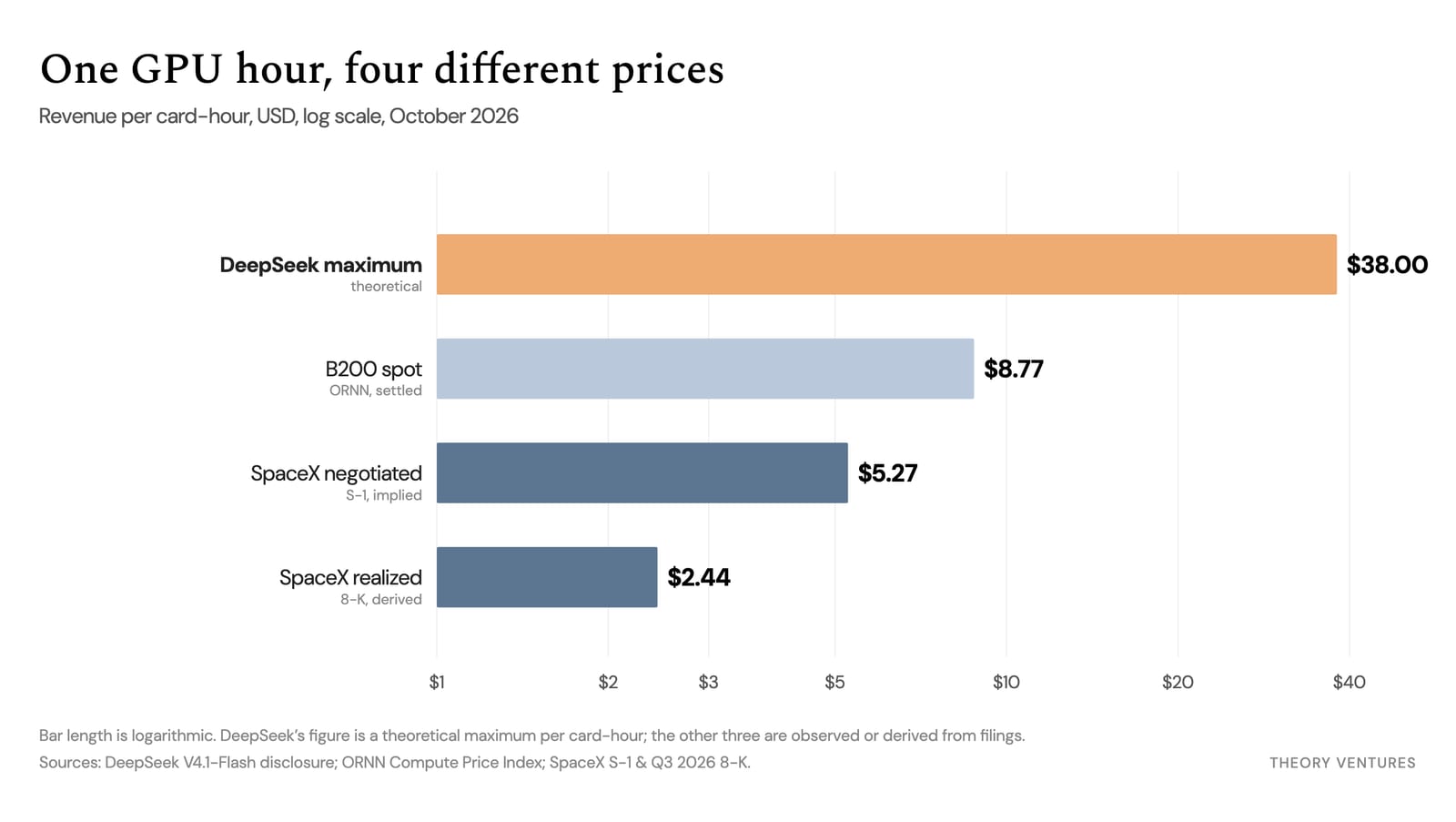
Tom Tunguz laid out a GPU pricing ladder from DeepSeek's theoretical $38.00 per card-hour maximum down to SpaceX's realized $2.44, with B200 spot at $8.77 and SpaceX's negotiated price at $5.27.
Why it matters
The gap between theoretical and realized revenue suggests inference businesses can be healthy even at current prices and efficiencies, with room to climb if demand persists at higher prices per card-hour.
Summaries like this, in your inbox every morning.
The pricing ladder is built from two disclosures: SpaceX's third-quarter report and DeepSeek's inference post. DeepSeek's $38.00 figure is a theoretical maximum that assumes optimal conditions and full list price, while SpaceX's $2.44 realized revenue reflects operations costs, training, and unusable or unbillable work. Between those extremes sit the B200 spot price of $8.77 and SpaceX's negotiated $5.27.
The case for healthy inference economics rests on demand persisting and efficiency outrunning price cuts. The forces pushing the other way are considerable: GPU rental prices doubled in six months, from $4.40 to $8.08 per card hour, while the price of intelligence fell much faster, with OpenAI cutting Luna 80% in July and another 50% in September. A benchmark threshold that cost $0.55 eighteen months ago now clears at $0.0015, a 377-fold reduction.
The second force moves inference off the datacenter altogether. AI companies are asking Qualcomm to run large models on the handset itself, with Cristiano Amon, CEO of Qualcomm, saying on the Sources podcast that some at the forefront of AI want a hundred billion parameter model running on a phone by 2028. But the cloud is not big enough to support demand, and new data centers are behind schedule, with GPUs sitting idle on warehouse floors waiting for power. JPMorgan finds that more than 60% of the data center capacity planned for 2027 is not yet under construction, and a further 7% is delayed. With demand continuing to drive record revenue growth for AI, the deflationary forces may succumb to too much demand, and token factories benefit from more rungs to climb on the pricing ladder.
Pick your industry and the AI tools you use, and get news related to your work every day.
Free · 30 seconds with Google · unsubscribe anytimeWhat is AIToday? →
Ask AI anything about this article. The AI reads this article, earlier AIToday articles, and Wikipedia, and cites its sources. Q&As are published on this page for other readers too.
China set up National Data Group, a state-owned enterprise headquartered in Xiong'an, Hebei province, with Vic…

Anthropic's draft IPO prospectus disclosed first-half revenue of $16.3 billion alongside an $80.7 billion net…
Klique announced platform support for NVIDIA Nemotron 3.5 Super VL, OpenShell, Dynamo, and NeMo Switchyard, le…
In Q3 2026 results on Oct

Google Cloud now offers OpenAI's GPT-6 Astra, GPT-6.1 Sol and GPT-6 Luna next to Gemini and Claude, starting a…

Schmidt owns a 1% stake in Anthropic, per Bloomberg sources, potentially worth $20 billion if it lists at its…