AIToday

AI agents vs. generative AI: key difference is autonomy

AINOW6h ago
AI agents vs. generative AI: key difference is autonomy

Key takeaway

Generative AI and AI agents serve different purposes: generative AI responds to individual prompts without autonomous decision-making, while AI agents autonomously break down goals into multi-step plans and execute them using external tools and information. The distinction matters because deploying the wrong tool—such as using generative AI for tasks requiring multi-step automation—wastes resources, whereas AI agents excel at complex workflows like customer support, sales pipeline management, and back-office operations that generative AI alone cannot handle efficiently.

Summaries like this, in your inbox every morning.

Sign up free →

3 Key Points

  • What happened

    The article explains that AI agents and generative AI differ fundamentally in their autonomy—generative AI responds to single prompts passively, while AI agents autonomously execute multi-step tasks by perceiving goals, planning, acting with tools, and learning from results.

  • Why it matters

    Choosing the wrong tool wastes resources; generative AI suits one-off writing or image tasks, while AI agents handle complex workflows like customer support automation or proposal creation. Understanding this distinction helps businesses invest wisely and avoid costly missteps.

  • What to watch

    Common development tools include LangChain (for engineers), Dify (no-code platform), n8n (workflow + agent hybrid), and Claude Agent SDK. Three key risks require mitigation: incorrect permission settings can leak data, unchecked autonomous execution can compound errors, and AI hallucinations can propagate into real actions.

In Depth

The article opens by observing that the term "AI agent" is becoming common, yet many people struggle to articulate how it differs from the generative AI they use daily. This confusion matters: deploying the wrong tool can lead to off-target proposals within organizations and unnecessary investments.

The fundamental distinction rests on autonomy. Generative AI—exemplified by ChatGPT or Gemini—operates as a passive responder. When a user asks it to "summarize a report," it produces a summary but stops there; it does not submit or share the document. The core mechanism is prediction: an LLM (large language model) ingests text and predicts the next token, continuing until the response is complete. Without new input, a generative AI system remains idle. In contrast, an AI agent is active. Given a goal such as "prepare next week's meeting materials," it autonomously searches for information, drafts the document, and shares it with stakeholders. The agent uses a generative AI as its reasoning engine but wraps that engine in a control loop that decides what action to take next.

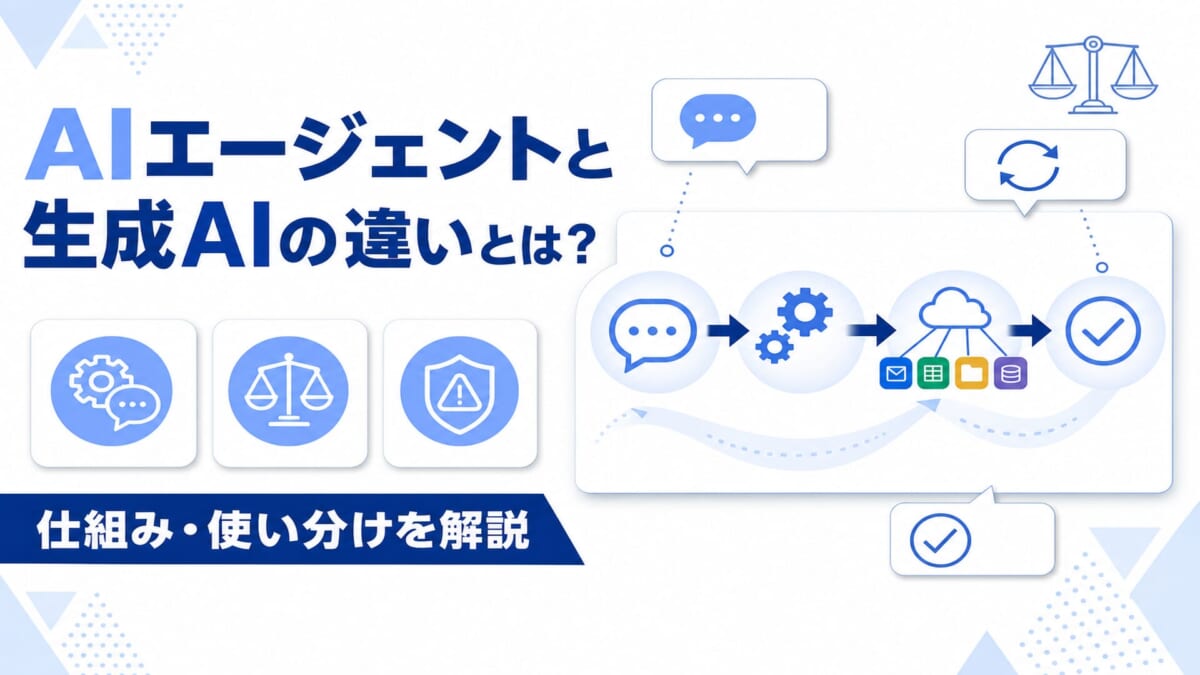
The architecture of autonomy breaks into four steps. First, perception: the agent recognizes the goal and gathers relevant information from databases, APIs, and the user's instruction. For example, if asked to "create a proposal for next month based on last month's sales data," the agent identifies where the sales data resides. Second, reasoning: the agent decomposes the goal into a sequence of tasks and orders them. It might break the proposal-creation task into analyzing sales data, summarizing trends, and structuring a presentation—then decide which steps come first. Third, action: the agent executes each step by invoking external tools (search, file operations, system APIs), retrieves data, performs analysis, and generates artifacts. Fourth, learning: the agent compares its output to the intended result, identifies gaps, and adjusts its approach for future tasks. This feedback loop allows the agent to improve over repeated use.

The article distinguishes three related but distinct concepts. Generative AI generates content in response to prompts but lacks autonomy or cross-session memory. An AI agent has partial autonomy within a defined scope: given a goal, it plans and executes but does not set its own goals or accumulate memory over months. Agentic AI (a next-generation form cited by Gartner) combines long-term memory and self-directed goal-setting, allowing it to prioritize across projects and adjust its objectives as circumstances change. Today's AI agents occupy the middle tier and are the most practical for enterprise deployment.

When to use which? Single-pass tasks—composing an email, generating a single image, writing a summary—suit generative AI alone; adding agent overhead is wasteful. Multi-step workflows spanning information collection, processing, and execution demand an AI agent. A customer-support use case illustrates: an agent retrieves past interactions, queries internal knowledge, drafts a response, and routes complex issues to a human. Sales examples include consolidating prospect data and generating draft proposals. Back-office automation covers invoice processing and attendance tracking across multiple systems. The article also endorses a hybrid model: generative AI drafts a creative outline, then an AI agent handles the distribution and follow-up.

Three deployment risks require attention. First, misconfigured permissions: if a customer-service agent gains access to HR records, it might inadvertently expose or output confidential data. Second, error propagation: one early mistake in task execution becomes the foundation for all downstream steps, and without human review, the compounded error flows through to completion. Third, hallucination in the reasoning layer: if the underlying generative AI fabricates a data point or process step, the agent treats that falsehood as fact and executes real actions based on it. Mitigation strategies include role-based access controls, mandatory human sign-off at critical checkpoints, and final verification before external communications.

The article surveys four popular development tools. LangChain is an open-source framework for engineers, offering pre-built components for tool orchestration and memory. Dify is a no-code platform where non-programmers can assemble agents through a visual interface. n8n bridges workflow automation and AI by adding reasoning capabilities to existing automation pipelines. Claude Agent SDK is Anthropic's official toolkit for building agents that leverage Claude as the reasoning engine. The choice depends on available technical expertise and the complexity of the workflow.

The article concludes by reiterating that autonomy—not underlying technology—is the dividing line. Single-task work belongs to generative AI; multi-step business processes belong to AI agents; and combining them is valid. Success depends on first inventorying which tasks are single-pass and which are multi-step, then selecting the right tool and starting with a low-risk pilot using a no-code platform before scaling.

Context & Analysis

The article addresses a practical problem facing business decision-makers: how to distinguish between two increasingly visible AI capabilities and allocate investments correctly. The core insight—that autonomy, not technology, defines the difference—provides a clear mental model. Generative AI remains fundamentally reactive: it awaits input and produces output for a single task, making it efficient for creative work (drafting text, generating images) or information retrieval that requires no follow-through. AI agents, by contrast, embed planning and tool orchestration, allowing them to execute workflows without human re-direction between steps.

The four-step mechanism (perceive, reason, act, learn) reveals why AI agents suit repetitive, multi-system business processes. A customer support agent can retrieve past interactions, consult a knowledge base, draft an answer, and escalate to a human—all without waiting for intermediate approvals. A sales agent can consolidate prospect data, prioritize leads, and generate proposal drafts. This automation of judgment and execution is what generative AI alone cannot deliver. The article also introduces a third category—agentic AI (with long-term memory and self-directed goal-setting)—positioning AI agents as a transitional form between today's generative AI and a future where systems may set their own priorities.

Risks are grounded in the new autonomy: because agents access multiple systems and run unsupervised loops, permission misconfiguration can expose data; a single logical error can cascade through multiple downstream steps; and hallucinations in the reasoning engine translate into real-world errors. The remedy is not to abandon automation but to insert human checkpoints at high-stakes stages and to scope permissions tightly by business function.

FAQ

What are the four steps that allow AI agents to work autonomously?
AI agents operate through perception (recognizing goals and gathering information), reasoning (planning the steps needed to achieve the goal), action (executing tasks with external tools and APIs), and learning (reviewing results and adjusting future behavior based on feedback).
When should a company use generative AI instead of an AI agent?
Generative AI is sufficient for single-step tasks like creating an email, summarizing meeting notes, or generating one image. For these one-off requests, adding AI agent complexity would increase operational costs without benefit.
What are the main risks of deploying AI agents in business?
Three key risks are: overly broad permission settings that can cause unintended access to sensitive information, autonomous execution of incorrect decisions that compounds errors across multiple steps, and hallucinations from the underlying generative AI propagating into actual business actions. Mitigating these requires fine-grained access controls, human approval gates at critical steps, and final human review before external communication or high-stakes decisions.

Get AI news like this every morning

AI-summarized, only the topics you pick — one digest a day via Email, Slack, or Discord.

Free · takes 30 seconds · unsubscribe anytime

Discussion

No discussion yet for this article

Stay ahead with AI news

Get curated AI news from 200+ sources delivered daily to your inbox. Free to use.

Get Started Free

Free · takes 30 seconds · unsubscribe anytime

1 minute a day. The AI essentials.

200+ sources · Email / LINE / Slack

Get it free →