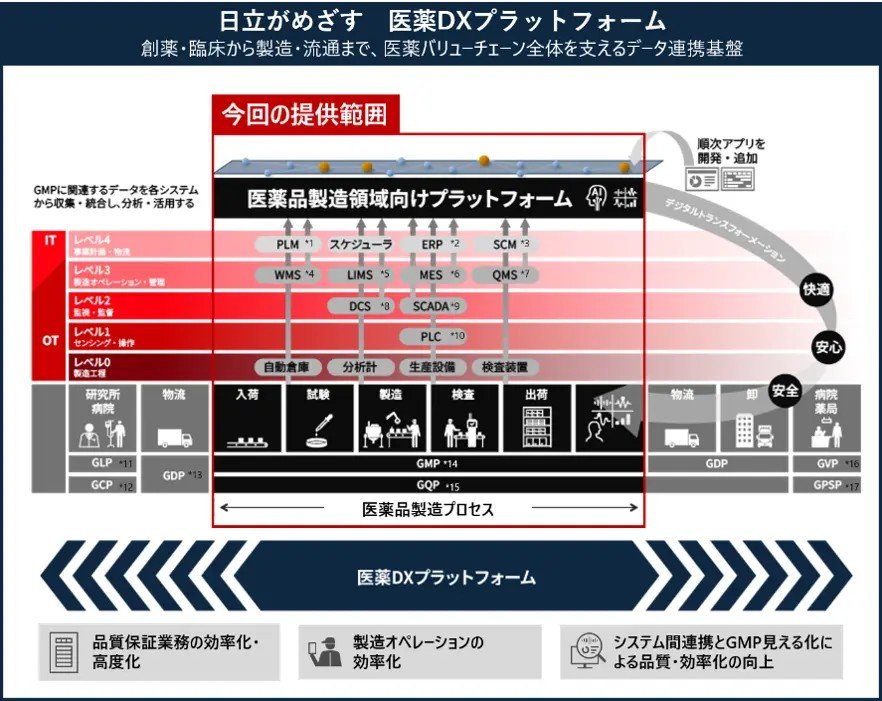
Hitachi has introduced an integrated platform leveraging generative AI to streamline GMP (Good Manufacturing Practice) operations in pharmaceutical manufacturing.
GMP compliance is essential for drug production safety and regulatory approval, and automating these workflows through AI can reduce manual effort while maintaining quality standards.
What happened
Hitachi and partners have launched an integrated platform that uses generative AI to improve GMP (Good Manufacturing Practice) operations in pharmaceutical manufacturing.
Why it matters
GMP compliance is a critical regulatory requirement in drug production. Automating these workflows with AI can reduce manual administrative work and help manufacturers maintain quality standards more efficiently.
What to watch
The article does not specify pricing, availability date, or target customers for the platform.
Hitachi has developed an integrated platform designed to enhance pharmaceutical manufacturing operations by automating GMP (Good Manufacturing Practice) workflows through generative AI technology. GMP compliance is a foundational regulatory requirement in drug production, encompassing quality control, documentation, traceability, and manufacturing procedures that must meet strict standards set by health authorities worldwide. The platform leverages generative AI—machine learning models trained to understand and generate text and data—to reduce manual effort in GMP-related administrative and operational tasks. By automating routine processes such as documentation, batch record generation, and compliance verification, the platform aims to free pharmaceutical manufacturers from labor-intensive administrative work while ensuring that regulatory and quality standards are consistently met. The initiative represents a broader trend of applying AI to heavily regulated industries where accuracy, traceability, and compliance documentation are critical. Hitachi and its partners have positioned this as an integrated solution, meaning it is designed to connect with existing pharmaceutical manufacturing systems and workflows rather than operate in isolation. The platform's introduction underscores growing recognition that generative AI can handle domain-specific, regulated workflows when properly configured and monitored.
The pharmaceutical industry faces constant pressure to balance regulatory compliance with operational efficiency. GMP (Good Manufacturing Practice) workflows are mandatory in drug production but often involve repetitive documentation, audit trails, and quality checks that consume significant manual labor. By deploying generative AI—technology that can understand and generate natural language and structured data—manufacturers can automate routine administrative tasks while maintaining the audit trails and compliance records that regulators require. Hitachi's entry into this space suggests that large industrial manufacturers are beginning to apply large language models (AI systems trained on vast amounts of text) to domain-specific, compliance-heavy industries where accuracy and traceability are non-negotiable.
AI-summarized, only the topics you pick — one digest a day via Email, Slack, or Discord.
Free · takes 30 seconds · unsubscribe anytime
Ask AI anything about this article. Q&As are published on this page for other readers too.
OpenAI completed a stock buyback worth roughly $7 billion, allowing current and former employees to sell share…

Brad Lightcap, OpenAI's Chief Operating Officer until April 2026 and a longtime executive who built the compan…

Brad Lightcap, who served as OpenAI's COO and most recently as special projects lead, announced his departure…

CEO Sundar Pichai announced that the Gemini app has surpassed 1 billion monthly active users, making it the 14…

Brad Lightcap, who joined OpenAI in 2018 and served as chief financial officer for four years before becoming…

River AI, founded by xAI co-founder Igor Babuschkin, raised $1.1 billion in a seed/Series A round led by Gener…

The AI news that matters, in one minute each morning.
Sign up free