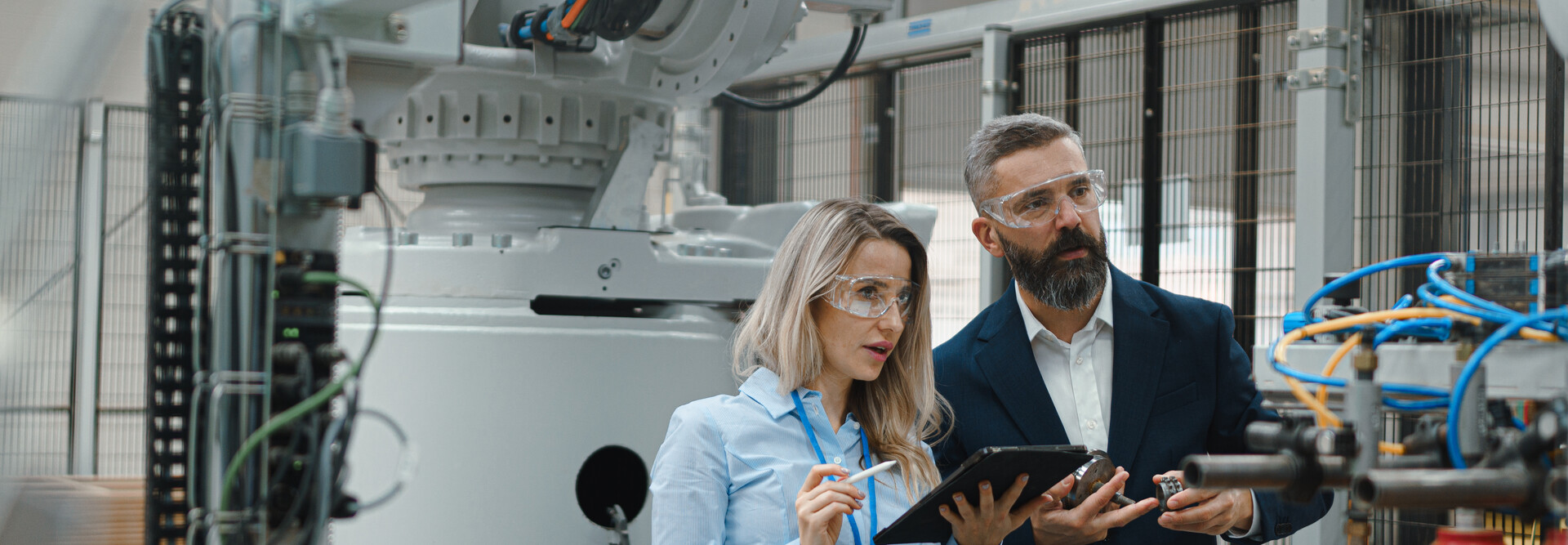
Manufacturing environments are adopting AI agents that can execute approved actions autonomously rather than merely advising operators, marking a shift from copilot-assisted work to closed-loop decision-making.
The change requires strict safeguards: agents must operate within deterministic boundaries, undergo digital twin testing, and integrate cybersecurity controls.
Success depends on pairing routine automation with human oversight of complex or safety-critical decisions, and measuring improvements in downtime, asset availability, and throughput.
What happened
Manufacturing is shifting from AI copilots that advise operators to AI agents that execute approved actions autonomously—coordinating scheduling, maintenance, quality and process optimization across operational systems. Honeywell's Russ Ford distinguishes the model: "An AI copilot advises; an AI agent acts."
Why it matters
Autonomous agents enable faster closed-loop decision-making on the factory floor, allowing operators to focus on oversight and exception handling rather than executing routine tasks. However, this shift requires manufacturers to establish firm engineering, safety and governance boundaries—including digital twin testing, cybersecurity controls, and deterministic rule constraints—to avoid what Ford calls "agentwashing" (relabeling conventional analytics as agents).
What to watch
Success metrics include reductions in unscheduled downtime, improved asset availability, higher throughput, greater yield, and better capacity utilization. The strongest early use cases are repetitive, data-rich workflows with well-defined procedures—such as sensor monitoring, routine startup/shutdown, weather responses, and logbook updates—where human operators retain oversight and intervention authority.
Artificial intelligence is crossing an important threshold on the factory floor. For years, AI copilots have helped operators interpret data, diagnose issues, and determine what actions to take—but a human always had to execute those actions. Emerging AI agents are designed to go further: they execute approved actions and confirm whether the actions produced the intended result.
Russ Ford, president of projects and automation solutions at Honeywell, explains the distinction clearly: "An AI copilot advises; an AI agent acts." This shift could reshape how production environments operate. Instead of waiting for an operator to respond to every recommendation, agents could coordinate scheduling, maintenance, quality, and process optimization across multiple operational systems simultaneously. The upside is faster, closed-loop decision-making—but only within carefully defined engineering, safety, and governance boundaries.
The operational model is what Ford calls "human-autonomy teaming." AI agents execute routine and repetitive activities while operators monitor performance and intervene when conditions exceed the agent's authority. "The role of the human shifts from task execution to supervision and exception management," Ford says. "Agents can perceive conditions, reason over context, execute approved workflows, interact with other agents, applications and operational systems, and verify results."
Not every factory task is ready for autonomous agents. The strongest early use cases involve predictable processes supported by extensive operational data. Ford identifies sensor malfunctions, routine startup and shutdown procedures, weather-related responses, field communications, shift handovers, logbook updates, and process optimization as potential applications. The best candidates are workflows that are repetitive, data-rich, governed by well-defined procedures, and have clearly understood outcomes. Conversely, humans should remain in the loop for activities involving significant ambiguity, safety-critical decisions, operational envelope changes, regulatory compliance, emergency response, and novel situations where historical data may not provide sufficient context.
To prevent safety failures or unauthorized behavior, these agents must operate inside deterministic boundaries established through engineering rules, equipment constraints, safe operating windows, and approved procedures. "While agents may use generative AI and probabilistic reasoning to analyze situations, any operational action must remain constrained by deterministic rules," Ford says. Before receiving production authority, agents should be tested using digital twins, training simulators, and other controlled environments. Cybersecurity is essential: agents interacting with operational technology require tightly managed access, network segmentation, continuous monitoring, and system validation. Formal governance should address accountability, compliance, model management, continuous lifecycle monitoring, and approval thresholds—for example, a low-risk logbook update may be automated, while a change affecting a critical production process could require explicit human authorization.
Ford also warns against what he calls "agentwashing"—relabeling conventional analytics or copilots as agents to create an impression of autonomy that does not exist. A meaningful autonomous system must be able to perceive, reason, execute, and continuously improve. If it only provides recommendations, it is an adviser, not an agent. Manufacturers should evaluate agents against production using metrics such as reductions in unscheduled downtime, improved asset availability, higher throughput, greater yield, and better capacity utilization. IT and operations leaders should also track how agents affect human performance—response times, operator span of control, shutdowns caused by human error, and variability between shifts. The goal is to determine the appropriate level of autonomy for each workflow, supported by human authority and evidence that the system is improving operations. As Ford concludes, "Successful organizations will be those that use AI agents to automate routine decisions, while empowering people to focus on the complex, high-value decisions that drive safety, reliability, and business performance."
Manufacturing has long used data analytics and AI-assisted copilots to help operators interpret sensor readings and diagnose issues, but the next phase moves the decision boundary. Rather than stopping at recommendation, autonomous agents now execute actions directly—coordinating across maintenance, quality, and production systems—and then confirm whether those actions achieved their intended outcome. This shift requires a fundamental recalibration of governance. Russ Ford, president of projects and automation solutions at Honeywell, articulates the model as "human-autonomy teaming": AI agents handle routine and repetitive activities while operators retain oversight, intervention authority, and responsibility for exceptional situations.
The risk, however, is that manufacturers may overstate the autonomy of systems that are merely more sophisticated versions of existing analytics. Ford warns against "agentwashing"—relabeling conventional advice-giving as agent-based action. A meaningful autonomous system must perceive conditions, reason over context, execute approved workflows, interact with other systems, and verify results. To prevent mission creep or safety failures, agents must operate strictly within deterministic boundaries established through engineering rules, equipment constraints, and safe operating windows. Cybersecurity becomes critical because agents interacting with operational technology (machinery, sensors, control systems) require tightly managed access and continuous validation.
Measuring success means tracking both operational metrics—unscheduled downtime, asset availability, throughput, yield, and capacity utilization—and human performance effects, such as response times, operator span of control, and variability between shifts. The goal is to establish the appropriate level of autonomy for each workflow, supported by evidence that the system improves operations and by human authority to intervene when conditions exceed the agent's defined scope.
AI-summarized, only the topics you pick — one digest a day via Email, Slack, or Discord.
Free · takes 30 seconds · unsubscribe anytime
Ask AI anything about this article. Q&As are published on this page for other readers too.
Security researchers led by Alexander Panfilov discovered a vulnerability in the APIs of all major AI provider…

OpenAI completed a stock buyback worth roughly $7 billion, allowing current and former employees to sell share…

Brad Lightcap, OpenAI's Chief Operating Officer until April 2026 and a longtime executive who built the compan…

Brad Lightcap, who served as OpenAI's COO and most recently as special projects lead, announced his departure…

CEO Sundar Pichai announced that the Gemini app has surpassed 1 billion monthly active users, making it the 14…

Brad Lightcap, who joined OpenAI in 2018 and served as chief financial officer for four years before becoming…

The AI news that matters, in one minute each morning.
Sign up free