What happened
A new deep dive in the RAG Systems course explains how to optimize the dominant latency bottleneck in production RAG systems—the prefill step, where a model processes retrieved chunks. Techniques like CacheBlend (reusing precomputed chunk caches) reduce time to first token by 2–3× while keeping answer quality within 0.01–0.03 F1 of full recompute; TurboRAG reports up to 9.4× reduction by moving prefill offline.
Why it matters
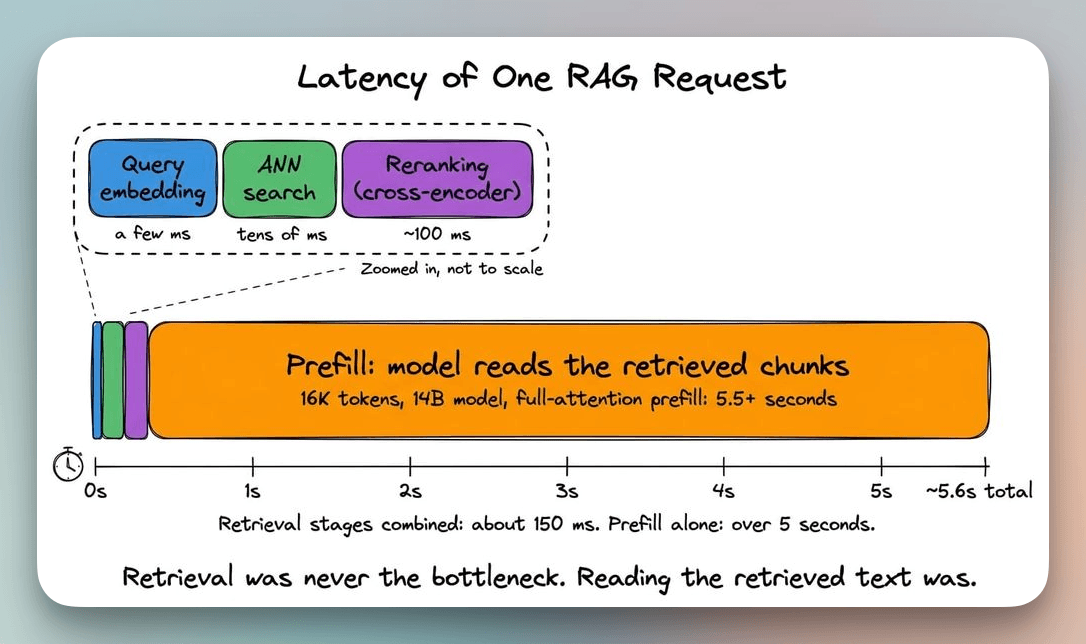
In RAG systems serving thousands of requests per hour, prefill latency—which scales quadratically with input length—is the dominant line item on the inference bill. Processing 16,000 input tokens with a 14B parameter model on an NVIDIA L20 takes ~5.5 seconds to get the first token, and the vast majority of those tokens are retrieved chunks. Every percentage point of cache reuse translates directly into GPU cost saved, making this one of the highest-leverage problems the industry is actively investing in.
What to watch
LMCache, the open-source package implementing CacheBlend, ships as a production integration on top of vLLM. Serving engines are adding non-prefix cache reuse as a first-class feature. The course covers KV cache mechanics, why prefix caching fails for RAG, three failure modes of naive cache reuse, and hands-on implementation with production best practices.
Summaries like this, in your inbox every morning.
The article identifies prefill—the step where a model processes retrieved context chunks—as the true performance and cost bottleneck in production RAG systems. While developers often focus on optimizing retrieval speed (embedding, vector search, reranking), these steps are fast in absolute terms; the real latency driver is the quadratic scaling of the attention computation over all input tokens. In a concrete example, 16,000 tokens on a 14B parameter model on an NVIDIA L20 GPU takes ~5.5 seconds just to produce the first output token, and because most of those tokens are retrieved context rather than the user's query, the prefill step dominates the inference cost.
The article frames the solution as cache reuse—specifically, reusing the KV (key-value) cache precomputed for retrieved chunks across multiple requests. CacheBlend demonstrates this by recomputing only 10–15% of tokens while maintaining answer quality within a narrow margin (0.01–0.03 F1 difference), achieving 2–3× reduction in time to first token. More aggressive approaches like TurboRAG move the entire prefill offline, yielding up to 9.4× speedup. These gains are economically significant: for systems serving thousands of requests per hour, prefill dominates the GPU bill, so every percentage point of cache reuse translates directly to cost savings.
The industry is treating this as a high-priority problem. Open-source infrastructure like LMCache (implementing CacheBlend) is being integrated into production serving engines such as vLLM, and inference teams are making cache reuse a first-class feature rather than an afterthought. The article positions understanding KV cache mechanics, the failure modes of naive reuse strategies, and the specific techniques to fix them as essential knowledge for anyone operating RAG systems at scale.
Pick your industry and the AI tools you use, and get news related to your work every day.
Free · 30 seconds with Google · unsubscribe anytimeWhat is AIToday? →
Ask AI anything about this article. The AI reads this article, earlier AIToday articles, and Wikipedia, and cites its sources. Q&As are published on this page for other readers too.
Circlia started a proof-of-concept for TASTE SIGNAL: visitors to Holland Village Cafe FUKUOKA taste cookies an…

In a webinar hosted by French Mathematical Society president Isabelle Gallagher, Fields Medal winner Hugo Dumi…

NVIDIA released Nemotron 3.5 Super VL, an open-weight model with 120 billion parameters that handles text, ima…

NVIDIA released Nemotron 3.5 Bolt 74B-A9B 24GB, an AI model for local agents that hits over 80 tokens per seco…
NVIDIA published a blog post titled "AI Security Is an Engineering Problem - How to Solve It at Every Layer of…

In the test, Haiku 5.5 on medium setting averaged scores close to Sonnet 5.5 on routine documents at about 1/1…