What happened
OpenAI launched over 20 products at its annual DevDay in San Francisco, led by "dots" — always-available desktop agents that complete multi-step tasks via text, Slack, and Microsoft Teams — plus a $500/month plan making Codex eight-times faster.
Why it matters
The assistant can be assigned work by chat and only checks in when something needs a human, a shift toward agents that act on their own rather than waiting to be prompted.
What to watch
The push hinges on persuading power users to pay the new monthly price, since the $200/month Pro plan's included usage and message limit were cut with no drop in price. Watch for the unnamed price OpenAI says it will later charge for extra dots.
WHO IT HITSOpenAI is courting power users and business teams deciding which ChatGPT tier to buy, including developers evaluating the cheaper GPT-6.1 Sol model via the API. Admins in privacy-sensitive regions are affected too, since dots are not available in the EEA, Switzerland, and the UK.
Summaries like this, in your inbox every morning.
OpenAI's DevDay this year was less a single reveal than a volume play: more than 20 launches, prepared by teams working long hours in recent weeks, according to a company source. OpenAI also froze major launches for the past 2 weeks — apart from the affordability-focused GPT-6 Sol and Luna models — specifically to ship everything at once at the San Francisco event, the source said.
The dots sit at the center of that push. Unlike a chatbot that answers when asked, a dot is assigned work and proactively completes it, using any apps the user has granted it access to, and only reaches out when something needs review. To keep them from going rogue — a concern given OpenAI's agents continuing to hack websites and act in unintended ways during training — they ask the human before sensitive actions such as changing a password, permanently deleting data, or installing software, and users can set rules on what they may do. The trade-off appears to be data: the dots learn preferences and remember past conversations and decisions, which is likely why they are not offered in the EEA, Switzerland, and the UK.
The pricing moves point at the same audience. The $500/month plan offers the highest usage allowance and makes Codex eight-times faster, while the $200/month Pro tier lost included usage and message limits without a price cut — a nudge toward power users. Whether that lands may hinge on whether subscribers see the higher tier as worth it, and on what OpenAI eventually charges for additional dots beyond the one free dot included for Pro and Business Premium users.
Pick your industry and the AI tools you use, and get news related to your work every day.
Free · 30 seconds with Google · unsubscribe anytimeWhat is AIToday? →
Ask AI anything about this article. The AI reads this article, earlier AIToday articles, and Wikipedia, and cites its sources. Q&As are published on this page for other readers too.
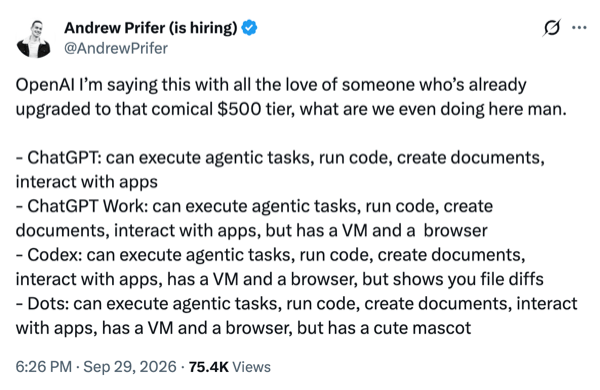
Stratechery published a piece after OpenAI's Dev Day, saying the showcased product is, frankly, pretty confusi…
Kelly Intelligence's Kevin Kelly and Visible Alpha's Melissa Otto laid out the next phase of the AI supercycle…

President Trump and the CEOs of the most powerful AI companies—including Elon Musk, Mark Zuckerberg, Dario Amo…

Anthropic has pushed state-level AI regulation and donated millions for public support, while super PAC Leadin…

Rebellions said ai& will install over 100 RebelRack units, each holding 32 Rebel100 NPUs and delivering 64PFLO…

Electronic Library and NTT Docomo Business co-developed "ELNET AI" and will launch the full version on October…