What happened
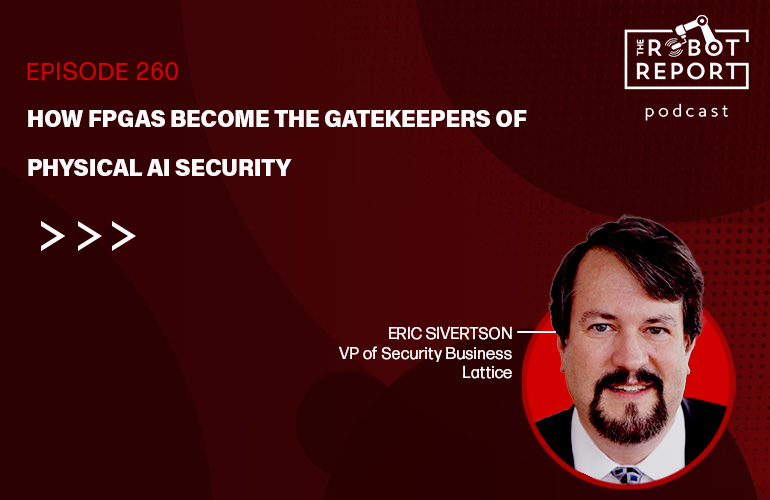
Eric Sivertson, vice president of the security business at Lattice Semiconductor, appeared on The Robot Report Podcast to discuss FPGAs (field-programmable gate arrays), physical AI, and building safe and secure robots.
Why it matters
Sivertson brings more than 30 years of experience developing technologies that enhance trust and security in embedded systems, wireless connectivity, and high-performance, reconfigurable computing. He is focused on building Lattice's business in this growth market and supporting leading-edge solutions development.
What to watch
The episode’s value hinges on whether Lattice can convert Sivertson’s security expertise into growth in the physical AI market, a test of its strategic positioning against larger rivals. Watch for signals on adoption of its FPGAs in the coming quarters.
Summaries like this, in your inbox every morning.
The podcast episode centers on the argument that FPGAs are becoming critical components for physical AI security. Eric Sivertson's background, spanning over 30 years in embedded systems and reconfigurable computing, lends weight to his perspective on this niche but growing field. The discussion frames FPGAs not just as hardware, but as a foundational technology for ensuring robots operate safely and securely.
This security focus comes alongside a broader wave of news in the robotics and AI sector, as highlighted by the episode's other segments. Deere's expansion of AI features for farmers, NVIDIA's move to acquire Hugging Face, and Skild AI's new robot foundation model all point to an industry rapidly integrating more advanced intelligence into physical systems. The ongoing legal dispute between Teradyne Robotics and JAKA Robotics adds a separate layer of business complexity to the field.
The implication, as presented, is that as robots become more capable and autonomous—powered by developments like foundation models—the need for robust, hardware-level security mechanisms will grow in tandem. FPGAs, with their reconfigurable nature, are presented as a versatile solution for this challenge.
Pick your industry and the AI tools you use, and get news related to your work every day.
Free · 30 seconds with Google · unsubscribe anytimeWhat is AIToday? →
Ask AI anything about this article. The AI reads this article, earlier AIToday articles, and Wikipedia, and cites its sources. Q&As are published on this page for other readers too.
On October 12, CNBC's Jim Cramer said combining CrowdStrike, Palo Alto Networks and Okta makes an AI "kill swi…

Sam Jenkins of Punchcard Systems cites a 2025 Microsoft survey of 1,725 data security leaders finding nearly t…

ServiceNow unveiled AI Passport on Thursday, built on open specifications and integrated with runtime environm…

IBM X-Force said publicly disclosed CVEs across Microsoft, Oracle, Google Chrome and Apache rose from about 1…

Anthropic has onboarded six METR employees, giving them company hardware, office space and internal tools roug…

In a decision dated September 24, 2026, the Aachen Regional Court banned Google from spreading three false AI…