AIToday

Why AI won't kill jobs — it's making work a conversation

Fortune AI1h agoSend on LINE
Why AI won't kill jobs — it's making work a conversation

Key takeaway

As AI automates the middle layer of knowledge work — the actual building and coding — the bottleneck is shifting to human decision-making and verification. At Yahoo, 24-hour development sprints and blurred job roles show that AI is functioning as a collaboration tool rather than an elimination engine. The risk now is that teams can build anything instantly without proper thoughtfulness; the challenge ahead is making sure the human layers of planning and delivery keep pace with execution speed.

Summaries like this, in your inbox every morning.

Sign up free →

3 Key Points

  • What happened

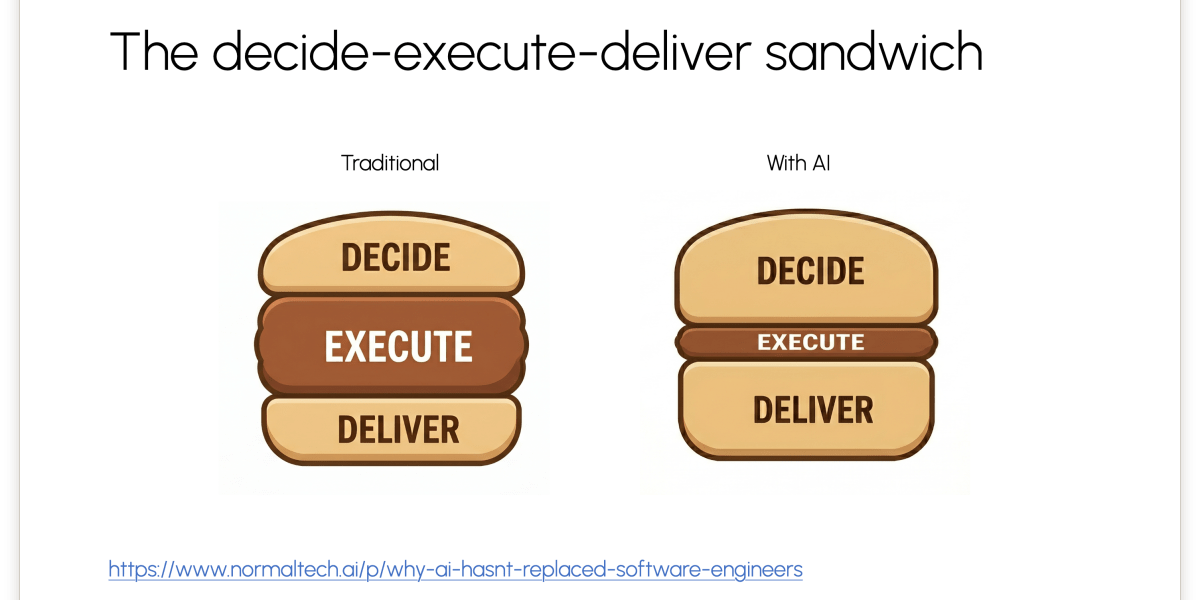
    Computer scientist Arvind Narayanan illustrated how AI is reshaping work using a hamburger metaphor — the "execute" layer (actual coding and building) has shrunk dramatically, while the "decide" (planning what to build) and "deliver" (testing and deployment) layers have grown larger. At Yahoo, this is playing out in practice: product teams are now shipping features in 24-hour sprints instead of two-week cycles, with one team delivering a fix in under four hours after receiving Friday evening feedback.

  • Why it matters

    As AI makes building cheap and fast, the real bottleneck has shifted from engineering execution to human decision-making and judgment. Yahoo leaders report that roles are blurring — designers now write code directly with AI, engineers weigh in on design — but the company's teams say this is accelerating innovation rather than destroying jobs. Users are spending 3x more time in Yahoo's new AlphaSpace investing product, and teams can test a hundred ideas instead of five. However, the easier it becomes to build anything instantly, the greater the risk of producing unnecessary work; McKinsey calls this the "false productivity" trap.

  • What to watch

    The real constraint is now what Narayanan calls the "deliver" layer — integrating, testing, and safely releasing what AI builds. Leimer noted that once a feature is technically complete, "delivery is just fiendishly difficult" due to security reviews and deployment pipelines. Whether companies can redesign work to make decision-making and verification less costly will determine if white-collar roles genuinely adapt or face structural pressure over the coming decades.

In Depth

Arvind Narayanan, a Princeton computer scientist who recently keynoted the International Conference on Machine Learning in Seoul, presented a visual framework comparing work before and after AI using a hamburger metaphor. The traditional burger shows a thick patty (the execute layer of coding and debugging) sitting between modest buns (decide and deliver). With AI, the patty has shrunk to a sliver while the buns have swollen. Narayanan argues that the execute slice was only ever about a third of the job; as AI compresses that middle, the top and bottom layers expand because once building gets cheap, it becomes easier to start projects and harder to keep up with deciding and verifying them.

At Yahoo, this model is manifesting in concrete operational changes. The company's product chief remarked that the hamburger slide perfectly captured what is happening inside their teams. Leimer, leading the AlphaSpace investing product, described a radical acceleration: sprints have compressed from two weeks to 24 hours, with planning in the morning, shipping by end of day, and a retrospective at night. In one instance, feedback arrived at 4:45 p.m. on a Friday; by 8:30 that same evening it was fixed, reviewed, and live. Users are spending 3x more time in AlphaSpace than the average Yahoo Finance user, and the team has shipped over 100 new features in roughly two months.

The effect on roles has been equally striking. On the Yahoo Scout team (an AI answer engine), principal product designer Nick Lockington began using Google's Vertex AI to generate structured JSON logic for new features, effectively creating a functional API by prompt and bypassing the traditional build phase. Distinguished software engineer David Grandinetti noted this was an "aha moment": "Nick became immediately the most leveraged engineer on our team, because he was working at the highest level of abstraction." Other team members followed, with one designer becoming known internally as a "design engineer" and an engineer with a strong eye for usability dubbed an "engineering designer." Stephane Koenig, vice president at Yahoo, explained the goal: "This is about increasing decision velocity and cutting the cost of experimentation, so teams can test a hundred ideas instead of five and quickly discard failures without the traditional burden of technical debt."

Yet this speed brings a hidden cost. As it becomes trivial to build anything instantly, the risk of producing unnecessary work — what McKinsey calls the "false productivity" trap — rises. Leimer cautioned that AI makes it "so easy to just build whatever you want," and cited advice from his manager, Yahoo Media Group President Ryan Spoon: "It's important that you're really convicted about what you build." When humans have not been thoughtful enough about what they build, the result is what has become known as "AI slop" — work product lacking rigor. The Stanford Social Media Lab estimated the cost of such unverified AI output at $9 million(約14億円) per year for a company of 10,000 workers. The bottleneck, Leimer emphasized, is now the "bottom bun" — delivery. Once decided and built, the work faces a gauntlet of security reviews, deployment pipelines, and testing. The metaphorical question becomes whether work might someday resemble pizza or flatbread, where decisions are the main work, tasks shrink to toppings, and delivery becomes seamless. For now, that remains aspirational; the real challenge ahead is redesigning work so that decision-making and verification do not become the new execution layer.

Context & Analysis

The article reframes AI's impact on work not as a job killer but as a rebalancing of effort. Narayanan's framework reveals that the execute layer — coding, debugging, actual building — was never more than about a third of knowledge work. The buns (decide and deliver) were always the heavier burden, and AI's compression of the middle means they now dominate. This mirrors patterns already seen in other fields: radiologists adopted AI while employment rose; lawyers file more suits thanks to easier drafting; translators still work even after machine translation reached human parity. The common thread is that as a technical barrier falls, demand shifts upward.

Yahoo's experience surfaces a less optimistic corollary: the ease of building creates a new risk called "false productivity," where teams ship features they did not need to. This is not about unemployment; it is about decision fatigue and the fragility of the deliver layer. Leimer's observation that "work is now primarily a conversation about work" captures the tension: teams can iterate a hundred times, but only if they agree on what matters. Security reviews, deployment pipelines, and long-term accountability do not shrink when the build time collapses; they become the stranglehold.

FAQ

What does the hamburger metaphor mean?
Computer scientist Arvind Narayanan uses it to illustrate three layers of knowledge work: a "decide" layer on top (understanding what to build and why), an "execute" layer in the middle (the actual implementation and coding), and a "deliver" layer on the bottom (testing, integration, and long-term accountability). AI is compressing the execute layer, but the decide and deliver layers are expanding instead of shrinking.
How fast are Yahoo teams shipping features with AI?
Sprints have compressed from two weeks to 24 hours, with planning in the morning, shipping by end of day, and a retrospective at night. In one case, feedback received at 4:45 p.m. on a Friday was fixed, reviewed, and live by 8:30 that same evening.
What is 'AI slop' or 'workslop' mentioned in the article?
It refers to when AI-generated work products are sent for review without proper verification or thoughtfulness. The Stanford Social Media Lab estimated the cost of this at $9 million(約14億円) per year for a company of 10,000 workers.

Get the latest AI Business & Industry news every morning

AI-summarized, only the topics you pick — one digest a day via Email, Slack, or Discord.

Free · takes 30 seconds · unsubscribe anytime

Discussion

No comments yet. Be the first to share your thoughts!

Log in to join the discussion

Related Articles

Stay ahead with AI news

Get curated AI news from 200+ sources delivered daily to your inbox. Free to use.

Get Started Free

Free · takes 30 seconds · unsubscribe anytime