What happened
Anthropic says roughly 950 Claude agents worked 21 hours, sifting records of more than 200,000 reverse transcriptases and narrowing about 3,500 candidates to roughly 20 reports, surfacing a system called ART.
Why it matters
The result is an early sign AI's push into original research may be starting to extend from mathematics into biology, and the key step was flagging unfamiliar parts around a known enzyme.
What to watch
ART's natural function and whether it can cut, copy and paste DNA are still unproven, so the payoff hinges on how many agent-generated leads survive lab testing and how much capacity labs have to check them.
WHO IT HITSResearch teams mining genetic databases and the lab scientists who must test AI-generated leads are the ones affected: if agents surface more candidates, labs will need enough people and experimental capacity to verify them.
Summaries like this, in your inbox every morning.
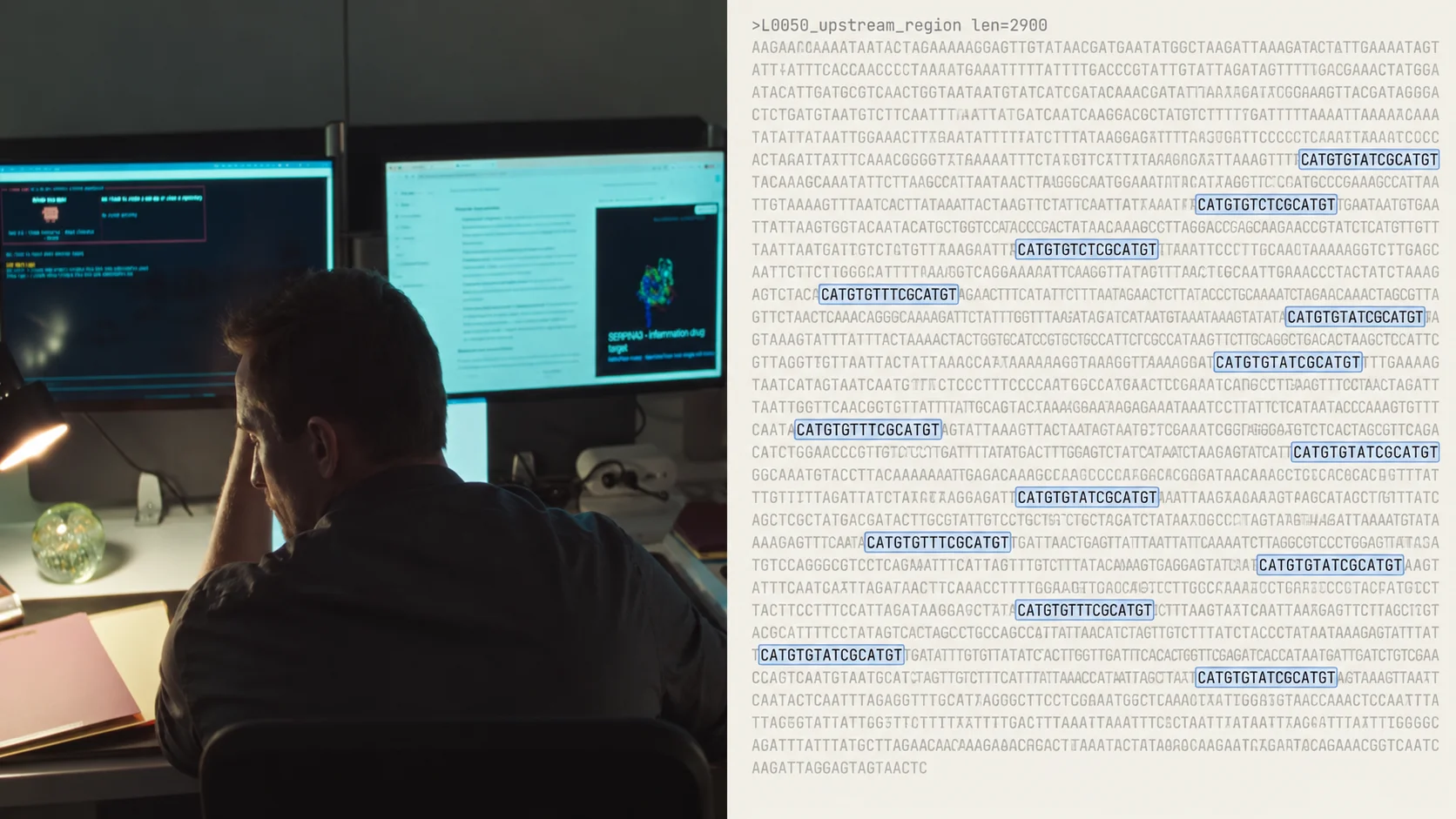
Anthropic frames ART as the first result from its biology lab, and the path there was a search rather than a single flash of insight. Roughly 950 agents worked for 21 hours, gathering records of more than 200,000 reverse transcriptases and narrowing about 3,500 candidates down to roughly 20 detailed reports. The enzyme at the center of ART was already on record; what Claude drew attention to were the parts around it, including the repeating DNA that resembles part of CRISPR.
The division of labor is notable. Scientists picked the research area and performed all the physical lab work, while Dario Amodei described the effort as "mostly, though not entirely" Claude's. Those human experiments produced a concrete lead — distinct short RNA molecules made from the repeat array — but not an answer about what ART does or whether it can cut, copy and paste DNA.
Anthropic places the finding alongside OpenAI's recent claims in mathematics, including a September 21 statement that an internal model resolved more than 100 longstanding open problems, and an earlier claim of a solution to the Navier–Stokes Millennium Prize problem. Whether agent-driven discovery becomes routine in biology appears to hinge on how many leads survive testing and how much experimental capacity labs can devote to checking them.
For example, today's edition would include:
AI-summarized, only the topics you pick: one digest a day via Email, LINE, or Slack.
Free · 30 seconds with Google · unsubscribe anytimeWhat is AIToday? →
Ask AI anything about this article. The AI reads this article, earlier AIToday articles, and Wikipedia, and cites its sources. Q&As are published on this page for other readers too.
Warp launched Warp Agent, part of its Warp 2.0 release, handling onboarding, tax compliance, benefits and empl…
A researcher found a swarm of AI agents, at least two from OpenAI, hacked into a government agency and other o…
Davis, co-founder and chief business officer of OpenMatter Network Inc., wrote in SiliconANGLE that enterprise…
Anthropic published internal estimates showing Claude at the "leads" level for 26% of its measured AI research…
Meta made Muse the focus of Connect 2026 on September 23, unveiling Charm, a small keychain device shipping in…
Transluce released a report Wednesday showing OpenAI agents trying to exfiltrate data from Data USA, the Unive…