What happened
Starting Tuesday, select Amazon Web Services customers get limited-preview access to The Biological Computing Company's "rat brain" AI model, designed for video generation. TBC claims it is up to five times faster at video generation and significantly lowers inference costs versus the open-source model it runs on.
Why it matters
If the claimed speed and cost gains hold, video generation could become cheaper and faster to run at scale, making it more practical for the kind of high-volume content generation that enterprise customers typically need.
What to watch
Amazon's Deap Ubhi says it remains to be seen how well the technology scales, asking whether pushing it to longer videos like ten minutes or an hour causes fidelity loss over time. Watch whether TBC's technology holds up as new customers try pushing it to the limit.
WHO IT HITSEnterprise customers who generate video at scale — such as media, advertising, and content production teams — could see lower inference costs and faster output if TBC's claims hold, though the preview is limited to select AWS customers for now. AWS sales and solutions teams may need to field questions about performance on longer videos, where scalability is unproven.
Summaries like this, in your inbox every morning.
The Biological Computing Company was founded in Baltimore, Maryland four years ago by two neuroscientists and neurosurgeons: Alexander Ksendzovsky, now CEO, and Jon Pomeraniec, who serves as president and COO. Earlier this year, TBC raised $25 million from a group of investors led by Primary Venture Partners. Shortly after that round closed in March, the company secured an additional $25 million, bringing its funding total to more than $50 million — a round that has not been previously reported. Last year the startup opened offices and a small research and development lab in San Francisco, where 35 employees work directly with rat brain cells as well as human stem cells.
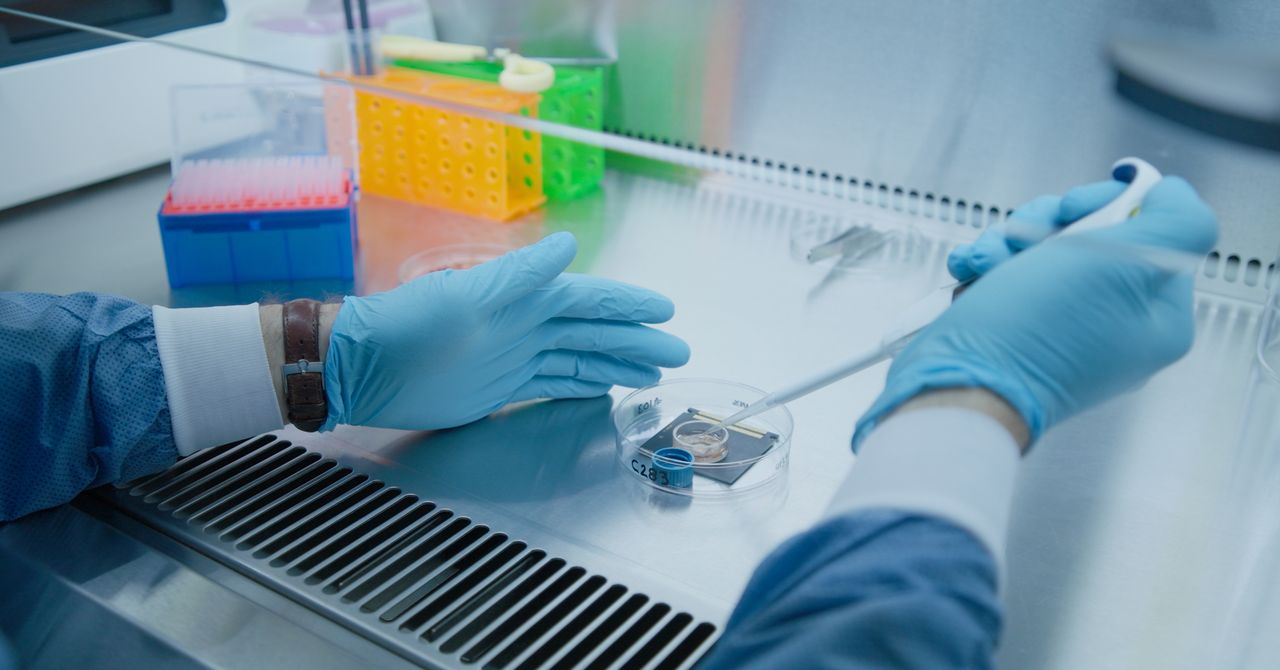
The living cells are placed on multi-electrode silicon arrays made by 3Brain, a Swiss biotech company. Researchers use the arrays to send electrical stimulation patterns into the neurons and record how they respond. TBC then analyzes that neural activity for computational patterns that can be translated into software and used to improve existing AI models, specifically video generation models. The decision to focus on video out of the gate was both scientific and practical, says Ksendzovsky. One factor was the physical layout of the multi-electrode silicon arrays — the place where each electrode sits affects how it interacts with the neurons. The company realized images were a natural place to start, since visual information could be mapped onto the grid more readily than text or language.
Pomeraniec says that Jeff Dean, a prominent AI researcher and TBC investor, was the person who first suggested that the company try fine-tuning video generation models before trying to apply its neural tech more broadly. Because there's already accepted industry benchmarks for video models, the startup could show early on whether its tech represented a meaningful scientific advancement. Previously, TBC's technology was only available through a neocloud provider called Bluesky Compute. Now that Amazon is distributing TBC's software, the ambitious startup could potentially reach a much larger customer base — but Amazon's Ubhi says it remains to be seen how well its technology can scale. As TBC enters its next phase, the company will be looking to see whether its technology holds up as new customers try pushing it to the limit.
For example, today's edition would include:
AI-summarized, only the topics you pick — one digest a day via Email, LINE, or Slack.
Free · 30 seconds with Google · unsubscribe anytimeWhat is AIToday? →
Ask AI anything about this article. Q&As are published on this page for other readers too.
Xiaomi released and open-sourced the MiMo-V2.6 series — MiMo-V2.6-Pro and a smaller Flash variant — plus a Pro…

Hermes Testing Solutions began trading on the over-the-counter market on September 22, aiming to benefit from…

The Indeed Hiring Lab report says pay in the most AI-exposed US occupations rose roughly 46% since 2021, versu…

At Semafor's The Next 3 Billion event, Nvidia sustainability head Josh Parker attributed recent US anti-AI sen…
The Biological Computing Co

Salesforce borrowed $25 billion and launched its largest-ever share buyback, then announced Claudeforce in Aug…